Amount exceeded


4.7 out of 5 based on 60193 reviews




















4.7 out of 5 based on 60193 reviews
.

Inside a controlled indoor trial across two F1 varieties and eight treatment groups: how pre-harvest flushing affected trimmed yield, THC and terpene results, and which protocols delivered the strongest outcomes.
Key Takeaways
Contents:
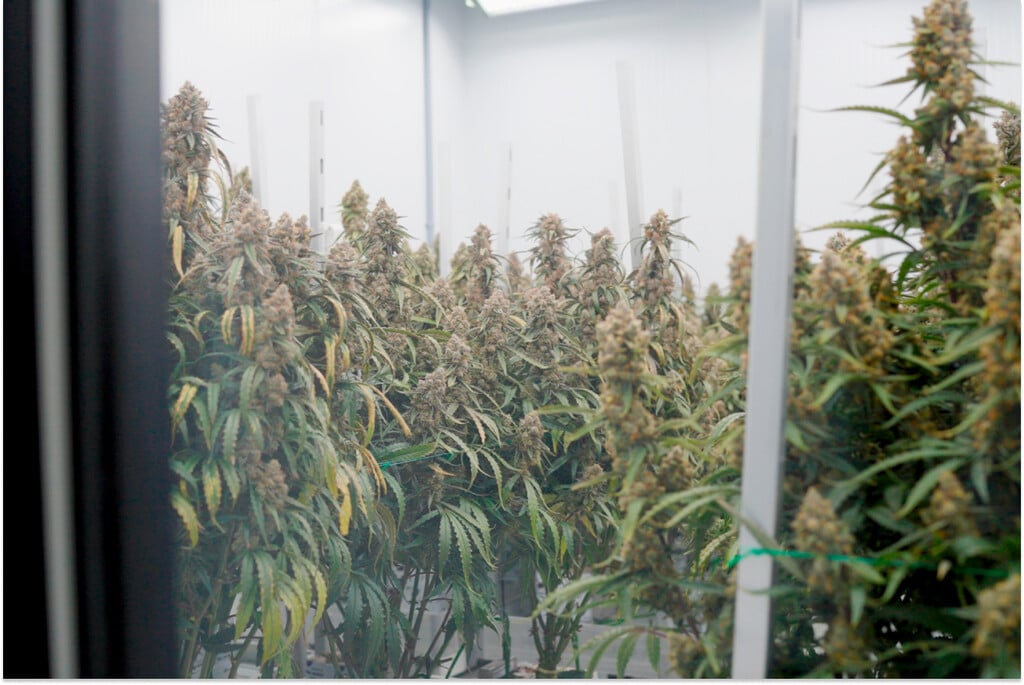
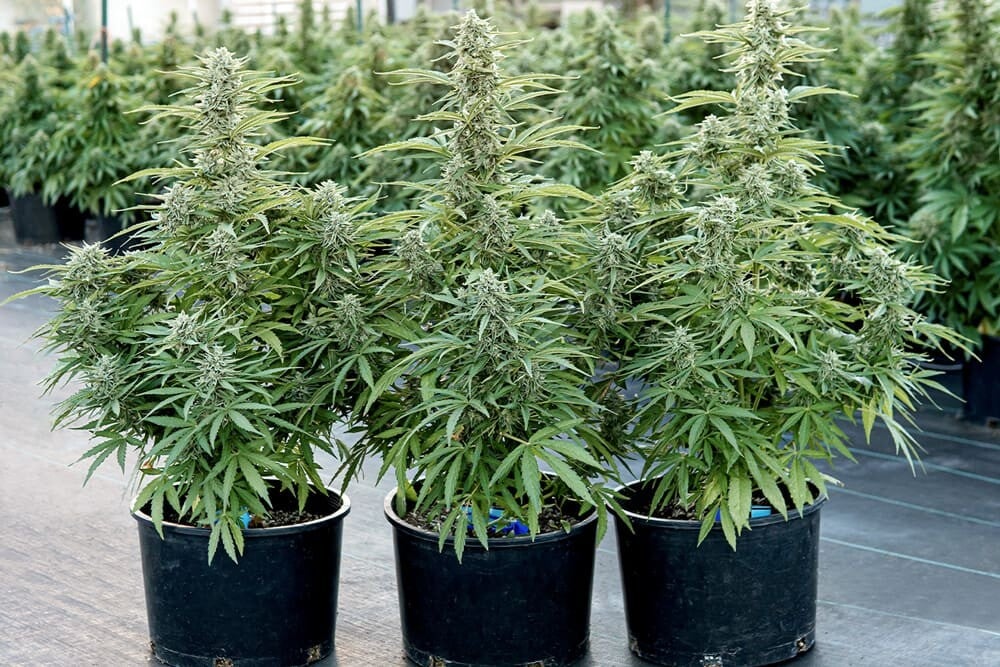
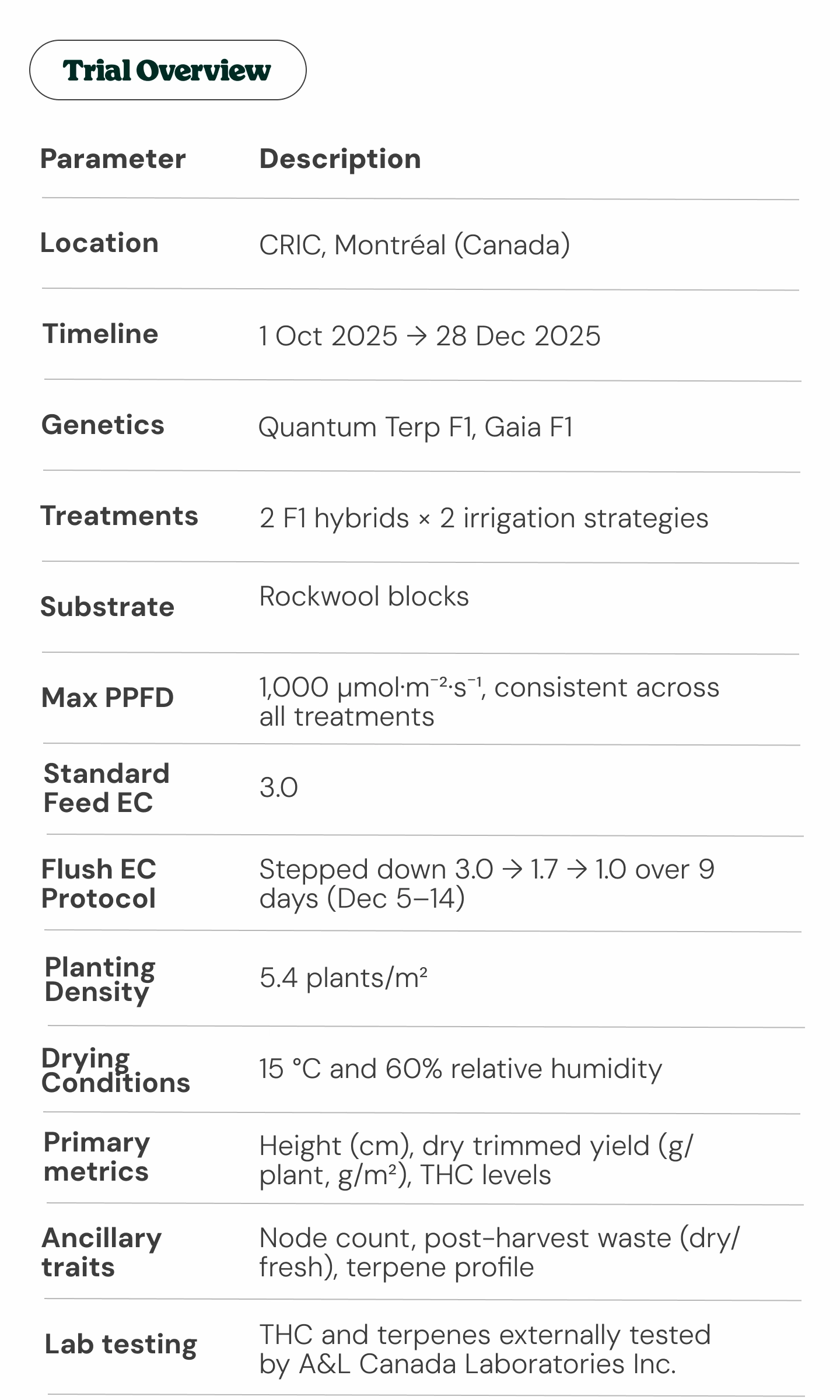
Growers often choose their rockwool blocks and flushing strategies based on experience, routine, or personal preference. To move beyond intuition and gather solid data, Grodan conducted a rigorous, controlled indoor cultivation trial at CRIC Labs in Montréal, Canada, in collaboration with Royal Queen Seeds.
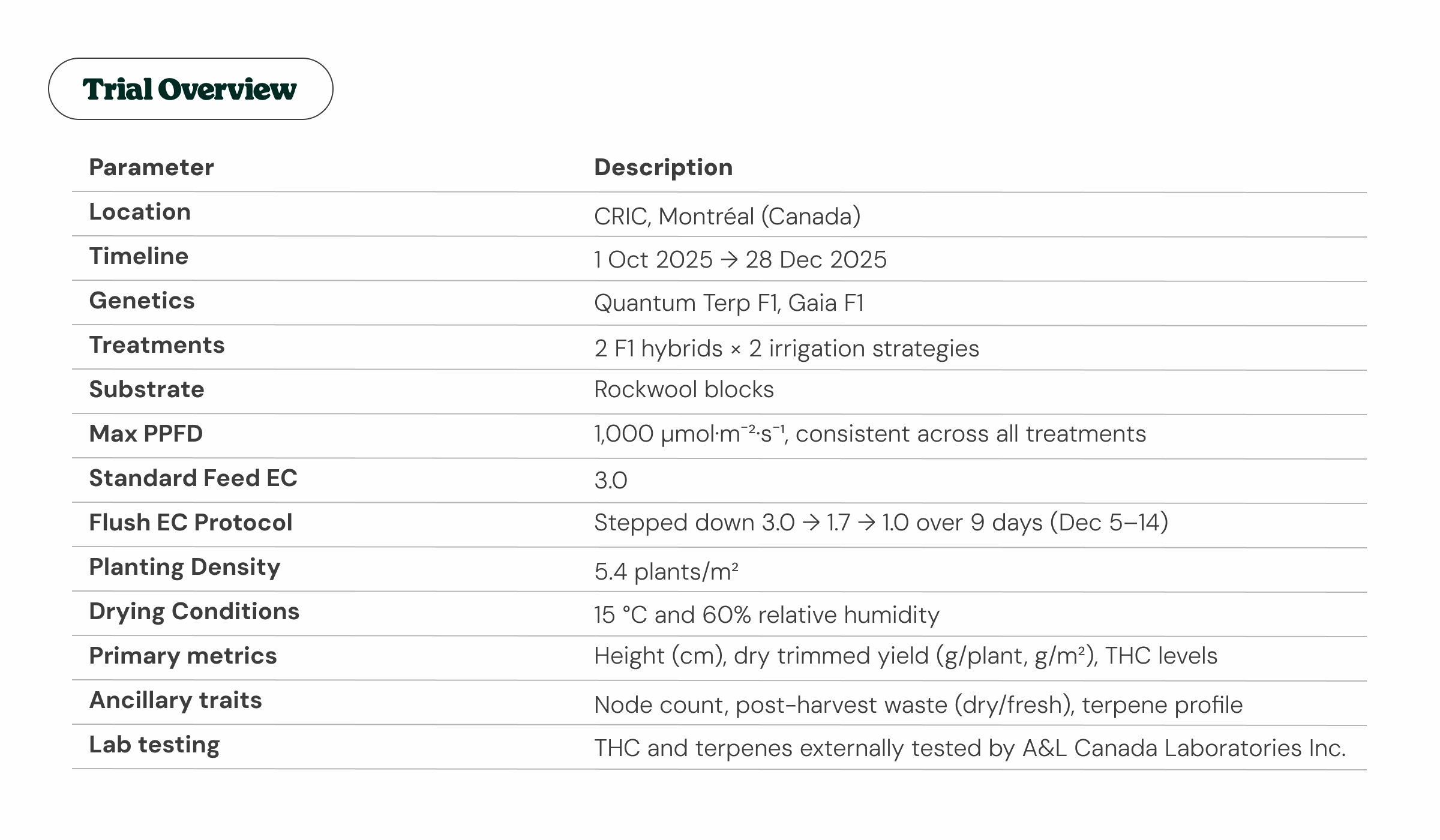
The goal: evaluate how two pre-harvest irrigation strategies (flushing vs. standard feeding) affect plant development, trimmed yield, post-harvest waste, potency, and terpene expression across two of our F1 hybrids: Quantum Terp F1 and Gaia F1.
For this trial, a pre-harvest flush was defined as gradually reducing the nutrient concentration during the final stage of bloom.
While the standard feed was kept at an EC of 3.0, the trial ran a 9-day flushing phase from December 5 to December 14. During this window, the EC was stepped down first to 1.7 and finally to 1.0 to clear nutrients from the root zone before harvest.
Note: Because flush outcomes depend heavily on starting EC, light intensity, and your specific feed chart, these results reflect our exact parameters and shouldn't be taken as a universal rule for every grow room.
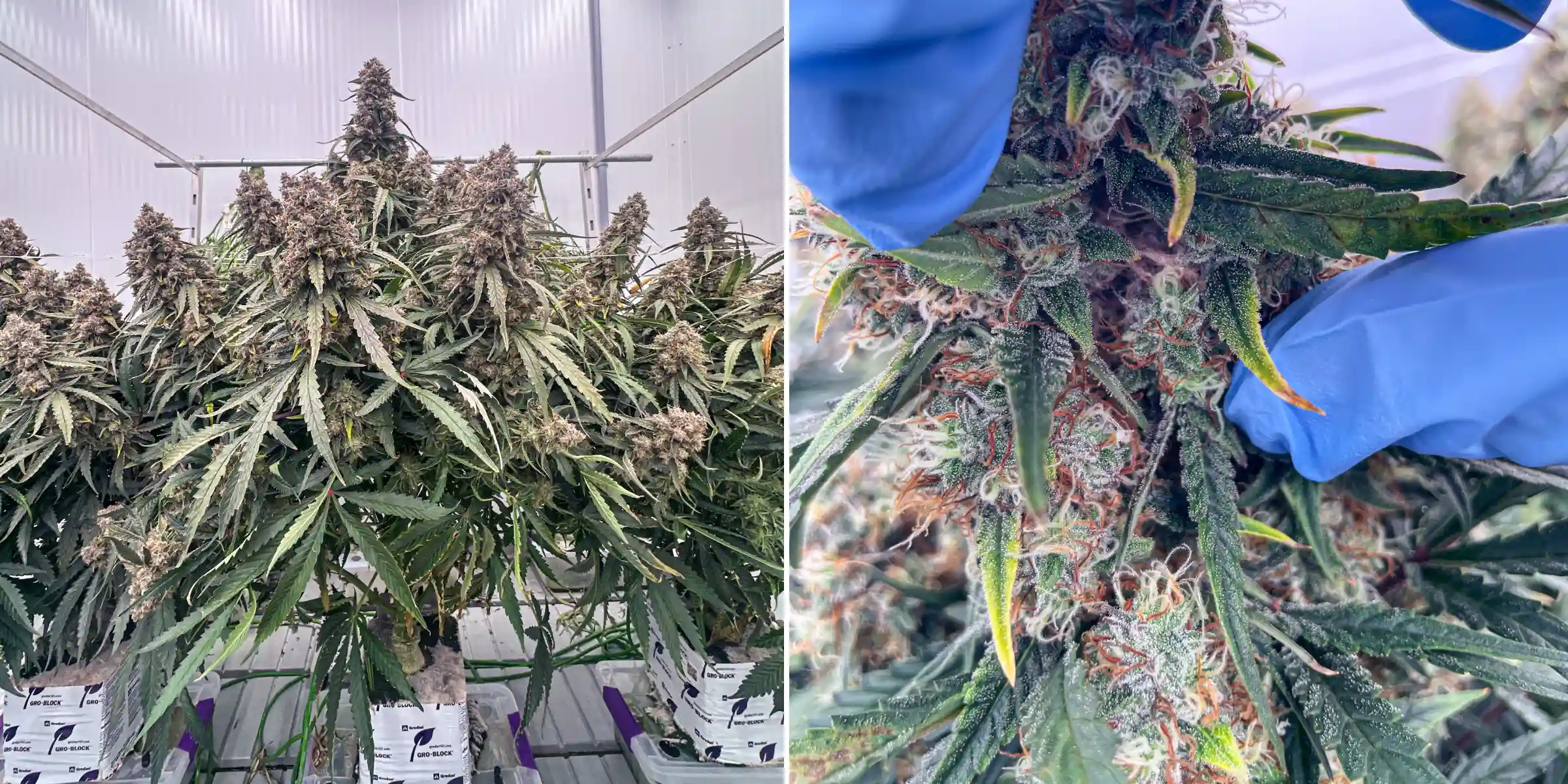
.webp "Cannabis Terpene Analysis: Resinous Flower Close-Up")
The trial ran from 1 October to 28 December 2025 with a total of 48 plants, split into four treatment groups (12 plants per group) to test two key variables:
Identical environmental conditions were maintained across all groups to isolate the effects of the irrigation strategies. Standardized metrics included height, fresh/dry weights, reject rates, cannabinoid content, and full terpene profiles.
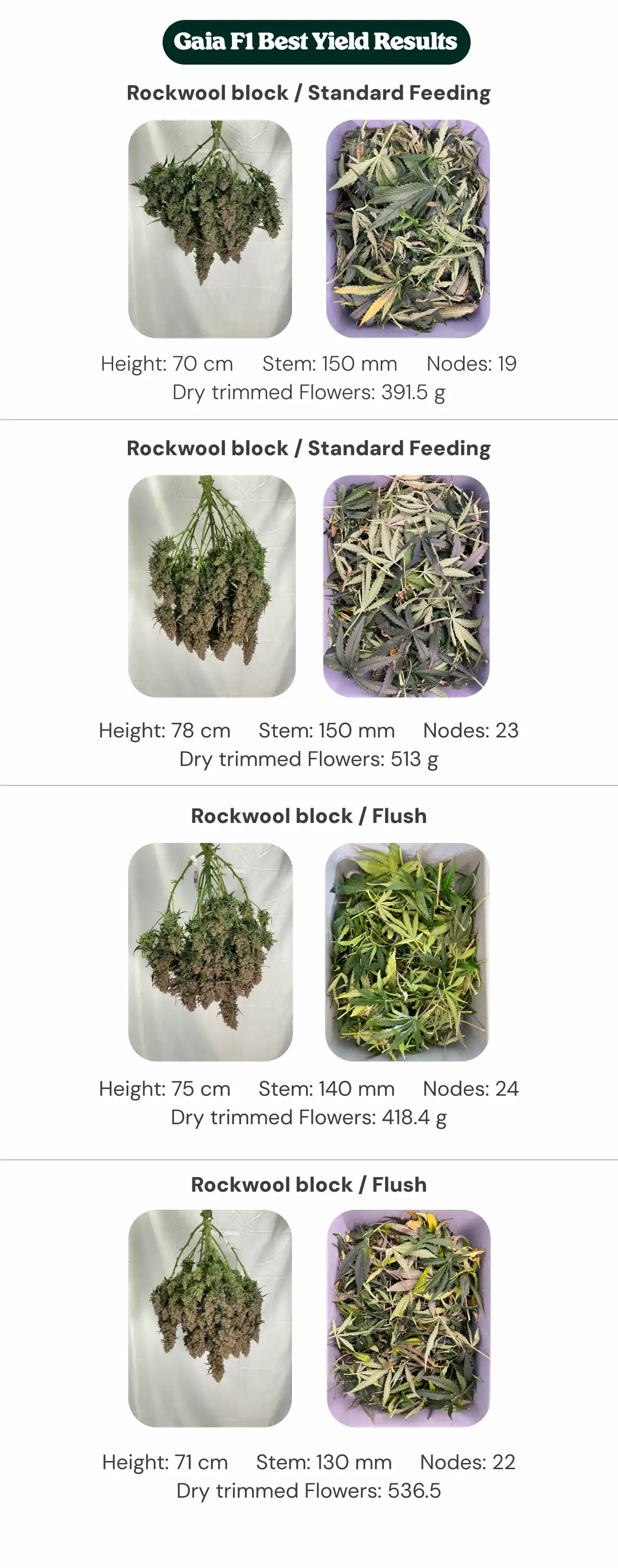
The tables below show the direct impact of our irrigation strategies across the different experimental configurations on plant structure and final yield.
Table 1. Quantum Terp F1 Average Results
| Rockwool Type & Irrigation | Avg. Height | Avg. Nodes | Trimmed Yield (per plant) | |
| QRS | Rockwool Type 01, Standard Feeding | 78.8 cm | 24.5 | 398.5 g |
| QNS | Rockwool Type 02, Standard Feeding | 69.7 cm | 21.8 | 371.2 g |
| QRF | Rockwool Type 01, Flush | 68.0 cm | 21.8 | 416.4 g |
| QNF | Rockwool Type 02, Flush | 73.0 cm | 23.5 | 387.6 g |
| Rockwool Type & Irrigation | Avg. Height | Avg. Nodes | Trimmed Yield (per plant) | |
| QRS | Rockwool Type 01, Standard Feeding | 78.8 cm | 24.5 | 398.5 g |
| QNS | Rockwool Type 02, Standard Feeding | 69.7 cm | 21.8 | 371.2 g |
| QRF | Rockwool Type 01, Flush | 68.0 cm | 21.8 | 416.4 g |
| QNF | Rockwool Type 02, Flush | 73.0 cm | 23.5 | 387.6 g |
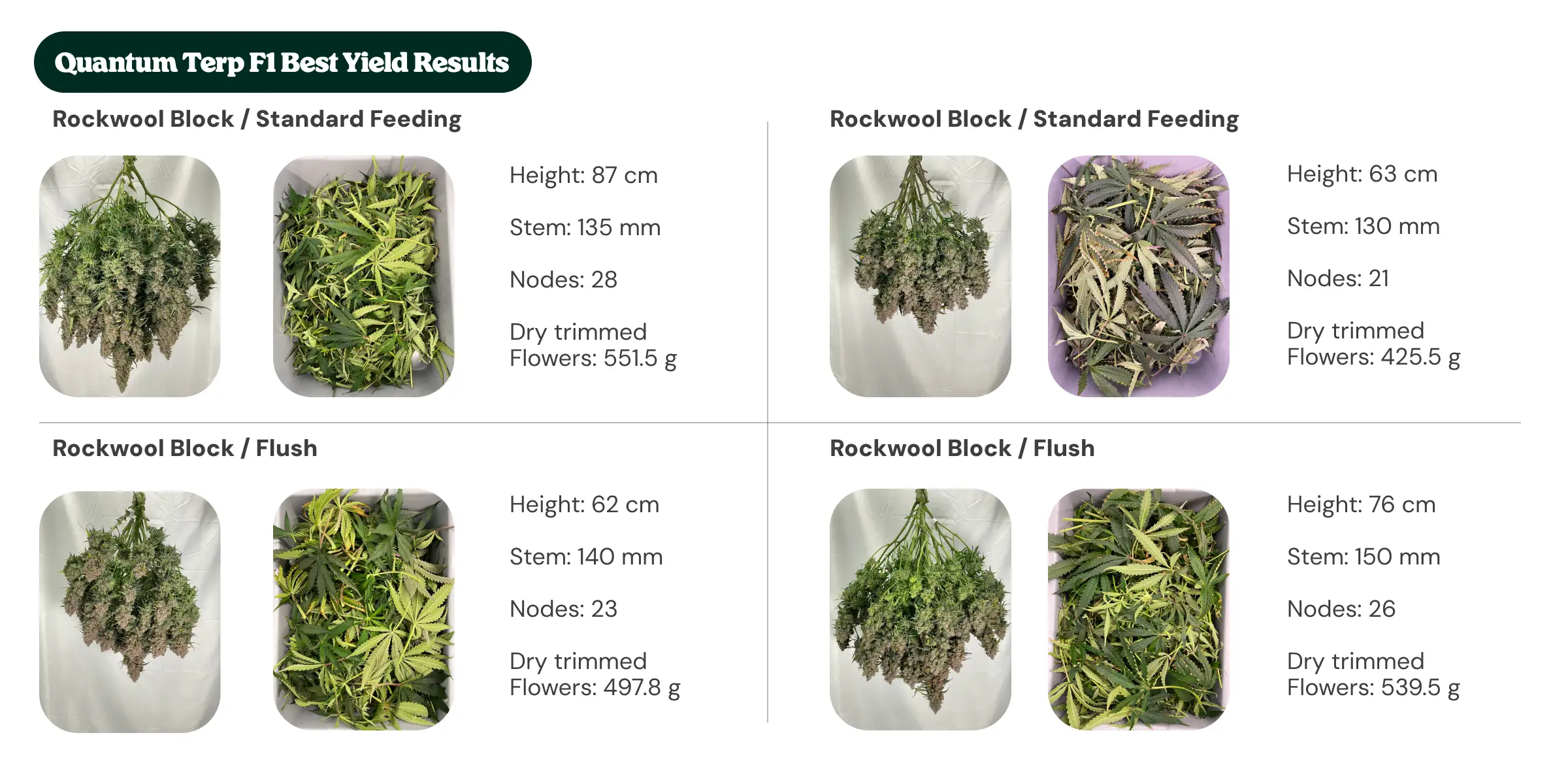
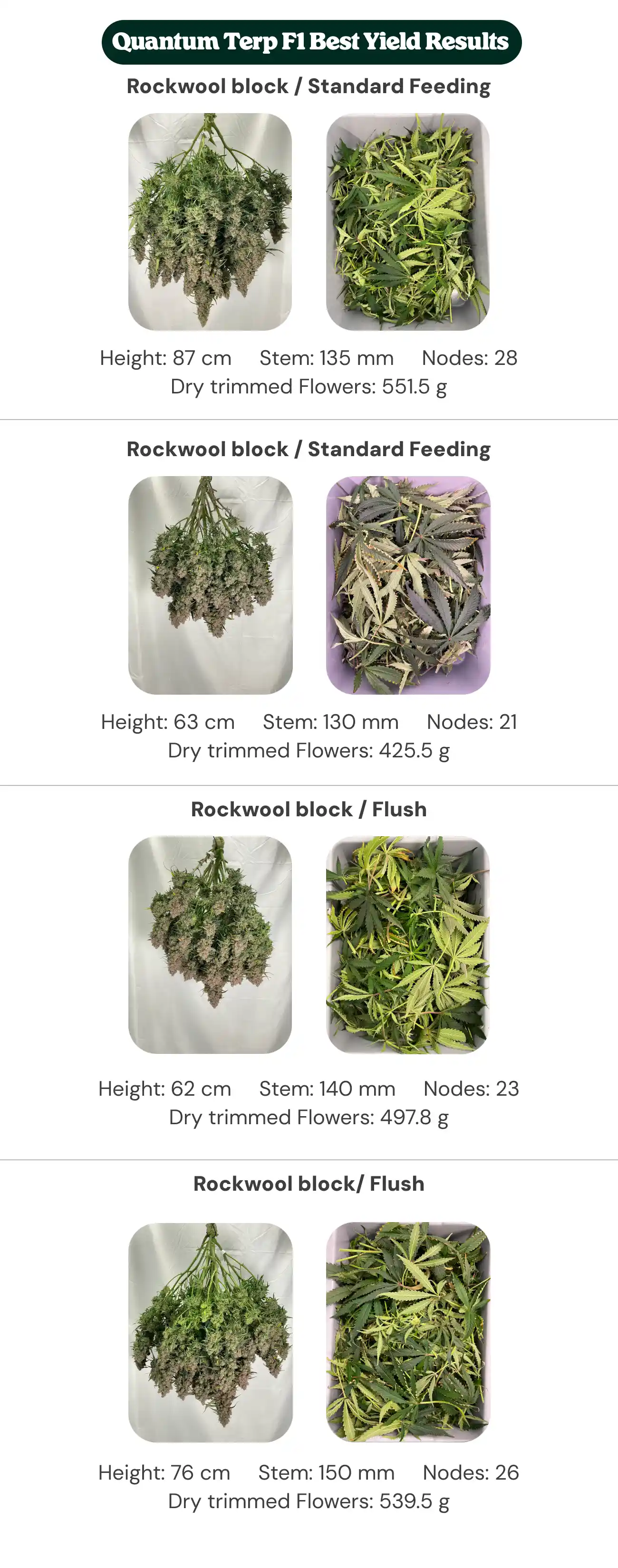
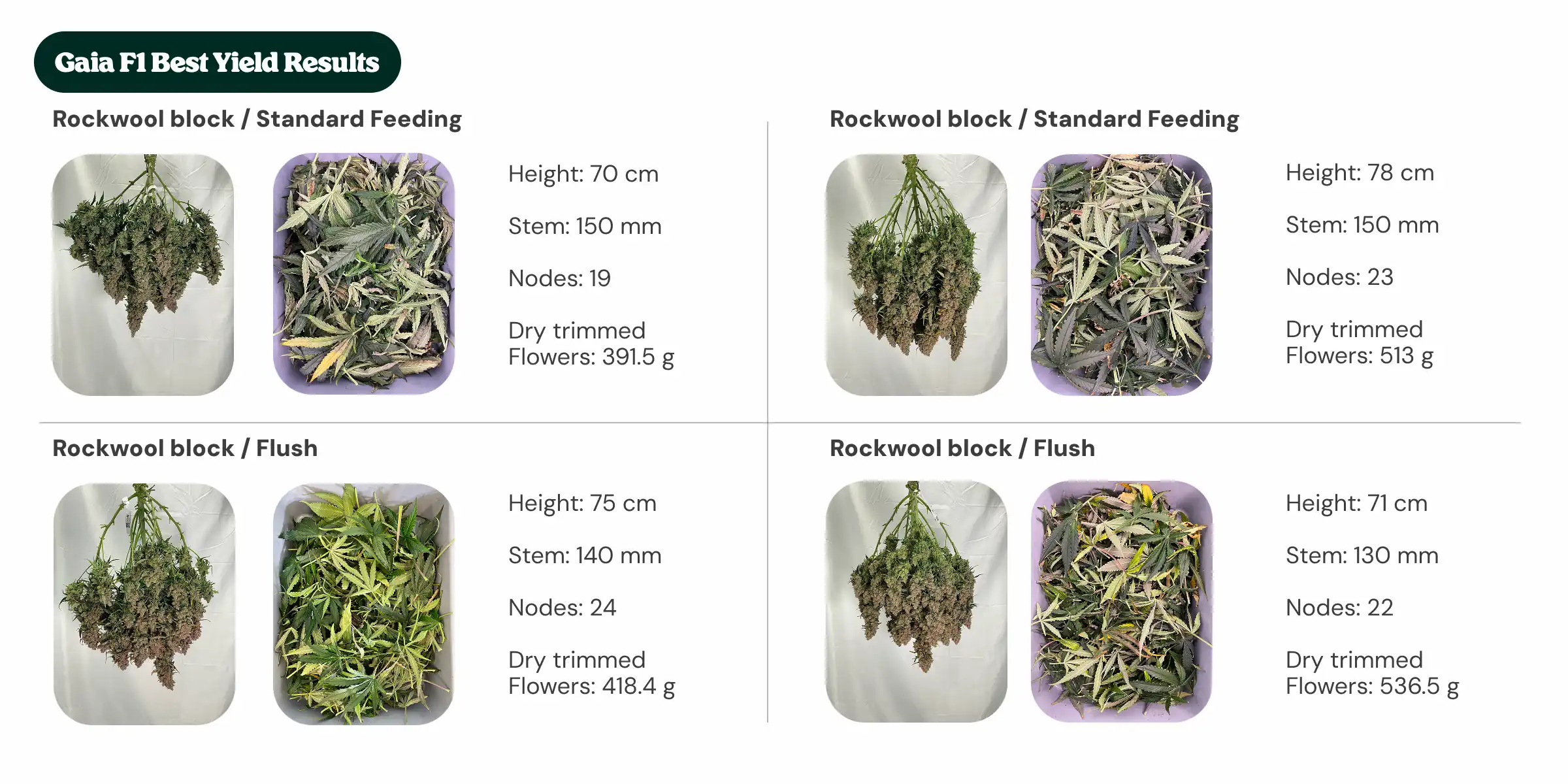
Table 2. Gaia F1 Average Results
| Rockwool Type & Irrigation | Avg. Height | Avg. Nodes | Trimmed Yield (per plant) | |
| GRS | Rockwool Type 01, Standard Feeding | 64.2 cm | 20.7 | 317.3 g |
| GNS | Rockwool Type 02, Standard Feeding | 61.8 cm | 19.8 | 336.8 g |
| GRF | Rockwool Type 01, Flush | 65.7 cm | 22.2 | 358.1 g |
| GNF | Rockwool Type 02, Flush | 58.3 cm | 20.8 | 361.1 g |
| Rockwool Type & Irrigation | Avg. Height | Avg. Nodes | Trimmed Yield (per plant) | |
| GRS | Rockwool Type 01, Standard Feeding | 64.2 cm | 20.7 | 317.3 g |
| GNS | Rockwool Type 02, Standard Feeding | 61.8 cm | 19.8 | 336.8 g |
| GRF | Rockwool Type 01, Flush | 65.7 cm | 22.2 | 358.1 g |
| GNF | Rockwool Type 02, Flush | 58.3 cm | 20.8 | 361.1 g |
Based on the trial planting density of 5.4 plants per square metre, the projected yields were calculated to show potential commercial scaling:
| Yield per Plant | Projected Yield per m² | |
| QRS | 398.5 g | 2,151.9 g/m² |
| QNS | 371.2 g | 2,004.5 g/m² |
| QRF (Highest) | 416.4 g | 2,248.6 g/m² |
| QNF | 387.7 g | 2,093.6 g/m² |
| GRS (Lowest) | 317.3 g | 1,713.4 g/m² |
| GNS | 336.8 g | 1,818.7 g/m² |
| GRF | 358.1 g | 1,933.7 g/m² |
| GNF | 361.1 g | 1,949.9 g/m² |
| QRS | |
|---|---|
| Yield per Plant | 398.5 g |
| Projected Yield per m² | 2,151.9 g/m² |
| QNS | |
| Yield per Plant | 371.2 g |
| Projected Yield per m² | 2,004.5 g/m² |
| QRF (Highest) | |
| Yield per Plant | 416.4 g |
| Projected Yield per m² | 2,248.6 g/m² |
| QNF | |
| Yield per Plant | 387.7 g |
| Projected Yield per m² | 2,093.6 g/m² |
| GRS (Lowest) | |
| Yield per Plant | 317.3 g |
| Projected Yield per m² | 1,713.4 g/m² |
| GNS | |
| Yield per Plant | 336.8 g |
| Projected Yield per m² | 1,818.7 g/m² |
| GRF | |
| Yield per Plant | 358.1 g |
| Projected Yield per m² | 1,933.7 g/m² |
| GNF | |
| Yield per Plant | 361.1 g |
| Projected Yield per m² | 1,949.9 g/m² |
Across all 48 plants, the trial brought in 17.68 kg of trimmed flower. Quantum Terp F1 proved to be our heavy hitter, averaging 393.4 g per plant compared to Gaia F1’s 343.3 g.
When looking at waste, the flushing strategy was a clear winner. Our 24 flushed plants produced a mere 25 g of dry waste and 136 g of fresh waste combined. Meanwhile, our 24 standard-fed plants racked up 178 g of dry waste and 619 g of fresh waste. Notably, our highest-yielding group (QRF) had zero recorded waste.
Our laboratory testing revealed a fascinating, consistent pattern: flushing reduced total terpene concentration across the board.
In every single group comparison, the flushed plants had lower total terpene levels than their standard-fed counterparts—averaging a 21.9% loss.
The impact on cannabinoids, however, was less clear-cut, meaning we cannot say flushing directly increases or decreases raw potency.
The table below shows the absolute highest terpene levels we recorded. Notice that 9 out of these 10 peak concentrations occurred in our standard-fed (non-flushed) plants.
| Terpene | Highest % (w/w) | Variety | Irrigation |
| β-Caryophyllene | 0.496% | Quantum Terp F1 | Standard Feeding |
| Terpinolene | 0.346% | Quantum Terp F1 | Standard Feeding |
| β-Myrcene | 0.211% | Gaia F1 | Standard Feeding |
| d-Limonene | 0.190% | Quantum Terp F1 | Standard Feeding |
| β-Ocimene | 0.129% | Gaia F1 | Standard Feeding |
| α-Humulene | 0.119% | Quantum Terp F1 | Standard Feeding |
| β-Pinene | 0.105% | Quantum Terp F1 | Standard Feeding |
| E-β-Farnesene | 0.094% | Gaia F1 | Flush |
| Valencene | 0.090% | Quantum Terp F1 | Standard Feeding |
| trans-Nerolidol | 0.076% | Quantum Terp F1 | Standard Feeding |
| β-Caryophyllene | |
|---|---|
| Highest % (w/w) | 0.496% |
| Variety | Quantum Terp F1 |
| Irrigation | Standard Feeding |
| Terpinolene | |
| Highest % (w/w) | 0.346% |
| Variety | Quantum Terp F1 |
| Irrigation | Standard Feeding |
| β-Myrcene | |
| Highest % (w/w) | 0.211% |
| Variety | Gaia F1 |
| Irrigation | Standard Feeding |
| d-Limonene | |
| Highest % (w/w) | 0.190% |
| Variety | Quantum Terp F1 |
| Irrigation | Standard Feeding |
| β-Ocimene | |
| Highest % (w/w) | 0.129% |
| Variety | Gaia F1 |
| Irrigation | Standard Feeding |
| α-Humulene | |
| Highest % (w/w) | 0.119% |
| Variety | Quantum Terp F1 |
| Irrigation | Standard Feeding |
| β-Pinene | |
| Highest % (w/w) | 0.105% |
| Variety | Quantum Terp F1 |
| Irrigation | Standard Feeding |
| E-β-Farnesene | |
| Highest % (w/w) | 0.094% |
| Variety | Gaia F1 |
| Irrigation | Flush |
| Valencene | |
| Highest % (w/w) | 0.090% |
| Variety | Quantum Terp F1 |
| Irrigation | Standard Feeding |
| trans-Nerolidol | |
| Highest % (w/w) | 0.076% |
| Variety | Quantum Terp F1 |
| Irrigation | Standard Feeding |
The trial systematically challenges the idea that flushing is a simple "yes or no" choice. Instead, the data suggests it can be viewed as a precise tuning knob that presents growers with two distinct cultivation goals:
The trial provides controlled data that can help inform F1 hybrid cultivation, showing how different irrigation strategies can influence yield and terpene expression. Whether you prioritize market-leading weights or aromatic profiles, the results provide a useful reference for understanding how these variables performed under the specific conditions tested.
Further trials will help build on these findings and explore how F1 genetics respond to different cultivation strategies.