By RQS Editorial Team

Key Takeaways

  • This trial tested two everyday grow-room decisions, plant maintenance and overnight dryback, head to head across two F1 varieties in a fully controlled indoor environment.
  • Yield and THC pulled in different directions: the protocol that maximised yield was not the one that maximised potency.
  • No maintenance consistently out-yielded regular maintenance, while regular maintenance tended to favour higher THC.
  • Dryback size mattered too, but its effect depended on which cultivar and maintenance protocol it was paired with.
  • Quantum Terp F1, Royal Queen Seeds' highest-THC autoflower, is featured here for the first time, tested directly against Gaia F1.
  • The findings point to a practical trade-off: growers need to choose their protocol based on whether yield or potency is the priority.


Two routine calls shape every grow room: whether to keep up regular plant maintenance, and how hard to let the substrate dry back overnight. CRIC Labs, in Québec, Canada, ran a controlled indoor trial in collaboration with Royal Queen Seeds to put both to the test. The aim was to evaluate how plant maintenance protocol and overnight dryback intensity affect growth, yield, potency and terpene expression across two F1 varieties, Quantum Terp F1 (QT) and Gaia F1 (GA).

This trial marks the debut of Quantum Terp F1, Royal Queen Seeds' highest-THC autoflower, tested here head to head with Gaia F1. Seeds were started in rockwool plugs on 6 June 2025, transplanted into rockwool medium, moved to the generative stage on 18 June, and harvested on 13 August, a roughly eight-week flower cycle. In rockwool-based controlled-environment agriculture, maintenance shapes canopy structure, labour and airflow, while overnight dryback drives irrigation steering and how the substrate holds and releases moisture, so both decisions warrant evidence rather than habit.

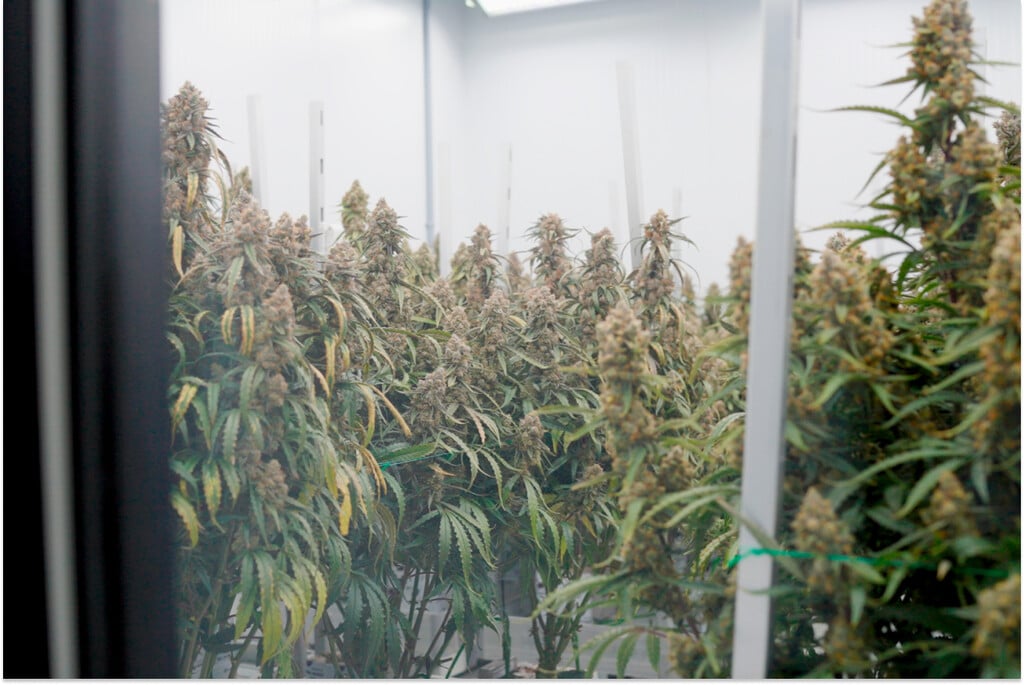
Side-by-side comparison of Quantum Terp F1 and Gaia F1 cannabis plants in bloom, showing tall resinous colas, dense green canopies, and mature flowering structures.

What Is Dryback

In cannabis cultivation, a dryback is the process of allowing the growing medium (like coco coir, soil, or rockwool) to partially dry out between watering events. Instead of keeping the medium constantly saturated, growers intentionally let moisture drop to create a mild deficit that forces roots to search for water, improving oxygenation and nutrient absorption. Drybacks are a cornerstone of commercial "crop steering" using irrigation management to manipulate how a plant grows.

How Dryback Works

As the medium loses moisture, oxygen replaces the water in the root zone. This slight dryness triggers a survival mechanism in the plant, encouraging fine, dense root development and increasing nutrient uptake. The depth of the dryback is usually measured as a percentage of water loss (or Volumetric Water Content, VWC) from a fully saturated state.

Stages of Dryback

The level of dryness is adjusted depending on the plant's life cycle:

  • Vegetative Stage: Growers use moderate drybacks to build root momentum and encourage lateral root expansion while avoiding overly saturated mediums.
  • Flowering Stage: Drybacks are used to steer the plant. Allowing the medium to dry back more aggressively restricts vegetative growth (stretching) and pushes the plant to focus its energy on stacking floral biomass.
  • Final Ripening: Growers may conservatively adjust irrigation to avoid severe stress that could damage the root zone while pushing for maturation.

Managing the Technique

Proper dryback requires balancing watering frequency and volume to avoid "drying out" (which irreversibly damages roots) and nutrient salt build-up. Commercial growers use precision moisture meters and substrate sensors to track exact water percentages and automate irrigation with high accuracy.

Note: Drybacks are widely used in synthetic or soilless setups, but they are generally not recommended for organic living soil , because the beneficial microbes responsible for breaking down organic nutrients require a consistently moist environment to survive.

What Is Plant Maintenance?

Plant maintenance refers to the scheduled, hands-on interventions a grower makes to the canopy during the cycle: defoliation (removing fan leaves to open up airflow and light penetration), pruning (taking off lower growth that will not make usable flower), and training (bending or tying stems to even out the canopy). A regular-maintenance approach applies these on a set schedule; a no-maintenance approach leaves the plant to develop without any scheduled intervention.

Each choice carries trade-offs. Regular maintenance can improve light distribution and airflow through a dense canopy and direct energy toward the most productive sites, but it adds labour and removes plant material the plant has already invested in. No maintenance saves labour and preserves that existing structure, which can support more flowering sites, but it leaves denser canopies that need closer attention to airflow and humidity.

Side-by-side comparison of cannabis plants after harvest, showing regular maintenance versus no maintenance treatments, with differences in canopy density, foliage, bud structure, and trimmed branches.

Practical Insights

Cutting back regular plant maintenance may lower labour and preserve productive plant structure, but airflow and humidity need close monitoring, especially in dense canopies. Standardising the dryback protocol reduces substrate variability and makes steering more repeatable between cycles. To reproduce these outcomes at scale, hold CO₂ (around 900 ppm), PPFD (1,000 µmol·m⁻²·s⁻¹), temperature and the humidity ramp steady.

Materials And Methods

The trial used a 2x2x2 design: two genetics, two maintenance levels and two dryback levels, giving eight treatment groups of six plants each.

The two maintenance protocols were Regular Maintenance and No Maintenance, defined by the trial protocol as regularly scheduled canopy interventions versus no scheduled maintenance treatment. The two dryback levels were Small Dryback and Large Dryback, a smaller versus a larger overnight reduction in substrate moisture. For readers new to the term, dryback is the decrease in substrate water content between the final irrigation event of one cycle and the first of the next; a small dryback means a smaller overnight reduction, not simply drier conditions.

Measured parameters covered height (cm), dry trimmed weight (g/plant and g/m²), THC, node count, stem diameter and terpene profile. THC and terpene results were tested externally.

Trial overview table for a cannabis grow test in Montréal, showing location, timeline, genetics, treatments, substrate, PPFD, primary metrics, ancillary traits, and lab testing details.

Results

Results varied by variety and treatment, as summarised in Tables 1 and 2. The group-level figures behind these trends are detailed in the Key Findings below. Overall, no maintenance with a small dryback led on yield, while Quantum Terp F1 on regular maintenance with a small dryback led on THC; Gaia F1's highest THC came under regular maintenance with a large dryback.

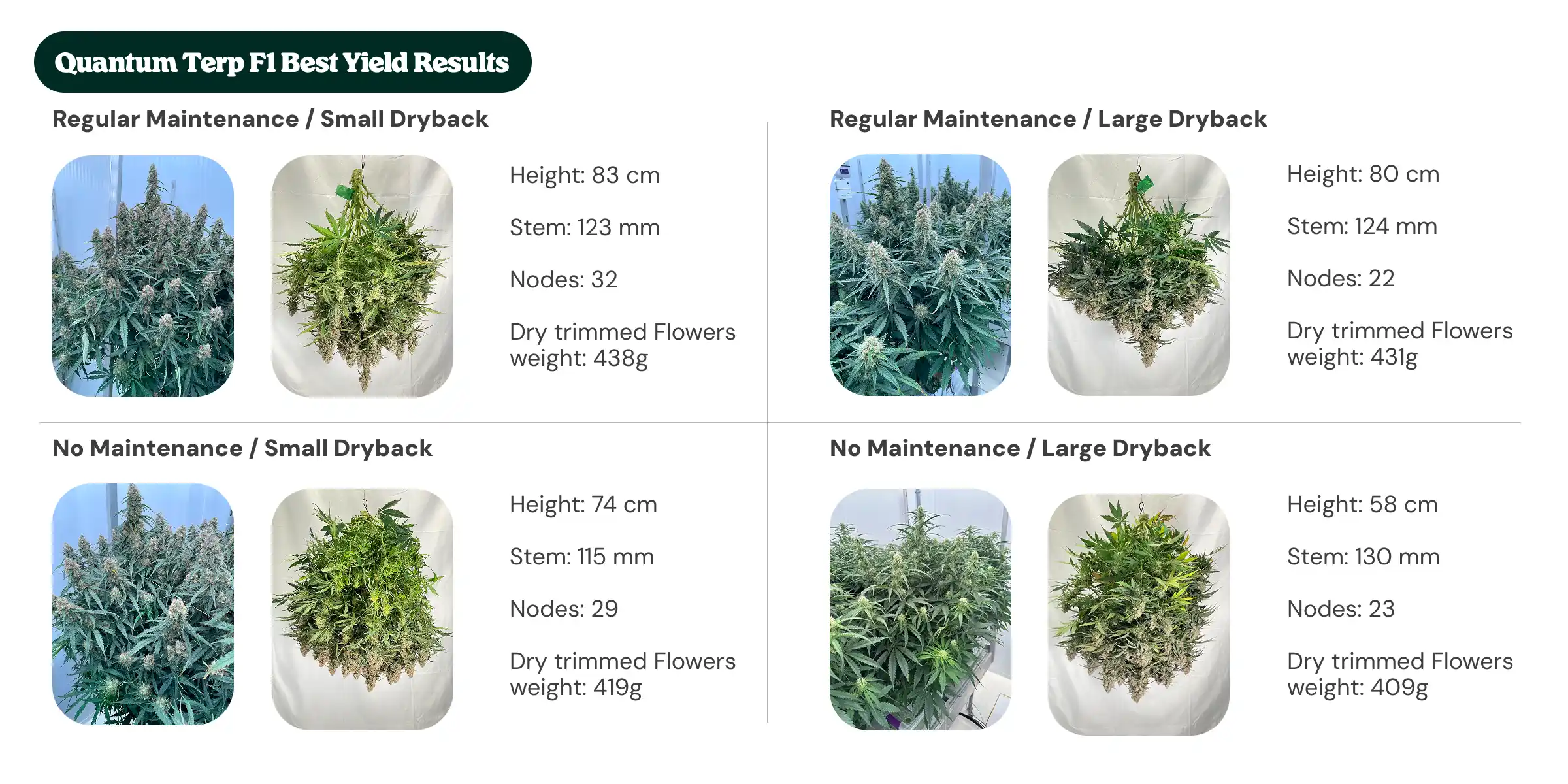
Table 1. Quantum Terp F1 best results

REGULAR MAINTENANCE / SMALL DRYBACK
HEIGHT (CM) 80
YIELD (G/PLANT) 331
YIELD (G/M²) 1,784
REGULAR MAINTENANCE / LARGE DRYBACK
HEIGHT (CM) 69
YIELD (G/PLANT) 311
YIELD (G/M²) 1,676
NO MAINTENANCE / SMALL DRYBACK
HEIGHT (CM) 72
YIELD (G/PLANT) 392
YIELD (G/M²) 2,108
NO MAINTENANCE / LARGE DRYBACK
HEIGHT (CM) 80
YIELD (G/PLANT) 386
YIELD (G/M²) 2,079

Quantum Terp F1 results overview showing regular maintenance and no maintenance treatments with small and large dryback, comparing plant height, stem diameter, node count, and dry trimmed flower weight.

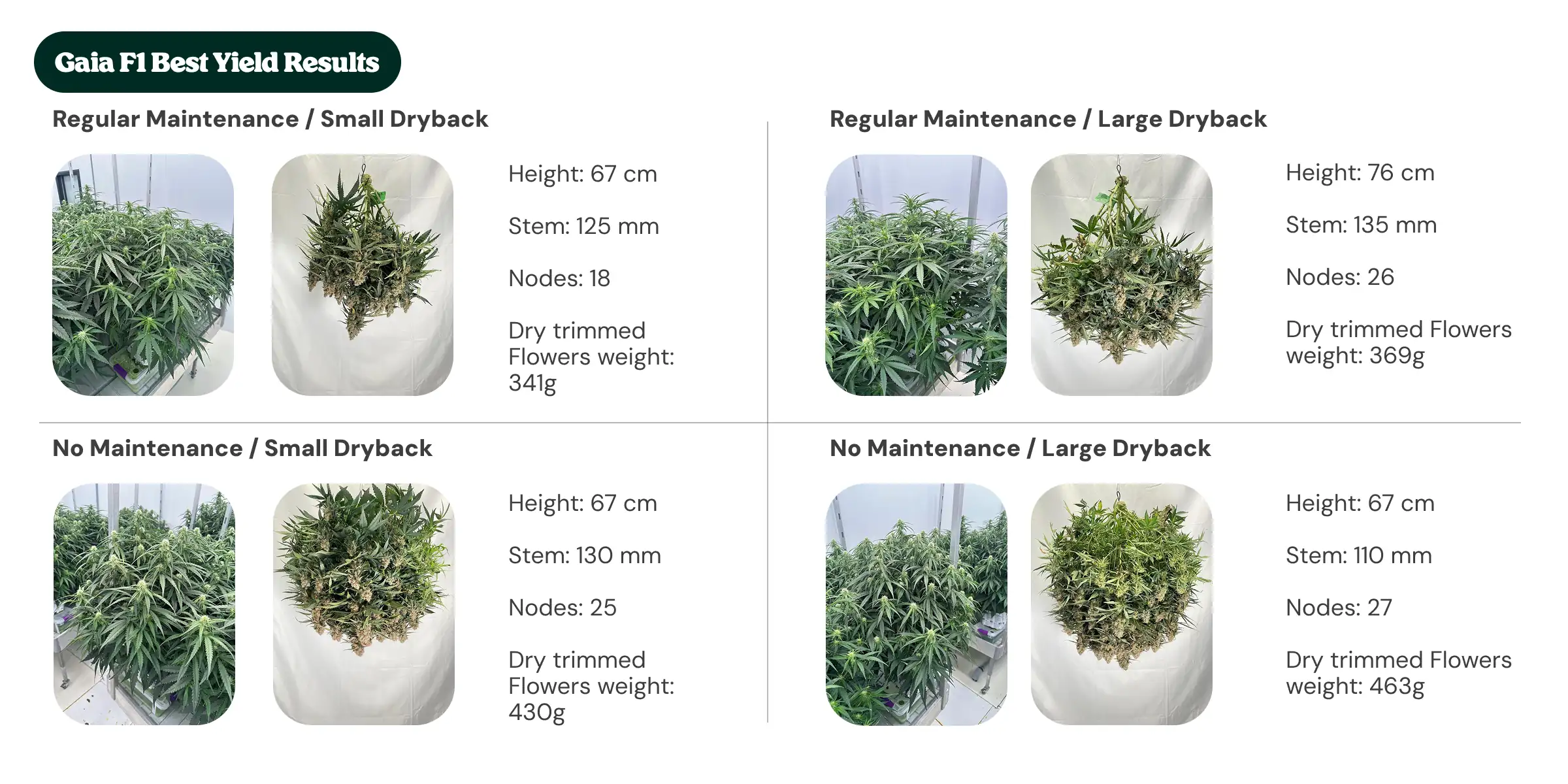
Table 2. Gaia F1 best results

REGULAR MAINTENANCE / SMALL DRYBACK
HEIGHT (CM) 64
YIELD (G/PLANT) 249
YIELD (G/M²) 1,341
REGULAR MAINTENANCE / LARGE DRYBACK
HEIGHT (CM) 70
YIELD (G/PLANT) 299
YIELD (G/M²) 1,610
NO MAINTENANCE / SMALL DRYBACK
HEIGHT (CM) 64
YIELD (G/PLANT) 396
YIELD (G/M²) 2,129
NO MAINTENANCE / LARGE DRYBACK
HEIGHT (CM) 58
YIELD (G/PLANT) 358
YIELD (G/M²) 1,928
Gaia F1 results overview showing regular maintenance and no maintenance treatments with small and large dryback, comparing plant height, stem diameter, node count, and dry trimmed flower weight.

On potency, ranked in relative terms rather than by figure, Quantum Terp F1 outranked Gaia F1 across every matched treatment. Within Quantum Terp F1, regular maintenance with a small dryback ranked highest and regular maintenance with a large dryback lowest. Within Gaia F1, regular maintenance with a large dryback ranked highest and no maintenance with a small dryback lowest.

Crucial Findings And Takeaways

Plant height ranged from 69 to 80 cm in Quantum Terp F1 and 58 to 70 cm in Gaia F1, but height did not consistently predict the top yielders. Quantum Terp F1's best-yielding group, no maintenance with small dryback, stood at 72 cm, below the 80 cm regular-maintenance group that yielded less, so height is better read as one signal among several than as a yield predictor.

On dry flower yield, the no-maintenance groups led as a clear trial trend. The reasons are not settled here: preserved productive structure, better light interception, or less stress from intervention are all plausible contributors, but they remain hypotheses rather than proven causes. Airflow is worth treating as a management consideration alongside this, not a guaranteed benefit of skipping maintenance.

On potency, Quantum Terp F1 with regular maintenance and a small dryback delivered the highest THC in the trial, and Quantum Terp F1 outranked Gaia F1 on THC across every matched treatment, a strong first showing for Royal Queen Seeds' highest-THC autoflower. Within Gaia F1, regular maintenance with a large dryback recorded that variety's highest THC.

Terpene data comes from a single sample, ANL-5 (Quantum Terp F1, no maintenance, large dryback): total terpenes 1.252%, led by beta-Caryophyllene at 0.338%, Terpinolene at 0.205% and alpha-Humulene at 0.085%, a likely spicy, woody, herbal aroma. With only one sample, this should not be generalised across treatments or varieties.

The largest yield shortfall in the trial appeared in Gaia F1 on regular maintenance with small dryback. Because that gap sits well outside the pattern seen elsewhere, it should not be read as caused by maintenance or dryback alone.

Cannabis plants growing in rockwool blocks during a controlled trial, showing dense green foliage, irrigation lines, hydroponic trays, and healthy early flowering development.

Practical Recommendations

For yield, no maintenance with a small dryback was the leading protocol in this trial. The top result came from Gaia F1 on that protocol, at 396 g/plant and 2,129 g/m², with Quantum Terp F1 close behind on the same protocol at 392 g/plant and 2,108 g/m².

For THC, regular maintenance with a small dryback is the pick, particularly for Quantum Terp F1, which recorded the highest THC overall. For Gaia F1, regular maintenance with a large dryback gave that variety's highest THC, so THC steering should be validated cultivar by cultivar.

For mid-cycle monitoring, plant height and node count at mid-flowering are useful tracking indicators rather than definitive predictors of final yield.

On substrate and irrigation, keep in mind that small dryback means a smaller overnight reduction in substrate moisture, not drier overnight conditions. In rockwool, that means setting a consistent target overnight dryback, monitoring substrate moisture, keeping irrigation timing repeatable, and avoiding large unplanned moisture swings.

None of this holds without environmental discipline: CO₂, PPFD, temperature and humidity all need tight control to replicate these results. In dense or low-maintenance canopies, monitor humidity and airflow carefully before scaling the protocol. Growers are best served testing these protocols in their own setups and tracking the same metrics across cycles.

What Maintenance and Dryback Mean for Cannabis Yield and THC

Four findings carry the most weight. First, no-maintenance treatments supported higher yields here, though plant health has to be weighed when reading that gap. Second, small dryback lined up with the strongest yield outcomes, but the effect should be interpreted together with cultivar and maintenance strategy. Third, variety choice strongly shaped the THC ceiling: Quantum Terp F1 led on potency, while Gaia F1 delivered the single highest biomass result. Fourth, terpene sampling needs to cover all treatments before aromatic expression can be compared across maintenance or dryback strategies.

The practical value is that maintenance protocol and dryback size are two levers growers can use to steer toward a commercial target. Useful next steps would be multi-cycle replication, broader terpene sampling across every treatment, and cultivar-specific dryback validation.

Cookies settings

We are requesting your permission to use your data for the reasons stated below:

Functional cookies

Functional cookies help our website to function optimally and allow us to personalise certain features.

Preference cookies

Preference cookies allow us to remember information that influences the way our website looks, including your preferred language based on your region.

Analytical cookies

Analytical cookies give us insights into website traffic and customer behaviour, including how many people visit our site, how long they browse for, and which parts of our site they visit.

What are cookies?

Cookies are small pieces of data from a particular website that get stored on a user’s computer while they’re surfing the internet. Cookies have several different functions. Some of them track browser activity that enables businesses to deliver targeted advertisements. Other cookies serve to remember user login details to different websites to make jumping on social media, or other sites, a more fluid process. Because each cookie has its own unique ID, these pieces of data allow website owners to measure the unique traffic coming into their site.

Why do we use cookies?

Cookies come in handy when you visit our website. They ensure you stay logged in, that you can shop safely, and that the items you add to your cart stay there before you make a purchase. But cookies also help us. The data they provide allow us to improve our website and enable us to present you with targeted advertisements that are compatible with your interests.

What kind of cookies do we use?

Functional cookies

Functional cookies help our website to function optimally and allow us to personalise certain features.

Preference cookies

Preference cookies allow us to remember information that influences the way our website looks, including your preferred language based on your region.

Analytical cookies

Analytical cookies give us insights into website traffic and customer behaviour, including how many people visit our site, how long they browse for, and which parts of our site they visit.

How can I disable or delete cookies?

Not a fan of cookies? No worries. You can disable them (with the exception of necessary cookies) in your browser settings. However, blocking cookies may impact your browsing experience and prevent you from enjoying all of the technical features of our site.

Privacy Policy - Royal Queen Seeds

To ensure a safe online environment and guarantee adequate data protection, we strictly comply with all legal requirements. In this privacy statement, we provide information about how and for what purpose data is collected, safety measures, storage periods and contact details.


COMPANY NAME: SNORKEL SPAIN, SL (hereinafter ROYAL QUEEN SEEDS)

C/ Vilar d'Abdelà, 5 (nave 1) CP: 08170 de Montornès del Vallès

+34 937 379 846

[email protected]


The present Privacy Policy sets out the terms on which we will treat personal data at ROYAL QUEEN SEEDS; this includes any personal data collected through our website https://www.royalqueenseeds.com/ as well as any other data we process in the course of our business activities.

ROYAL QUEEN SEEDS collects the following personal data for the purposes listed below:

SECTION 1 – PERSONAL INFORMATION WE COLLECT

1.1 Account purchases

Account purchases can only be made if you are in possession of a personal account. When you create an account or purchase something from our shop, as part of the buying and selling process we collect the following personal information that you provide to us:

This information is required for delivery. In addition, when you browse our shop, we automatically receive the Internet Protocol (IP) address of your computer. Based on this information, we can optimise your online experience and at the same time protect our online environment.

Purpose of data collection

We collect and store account-related data for the following purposes:

(a) to carry out obligations arising from any contracts between you and us, and to provide you with information, products and services that you may request from us;

(b) to set up, manage and communicate with you about your account and your orders;

(c) to conduct market research and analysis;

(d) to confirm your age and identity, and to detect and prevent fraud.

1.2 Newsletters

With your explicit permission, we may send you newsletters about our shop, new products and other updates. We send newsletters based on your explicit consent. In the event that you purchase a product, and in accordance with current regulations, we may send you commercial communications in accordance with the legitimate interest of our company, always about products or services similar to those you have purchased or contracted. In any case, you may exercise your right of opposition through the channels announced in this Privacy Policy. The following information is collected in relation to the newsletter:

We do not need to know the sex of the person in order to send the newsletter (data minimisation: by law we must ask for data that is strictly necessary to provide the service, and in this case knowing the sex is not necessary to send the newsletter).

Purpose of data collection

The data collected is used to:

(a) personalise our emails, including your name and gender;

(b) provide gender-specific content.

You can withdraw your consent at any time by using the link provided in the newsletter or the contact information provided in section 2.

1.3 Customer service and contact form

In order to provide appropriate support, our customer service employees have access to information related to the account. Consequently, their support will be highly effective and friendly. The data provided in our contact form is used by our CRM provider, SuperOffice. We will only use your details to respond to your message.

SECTION 2 – LEGITIMATE INTEREST

If you have purchased any of our products, please note that we may process your personal data for promotional purposes, based on Royal Queen Seeds' legitimate interest only to offer you products or services from our company and about products or services similar to those you have purchased. You may exercise your right to opt out of future messages by the means set out in this Privacy Policy or through any notification you receive.

2.1 How do you withdraw consent?

If you change your mind, you can withdraw your consent for us to contact you for the purpose of collecting, using, or disclosing your data at any time by reaching out to us at: [email protected].

SECTION 3 – DISCLOSURE

We may disclose your personal information if we are required to do so by law or if you breach our Terms of Service.

SECTION 4 – HOW LONG DO WE KEEP YOUR DATA?

At Royal Queen Seeds, we will not retain your data for longer than is necessary for the purposes described in this Policy. Different retention periods apply for different types of data; however, the longest period we will normally hold any personal data is 10 years.

4.1 Account information

Data relating to the account remains relevant for as long as the consumer is in possession of an account. Therefore, the data remains documented for as long as the account exists. When our customers delete an account, the associated data will be deleted within a reasonable period of time. Requests regarding the inspection or correction of stored personal data or the deletion of an account can be sent to [email protected].

4.2 Newsletters

In the event that you give us your consent to inform you about our products or services, we will keep your data until you express your wish not to receive any further communications from us. However, we regularly (every month) carry out a relevance check. Registered customers (and their personal information) will be deleted whenever customers do not reply to our request. In addition, our newsletter mailing has an opt-out feature. Consumers can withdraw their consent by using this opt-out feature.

SECTION 5 – COOKIES

Cookies are small information files that notify your computer of previous interactions with our website. These cookies are stored on your hard drive, not on our website. Essentially, when you use our website, your computer displays its cookies to us, informing our site that you have visited before. This allows our website to function more quickly and remember aspects related to your previous visits (such as your username), making your experience more convenient. At Royal Queen Seeds, we use two types of cookies: functional and analytical.

5.1 Functional Cookies

Functional cookies are used to enhance your online experience. Among other things, these cookies track what is added to your shopping cart. The use of these cookies does not require prior authorization.
5.2 Analytical Cookies

Analytical cookies are used for research and market analysis. The data collected with these analytical cookies is anonymous, making it unusable for third parties. The use of these cookies does not require prior authorization.

SECTION 5 – THIRD-PARTY SERVICES

Third-party services are required to conduct transactions and provide our services. In general, the third-party providers we use will only collect, use and disclose your information to the extent necessary to enable them to perform the services they provide to us.

However, certain third-party service providers, such as payment gateways and other payment transaction processors, have their own privacy policies regarding the information we must provide to them for your transactions.

We encourage you to read the privacy policies of these providers so that you can understand how these providers will handle your personal information.
In particular, certain suppliers may be located or have facilities located in a different jurisdiction than yours or ours. Therefore, if you choose to proceed with a transaction involving the services of a third party, your information may be subject to the laws of the jurisdiction in which that service provider or its facilities are located.

Once you leave our website or are redirected to a third-party website or application, you are no longer governed by this Privacy Policy or the Terms of Service of our website.

Web analytics service (anonymous data)

On this website we have integrated an element of a web analytics service (with anonymisation functionality). Web analytics can be defined as the gathering, processing and analysis of data about the behaviour of visitors to websites. An analytics service collects, among other things, data about which website a person came from (the so-called referrer), which sub-pages they visited or how often and for how long they visited a sub-page. Web analytics is mainly used for website optimisation and for a cost–benefit analysis of internet advertising.

Courier service

To complete deliveries we use a courier service. This courier service carries out the delivery between our company and the consumer's home. To complete these logistics, the company requires access to the consumer's name and address information.

Mailing service

Royal Queen Seeds uses a third-party mail service provider to send its newsletter. This provider has access to limited account information related to opt-in consent (e.g. email address).

Marketing services

Royal Queen Seeds has the support of a company that specialises in marketing and communication activities. Their access to personal information is very limited and mostly anonymous.

Payment services

At Royal Queen Seeds we use external payment services to handle our transactions (e.g. credit card payments).

SECTION 6 – SECURITY

To protect your personal information, we take reasonable precautions and follow industry standard best practices to ensure that it is not inappropriately lost, misused, accessed, disclosed, altered or destroyed.

If you provide us with your credit card information, the information is encrypted using secure socket layer technology (SSL) and stored using AES-256 encryption. Although no method of transmission over the internet or electronic storage is 100% secure, we follow all PCI-DSS requirements and implement additional industry standards that are commonly accepted. Information related to the account is protected with a hashing method. This method transforms the information into a generated hash. As a result, confidential information is protected and invisible, even to us. In addition, our databases are exceptionally protected against unauthorised access. For example, access to the database is only possible and permitted via approved IP addresses (e.g. from Royal Queen Seeds headquarters). Other attempts and addresses are rejected at all times.

Furthermore, data is anonymised as much as possible, so it cannot be directly linked to a specific consumer. With this data, however, we may be able to carry out market research and analysis. In addition, the third parties concerned (e.g. mailing service) are examined prior to our collaboration, comply with the GDPR from the EU and receive a processing agreement. Within Royal Queen Seeds, employees are assigned different access permissions. Specific permission provides access only to information that is strictly required to perform a task. Digital security measures are subject to change and must meet high requirements to ensure the safety of online customers. That is why, at Royal Queen Seeds, we appoint a security officer. Regular verification and improvement of security measures (where necessary) are part of the role.

SECTION 7 – CHANGES TO THIS PRIVACY POLICY

We reserve the right to modify this Privacy Policy at any time, so please check back regularly. Changes and clarifications will be effective immediately upon being published on the Website. If we make substantial changes to this policy, we will notify you here that it has been updated so you will know what information we collect, how we use it and under what circumstances, if any, we use and/or disclose it.

SECTION 8 – YOU HAVE THE RIGHT TO: