Amount exceeded


4.7 out of 5 based on 60043 reviews




















4.7 out of 5 based on 60043 reviews
.

Inside a controlled indoor trial across two F1 varieties and eight treatment groups: how plant maintenance and overnight dryback affected cannabis yield, THC and terpene results, and which protocols led on each measure.
Key Takeaways
Contents:
Two routine calls shape every grow room: whether to keep up regular plant maintenance, and how hard to let the substrate dry back overnight. Grodan conducted a controlled indoor trial at CRIC Labs in Québec, Canada, in collaboration with Royal Queen Seeds to put both to the test. The aim was to evaluate how plant maintenance protocol and overnight dryback intensity affect growth, yield, potency and terpene expression across two F1 varieties, Quantum Terp F1 (QT) and Gaia F1 (GA).
This trial marks the debut of Quantum Terp F1, Royal Queen Seeds' highest-THC autoflower, tested here head to head with Gaia F1. Seeds were started in rockwool plugs on 6 June 2025, transplanted into rockwool medium, moved to the generative stage on 18 June, and harvested on 13 August, a roughly eight-week flower cycle. In rockwool-based controlled-environment agriculture, maintenance shapes canopy structure, labour and airflow, while overnight dryback drives irrigation steering and how the substrate holds and releases moisture, so both decisions warrant evidence rather than habit.
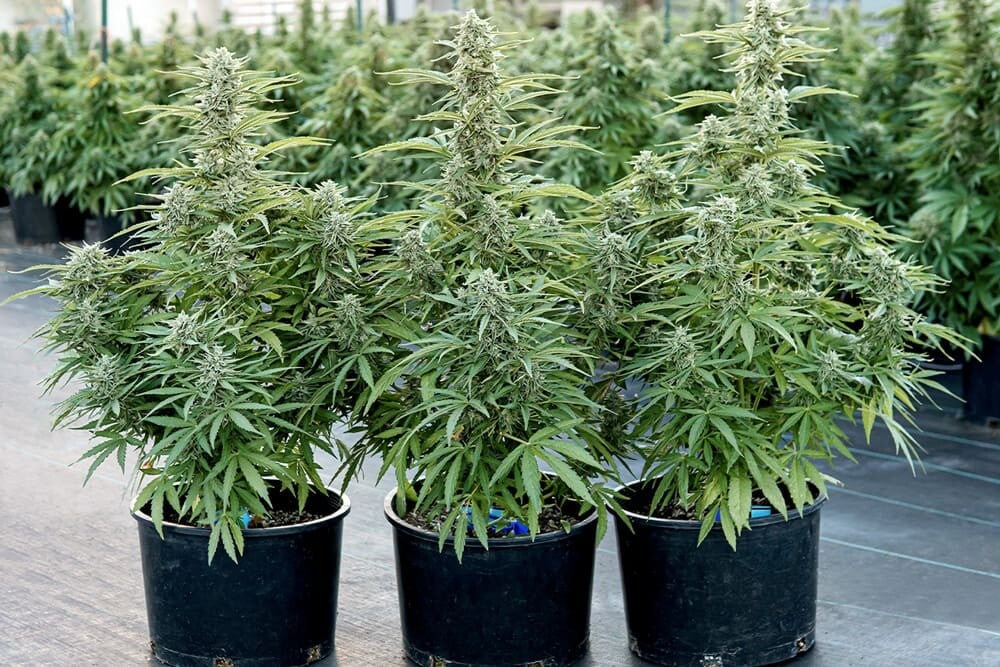
.webp "Cannabis Strain Comparison: Quantum Terp F1 vs Gaia F1")
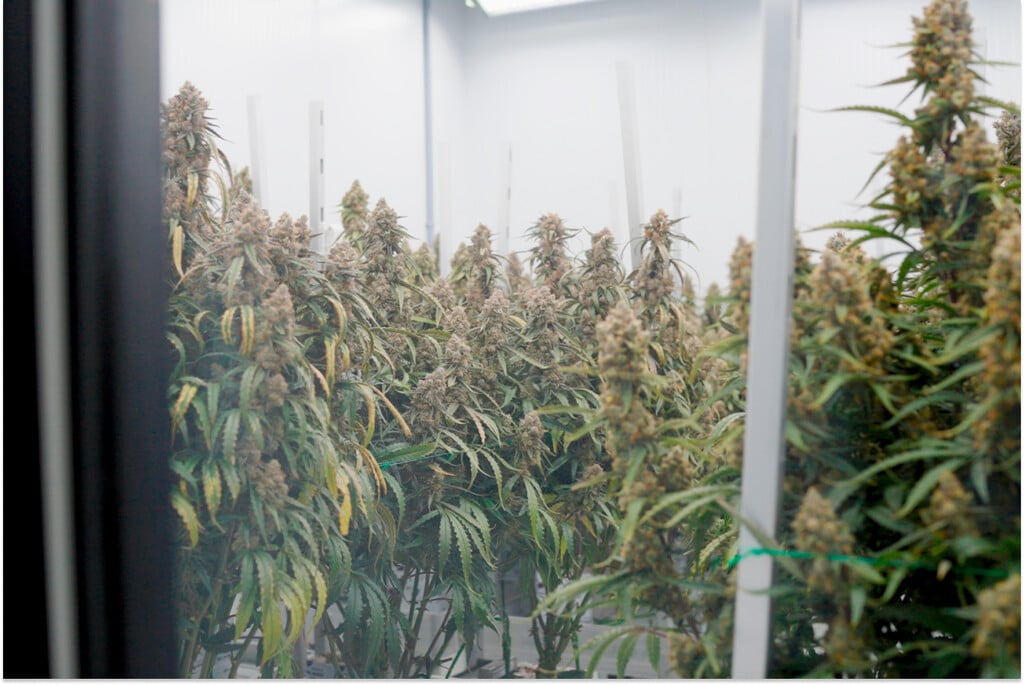
.webp "Cannabis Strain Comparison: Quantum Terp F1 vs Gaia F1")
In cannabis cultivation, a dryback is the process of allowing the growing medium (like coco coir, soil, or rockwool) to partially dry out between watering events. Instead of keeping the medium constantly saturated, growers intentionally let moisture drop to create a mild deficit that forces roots to search for water, improving oxygenation and nutrient absorption. Drybacks are a cornerstone of commercial "crop steering" using irrigation management to manipulate how a plant grows.
As the medium loses moisture, oxygen replaces the water in the root zone. This slight dryness triggers a survival mechanism in the plant, encouraging fine, dense root development and increasing nutrient uptake. The depth of the dryback is usually measured as a percentage of water loss (or Volumetric Water Content, VWC) from a fully saturated state.
The level of dryness is adjusted depending on the plant's life cycle:
Proper dryback requires balancing watering frequency and volume to avoid "drying out" (which irreversibly damages roots) and nutrient salt build-up. Commercial growers use precision moisture meters and substrate sensors to track exact water percentages and automate irrigation with high accuracy.
Note: Drybacks are widely used in synthetic or soilless setups, but they are generally not recommended for organic living soil , because the beneficial microbes responsible for breaking down organic nutrients require a consistently moist environment to survive.
Plant maintenance refers to the scheduled, hands-on interventions a grower makes to the canopy during the cycle: defoliation (removing fan leaves to open up airflow and light penetration), pruning (taking off lower growth that will not make usable flower), and training (bending or tying stems to even out the canopy). A regular-maintenance approach applies these on a set schedule; a no-maintenance approach leaves the plant to develop without any scheduled intervention.
Each choice carries trade-offs. Regular maintenance can improve light distribution and airflow through a dense canopy and direct energy toward the most productive sites, but it adds labour and removes plant material the plant has already invested in. No maintenance saves labour and preserves that existing structure, which can support more flowering sites, but it leaves denser canopies that need closer attention to airflow and humidity.
.webp "Cannabis Maintenance Comparison: Regular vs No Maintenance")
.webp "Cannabis Maintenance Comparison: Regular vs No Maintenance")
Cutting back regular plant maintenance may lower labour and preserve productive plant structure, but airflow and humidity need close monitoring, especially in dense canopies. Standardising the dryback protocol reduces substrate variability and makes steering more repeatable between cycles. To reproduce these outcomes at scale, hold CO₂ (around 900 ppm), PPFD (1,000 µmol·m⁻²·s⁻¹), temperature and the humidity ramp steady.
The trial used a 2x2x2 design: two genetics, two maintenance levels and two dryback levels, giving eight treatment groups of six plants each.
The two maintenance protocols were Regular Maintenance and No Maintenance, defined by the trial protocol as regularly scheduled canopy interventions versus no scheduled maintenance treatment. The two dryback levels were Small Dryback and Large Dryback, a smaller versus a larger overnight reduction in substrate moisture. For readers new to the term, dryback is the decrease in substrate water content between the final irrigation event of one cycle and the first of the next; a small dryback means a smaller overnight reduction, not simply drier conditions.
Measured parameters covered height (cm), dry trimmed weight (g/plant and g/m²), THC, node count, stem diameter and terpene profile. THC and terpene results were tested externally.
.webp "Cannabis Trial Overview: Genetics, Treatments, and Metrics")
.webp "Cannabis Trial Overview: Genetics, Treatments, and Metrics")
Results varied by variety and treatment, as summarised in Tables 1 and 2. The group-level figures behind these trends are detailed in the Key Findings below. Overall, no maintenance with a small dryback led on yield, while Quantum Terp F1 on regular maintenance with a small dryback led on THC; Gaia F1's highest THC came under regular maintenance with a large dryback.
Table 1. Quantum Terp F1 best results
| TREATMENT | HEIGHT (CM) | YIELD (G/PLANT) | YIELD (G/M²) |
| Regular Maintenance / Small Dryback | 80 | 331 | 1,784 |
| Regular Maintenance / Large Dryback | 69 | 311 | 1,676 |
| No Maintenance / Small Dryback | 72 | 392 | 2,108 |
| No Maintenance / Large Dryback | 80 | 386 | 2,079 |
| Regular Maintenance / Small Dryback | |
|---|---|
| Height (cm) | 80 |
| Yield (g/plant) | 331 |
| Yield (g/m²) | 1,784 |
| Regular Maintenance / Large Dryback | |
|---|---|
| Height (cm) | 69 |
| Yield (g/plant) | 311 |
| Yield (g/m²) | 1,676 |
| No Maintenance / Small Dryback | |
|---|---|
| Height (cm) | 72 |
| Yield (g/plant) | 392 |
| Yield (g/m²) | 2,108 |
| No Maintenance / Large Dryback | |
|---|---|
| Height (cm) | 80 |
| Yield (g/plant) | 386 |
| Yield (g/m²) | 2,079 |
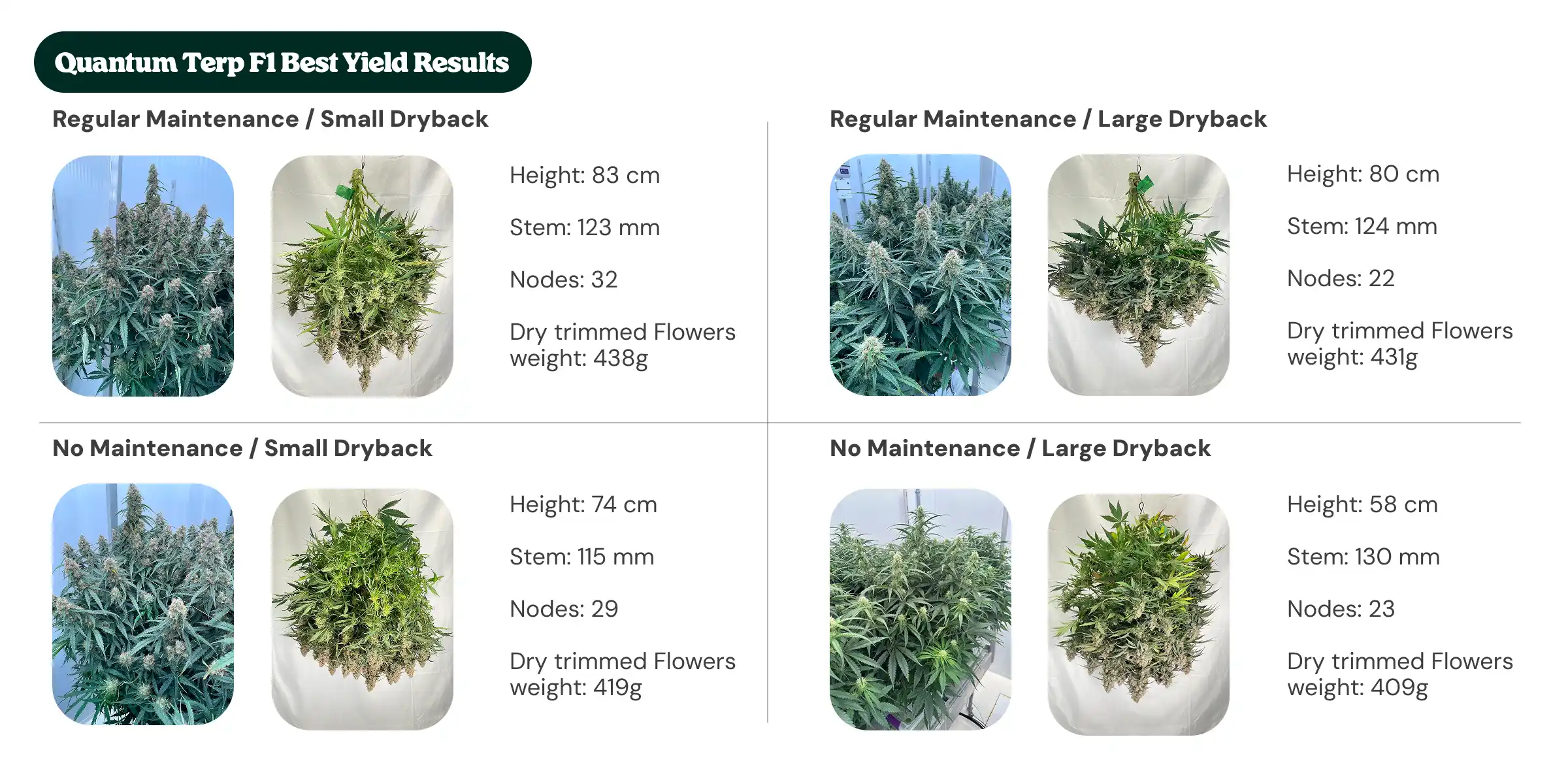
_2.webp "Quantum Terp F1 Results: Maintenance and Dryback Comparison")
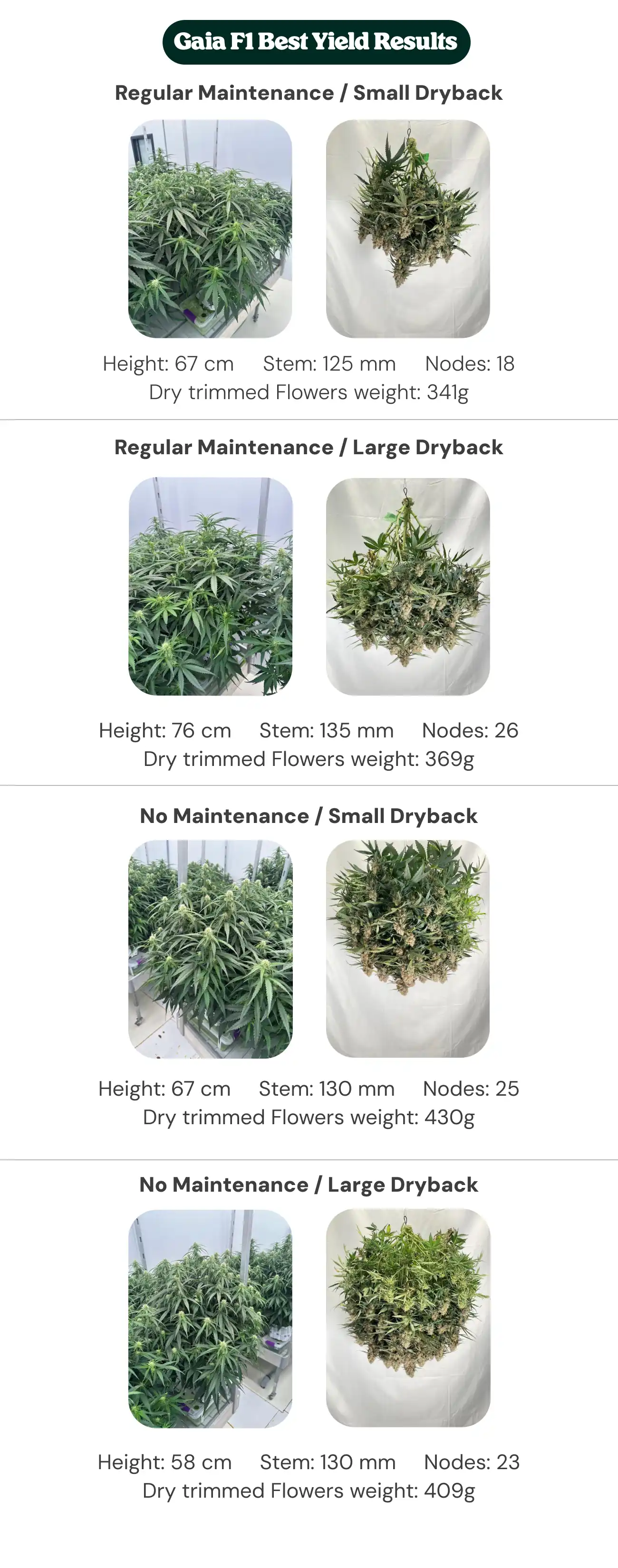
Table 2. Gaia F1 best results
| TREATMENT | HEIGHT (CM) | YIELD (G/PLANT) | YIELD (G/M²) |
| Regular Maintenance / Small Dryback | 64 | 249 | 1,341 |
| Regular Maintenance / Large Dryback | 70 | 299 | 1,610 |
| No Maintenance / Small Dryback | 64 | 396 | 2,129 |
| No Maintenance / Large Dryback | 58 | 358 | 1,928 |
| Regular Maintenance / Small Dryback | |
|---|---|
| Height (cm) | 64 |
| Yield (g/plant) | 249 |
| Yield (g/m²) | 1,341 |
| Regular Maintenance / Large Dryback | |
|---|---|
| Height (cm) | 70 |
| Yield (g/plant) | 299 |
| Yield (g/m²) | 1,610 |
| No Maintenance / Small Dryback | |
|---|---|
| Height (cm) | 64 |
| Yield (g/plant) | 396 |
| Yield (g/m²) | 2,129 |
| No Maintenance / Large Dryback | |
|---|---|
| Height (cm) | 58 |
| Yield (g/plant) | 358 |
| Yield (g/m²) | 1,928 |
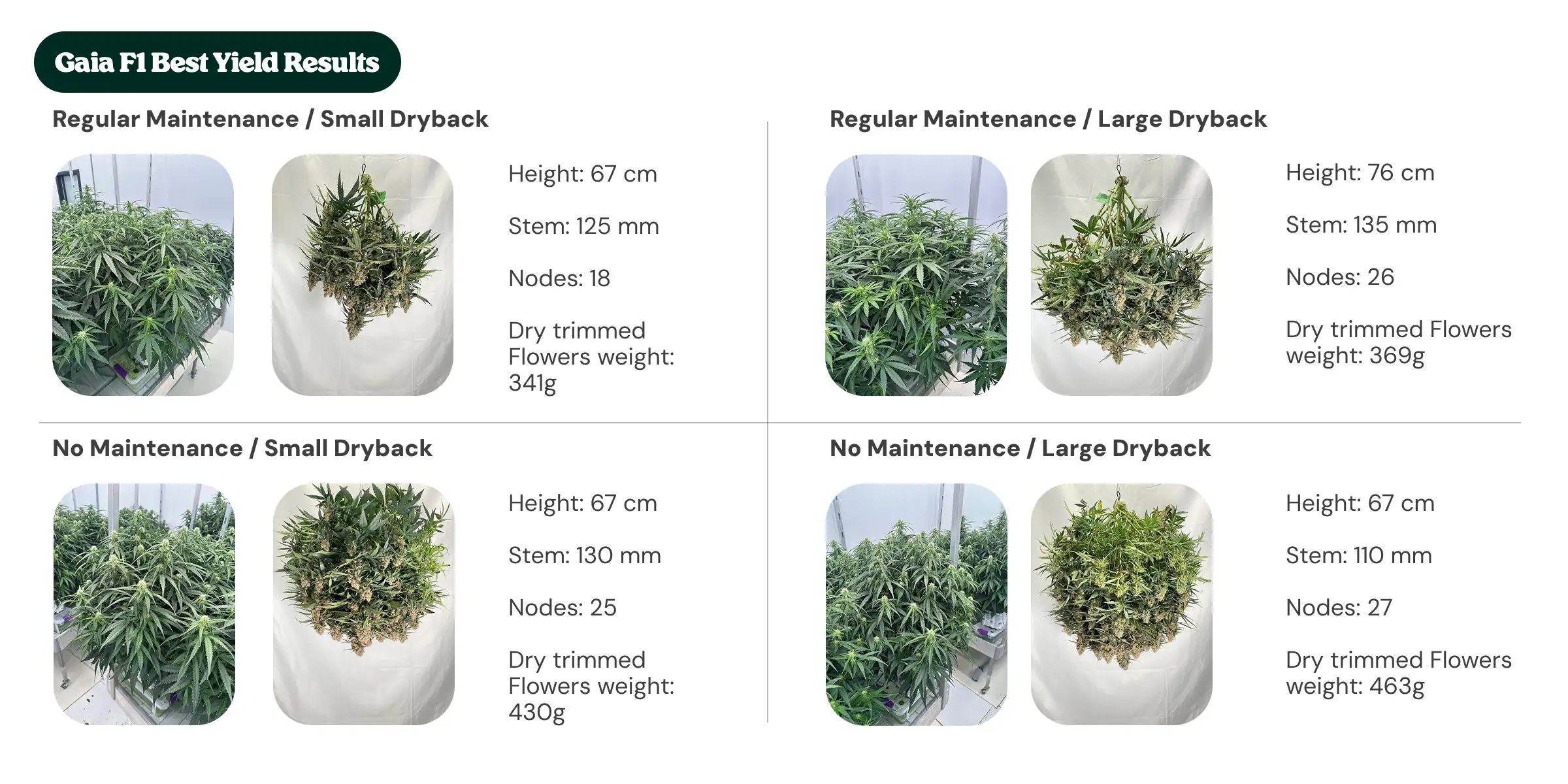
On potency, ranked in relative terms rather than by figure, Quantum Terp F1 outranked Gaia F1 across every matched treatment. Within Quantum Terp F1, regular maintenance with a small dryback ranked highest and regular maintenance with a large dryback lowest. Within Gaia F1, regular maintenance with a large dryback ranked highest and no maintenance with a small dryback lowest.
Plant height ranged from 69 to 80 cm in Quantum Terp F1 and 58 to 70 cm in Gaia F1, but height did not consistently predict the top yielders. Quantum Terp F1's best-yielding group, no maintenance with small dryback, stood at 72 cm, below the 80 cm regular-maintenance group that yielded less, so height is better read as one signal among several than as a yield predictor.
On dry flower yield, the no-maintenance groups led as a clear trial trend. The reasons are not settled here: preserved productive structure, better light interception, or less stress from intervention are all plausible contributors, but they remain hypotheses rather than proven causes. Airflow is worth treating as a management consideration alongside this, not a guaranteed benefit of skipping maintenance.
On potency, Quantum Terp F1 with regular maintenance and a small dryback delivered the highest THC in the trial, and Quantum Terp F1 outranked Gaia F1 on THC across every matched treatment, a strong first showing for Royal Queen Seeds' highest-THC autoflower. Within Gaia F1, regular maintenance with a large dryback recorded that variety's highest THC.
Terpene data comes from a single sample, ANL-5 (Quantum Terp F1, no maintenance, large dryback): total terpenes 1.252%, led by beta-Caryophyllene at 0.338%, Terpinolene at 0.205% and alpha-Humulene at 0.085%, a likely spicy, woody, herbal aroma. With only one sample, this should not be generalised across treatments or varieties.
The largest yield shortfall in the trial appeared in Gaia F1 on regular maintenance with small dryback. Because that gap sits well outside the pattern seen elsewhere, it should not be read as caused by maintenance or dryback alone.
For yield, no maintenance with a small dryback was the leading protocol in this trial. The top result came from Gaia F1 on that protocol, at 396 g/plant and 2,129 g/m², with Quantum Terp F1 close behind on the same protocol at 392 g/plant and 2,108 g/m².
For THC, regular maintenance with a small dryback is the pick, particularly for Quantum Terp F1, which recorded the highest THC overall. For Gaia F1, regular maintenance with a large dryback gave that variety's highest THC, so THC steering should be validated cultivar by cultivar.
For mid-cycle monitoring, plant height and node count at mid-flowering are useful tracking indicators rather than definitive predictors of final yield.
On substrate and irrigation, keep in mind that small dryback means a smaller overnight reduction in substrate moisture, not drier overnight conditions. In rockwool, that means setting a consistent target overnight dryback, monitoring substrate moisture, keeping irrigation timing repeatable, and avoiding large unplanned moisture swings.
None of this holds without environmental discipline: CO₂, PPFD, temperature and humidity all need tight control to replicate these results. In dense or low-maintenance canopies, monitor humidity and airflow carefully before scaling the protocol. Growers are best served testing these protocols in their own setups and tracking the same metrics across cycles.
Four findings carry the most weight. First, no-maintenance treatments supported higher yields here, though plant health has to be weighed when reading that gap. Second, small dryback lined up with the strongest yield outcomes, but the effect should be interpreted together with cultivar and maintenance strategy. Third, variety choice strongly shaped the THC ceiling: Quantum Terp F1 led on potency, while Gaia F1 delivered the single highest biomass result. Fourth, terpene sampling needs to cover all treatments before aromatic expression can be compared across maintenance or dryback strategies.
The practical value is that maintenance protocol and dryback size are two levers growers can use to steer toward a commercial target. Useful next steps would be multi-cycle replication, broader terpene sampling across every treatment, and cultivar-specific dryback validation.