Amount exceeded


4.7 out of 5 based on 59817 reviews




















4.7 out of 5 based on 59817 reviews
Key Takeaways
Contents:
Cosmos F1 is the first CBD strain I have ever grown, and she shared the tent with two Orion F1 plants, but this report follows her story alone. Using real GrowDiaries data, this Cosmos F1 grow journal outlines: heights, watering volumes, pH readings, nutrient combinations, and everything the environment was doing at each stage. A real Cosmos F1 grow report, not a breeder's spec sheet, so anyone can repeat the run week by week.
I chose Cosmos F1 for this round because it represented something genuinely new in the F1 catalogue. This is Royal Queen Seeds' first true F1 CBD cannabis variety and the largest autoflowering cultivar in their entire F1 line. Her genetics descend from a pure inbred line of CBD Oregon, giving her a strong sativa character: a tall, upright Christmas-tree structure with long, wispy flowers and bright green foliage. Because both parent lines were inbred for stability before crossing, plants from this variety are remarkably uniform, growing to a very similar height, following the same timeline, and delivering a consistent cannabinoid profile across the crop.
THC sits at just 0.5%, while CBD is listed as very high. She is an autoflowering variety with a flowering window of 45–55 days and a projected harvest time of 75–85 days from germination. Expected indoor yields are rated XXL, and the expected height lands at 70–100 cm. The terpene profile is led by myrcene, farnesene, limonene, pinene, and caryophyllene: crisp pine, a creamy cookie depth, and a distinctive peppery edge. The effect profile promised something clear and meditative, physical relaxation without mental fog, body ease without intoxication.
This was a compact indoor run in a small, shared tent with no training techniques, no transplants, and no interventions beyond watering, feeding, and basic environmental management.
I germinated directly into the final pot to avoid transplant stress. Before planting, I worked through the BioBizz All-Mix in layers: Easy Boost Organic Nutrition pellets first, then Seaweed, then a small addition of Trichoderma towards the top. Once each pot was mixed and soaked, I placed the seed inside and set pH to 6.0 from the very first watering. One Cosmos F1 seed went into the centre of the tent. Two Orion F1 seeds filled the remaining spots.
With the soil prepared and settled, all three pots went into the grow box with the humidifier running from the start. By day 3, the surface had dried slightly, so I gave a light top watering to maintain moisture without drenching the pot. On day 4, Cosmos F1 broke the surface at the same time as both Orion F1s: a clean, even emergence with no lag. By day 5, each plant received its first proper watering of 0.5 L at pH 6.0.
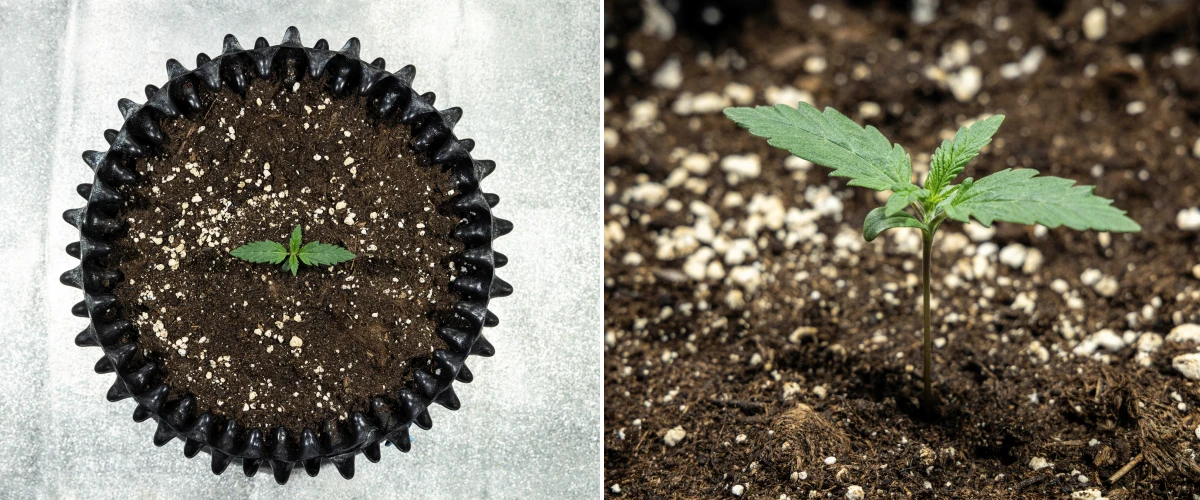
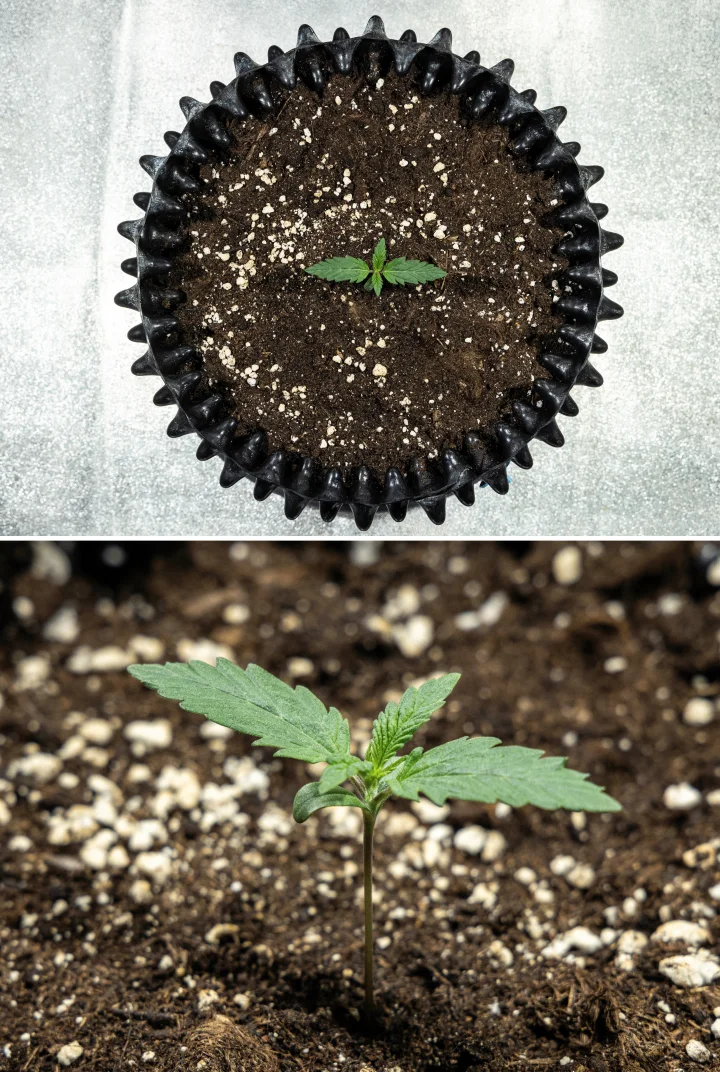
Vegetation begins once a seedling has at least four true leaves. Cosmos F1 hit that point around sprout day 5, measuring 4.5 cm, with even leaf spacing and a compact upright posture. On the following day, I watered lightly across the three plants, 3 L in total, keeping volumes modest while the roots established.
By sprout day 11, I introduced CalMg at 1 ml per litre, a preventative measure I use consistently after seeing deficiency symptoms appear on earlier runs when I skipped it. The MIGRO Aray 4 also arrived that day, replacing the MIGRO 200+. The improvement in light distribution across the full canopy was immediately visible. Six litres of water, CalMg at 1 ml/L, pH 6.0.
By sprout day 12, Cosmos F1 measured 8.5 cm. She was smaller than her Orion F1 roommates, but steady and clean. A relaxed start does not mean a weak plant.
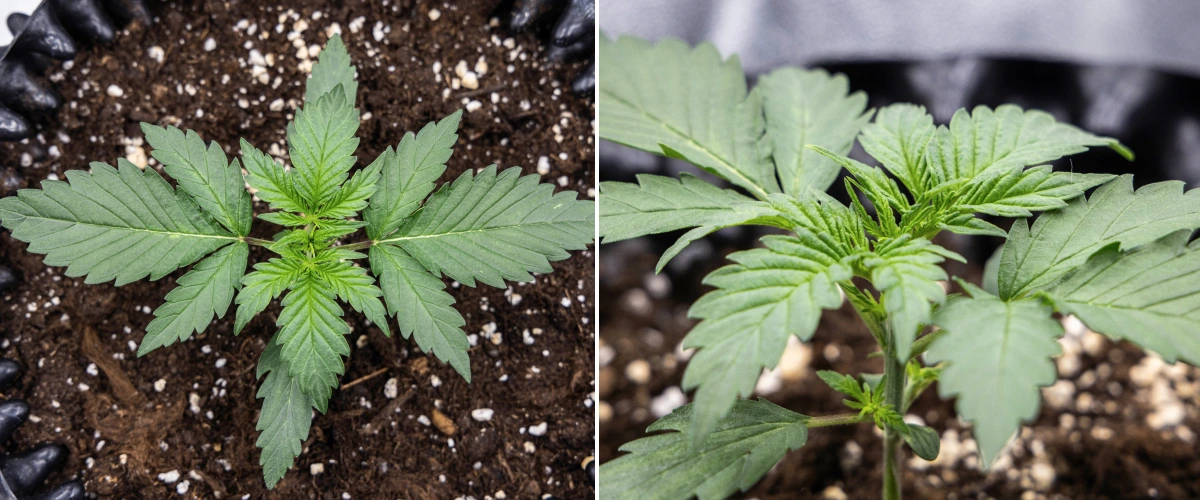
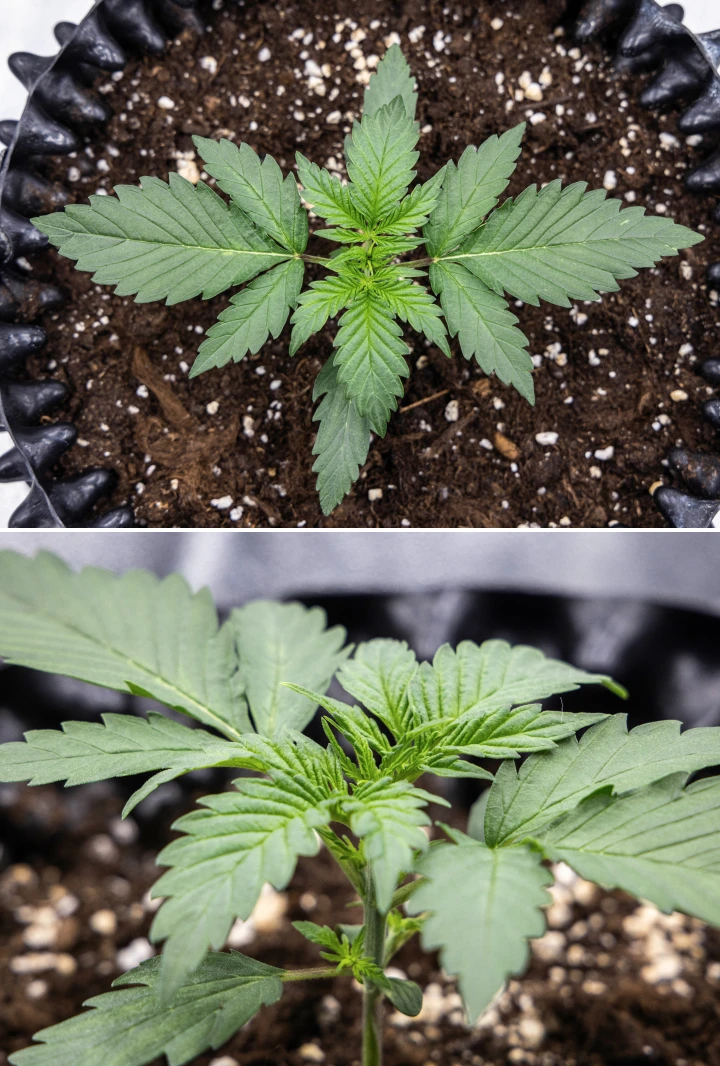
The start of Week 2 brought a switch to an 18/6 light cycle. Cosmos F1 responded well, putting on nearly 10 cm in a week and finishing at 18 cm, with a bushy, well-branched structure beginning to show the sativa skeleton underneath. Still shorter than the Orion F1s, but confident and even.
Watering settled into an every-3–4-day rhythm. CalMg continued at 1 ml/L, and I added Bigger Flowers from the RQS Bio Flowering Booster range once this week, an early introduction to flowering support. The medium was cycling through wet and dry naturally, and the plant was drinking predictably.
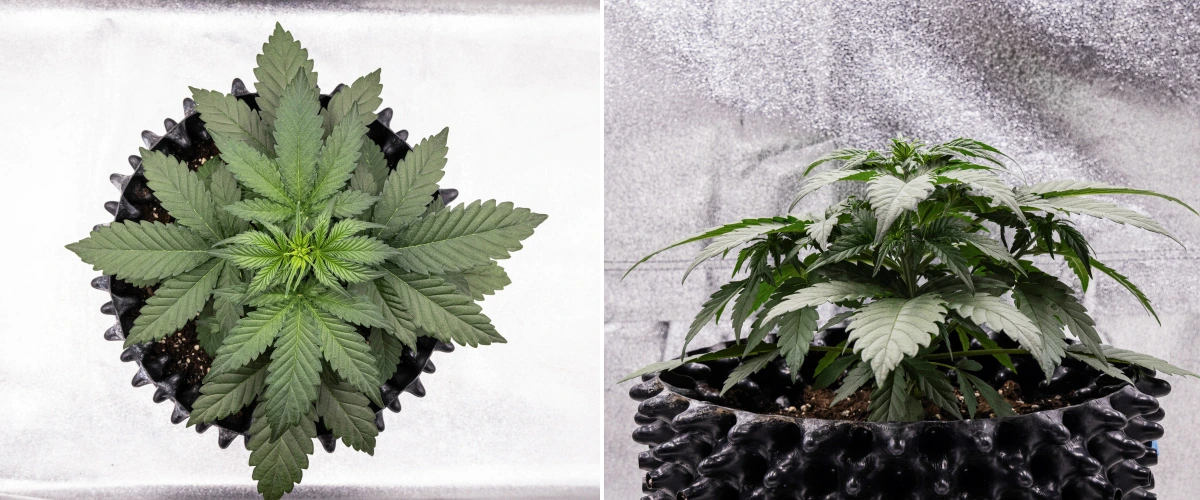
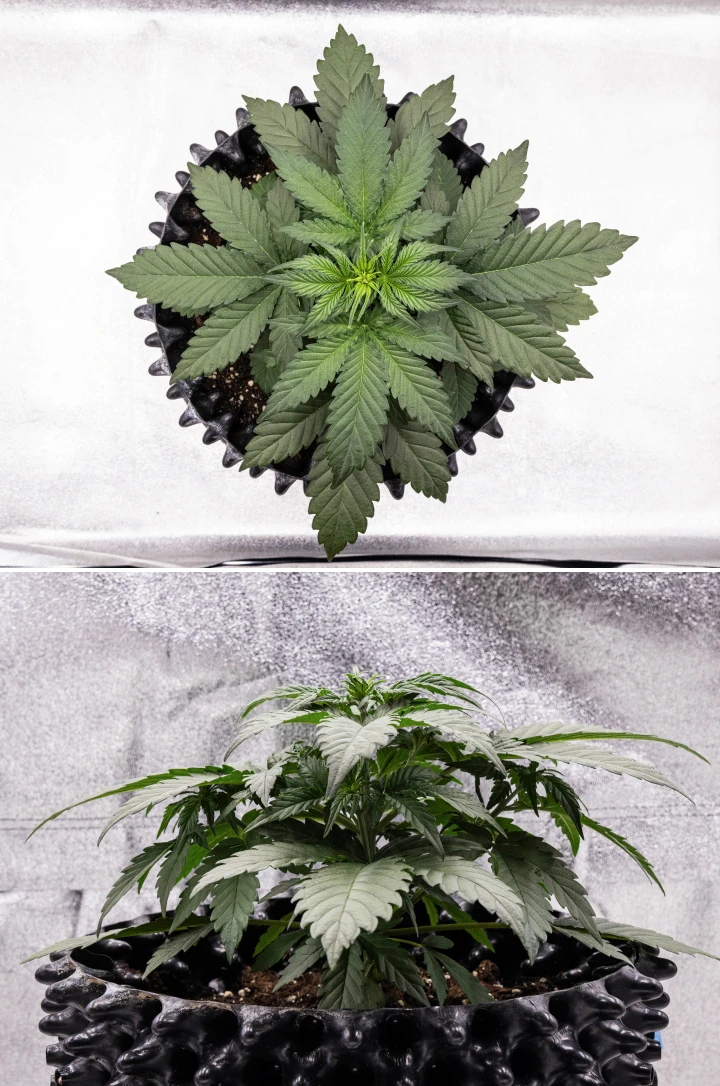
By the end of Week 3, Cosmos F1 had crossed into the flowering phase. The structure was clearly sativa-influenced: upward-reaching branches, tight node spacing in the lower section, and an increasingly defined central stem. The nutritional programme stepped up with Thicker Flowers added as a PK booster alongside CalMg and Bigger Flowers, plus two drops of SuperVit into one watering. Volume moved to roughly 7 L per session across the three plants, approximately 2.3 L each, every 3–4 days.
Early in the week I prepared 7 L with 7 ml CalMg, 7 ml Bigger Flowers, and 3.5 ml Thicker Flowers at pH 6.0. A few days later, the same volume with CalMg only and two drops of SuperVit.
The first pistil hairs were unmistakable by the end of this stretch: white and delicate at the nodes, the earliest sign that flowering had properly begun. With a CBD strain, this moment felt particularly significant.
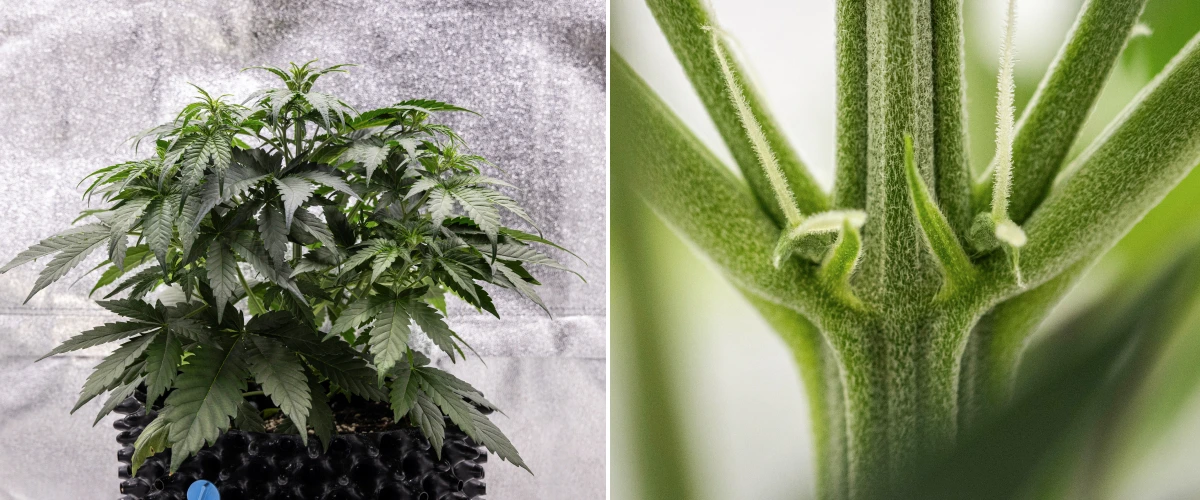
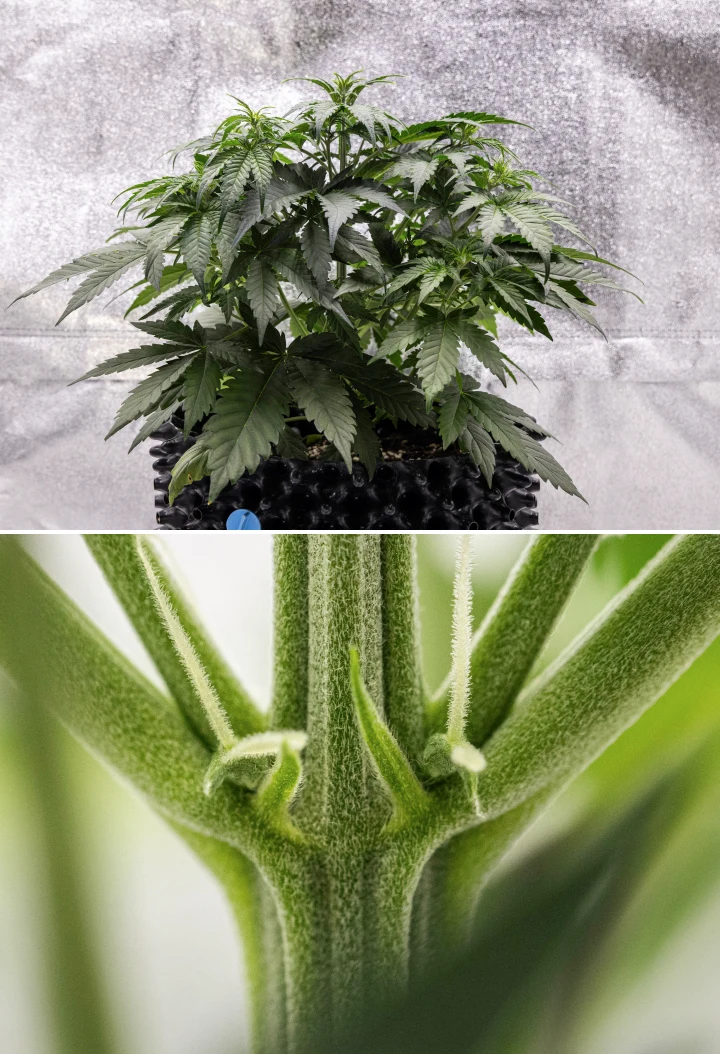
By the end of the first flowering week, Cosmos F1 stood at 54 cm, a jump of almost 25 cm in seven days and the most dramatic growth of the whole cycle. The Christmas-tree architecture was expressing itself clearly: a defined central cola forming above progressively lower branch tiers, each already carrying clusters of developing flowers. Dark green fan leaves looked healthy at every level; no canopy management was needed, and she had comfortable headroom inside the 178 cm tent.
Watering continued every 3–4 days at 7 L for the tent, pH 6.0, with CalMg, Bigger Flowers, and Thicker Flowers as the core combination. The medium was cycling cleanly between sessions, and the plant was drinking predictably.
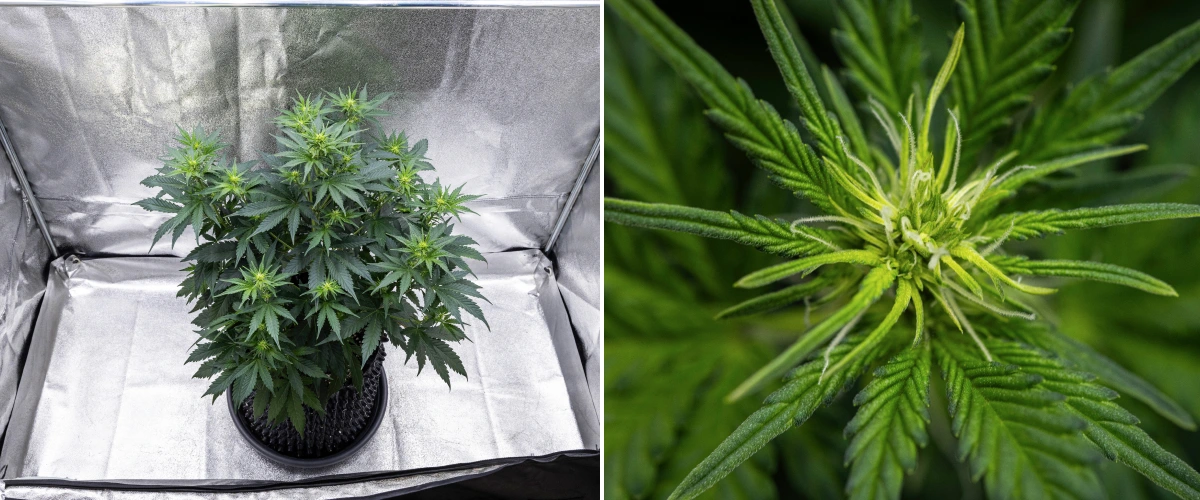
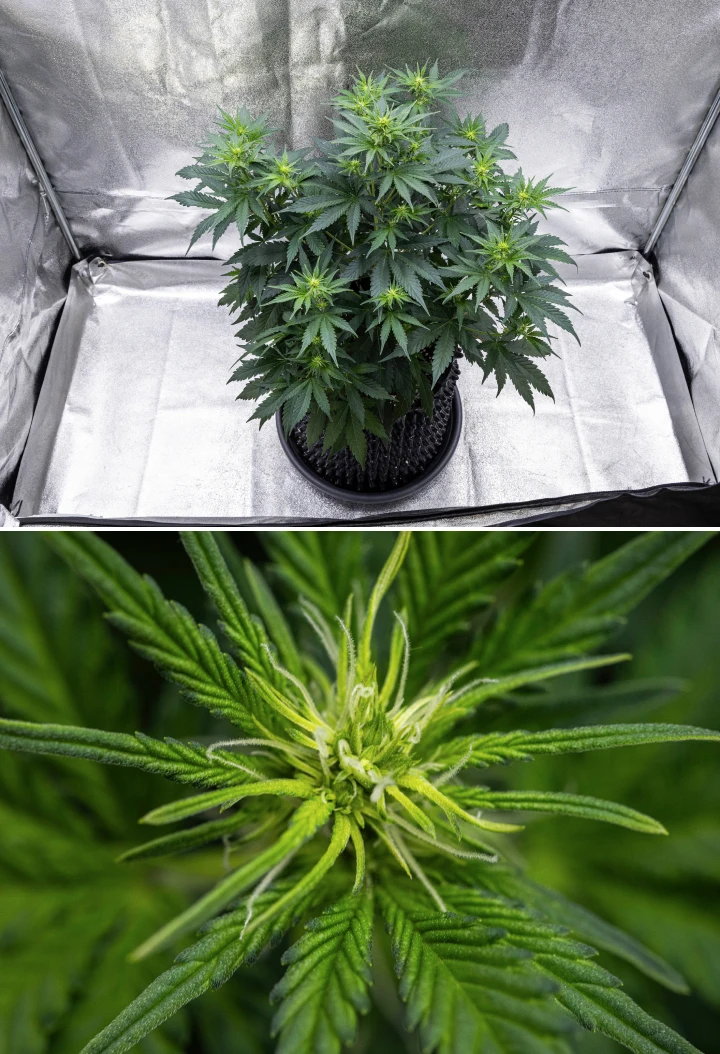
Week 2 of flowering was steady. By the end of it she measured 67 cm, around 13 cm of gain as vertical growth began to taper towards her final height. The flowers were still in early development, more skeleton than substance, but their arrangement up the main stem and along each lateral branch gave a clear indication of the yield potential building beneath. Leaf colour stayed strong, no deficiency symptoms showed, and the same 7 L every 3–4 days rhythm continued with CalMg and Bio Flowering Booster throughout.
The scent was beginning to emerge: faint at first, just a hint of pine when I opened the tent, but unmistakably there. Something fresh and clean, with a creamy undercurrent developing beneath it. The terpene profile was beginning to announce itself.
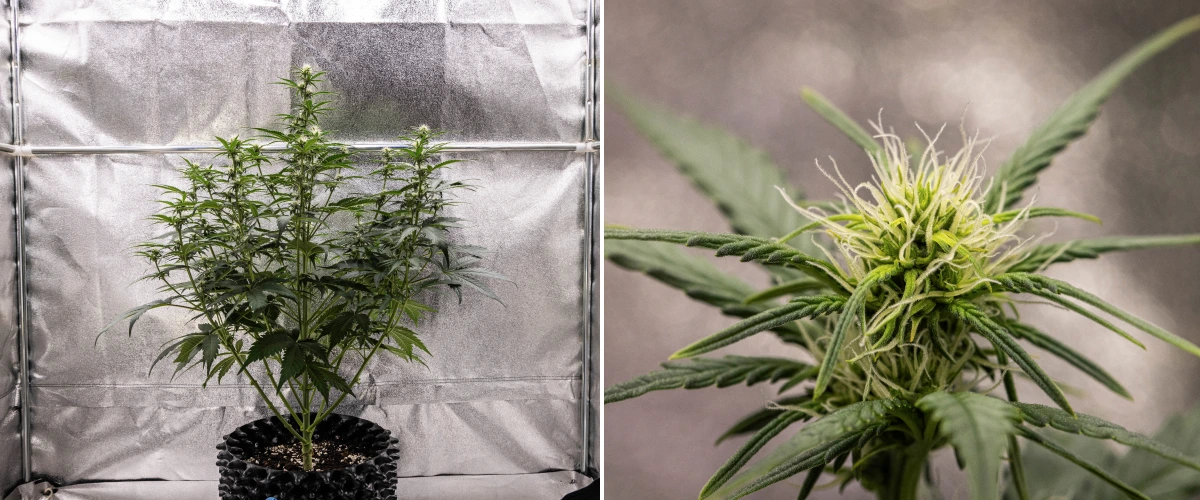
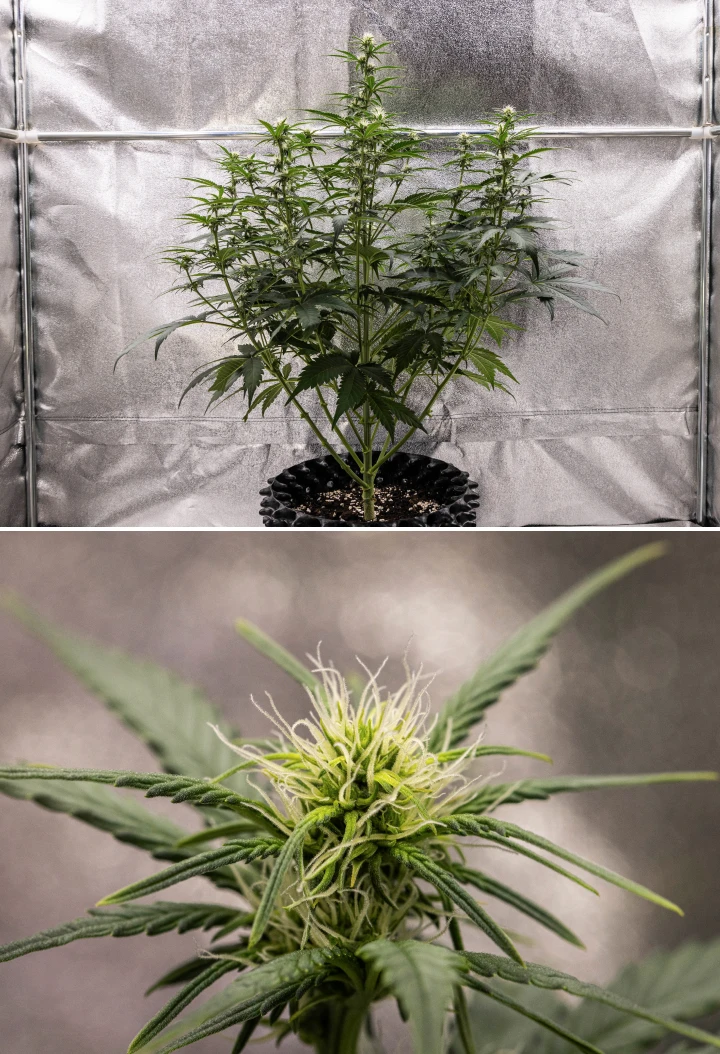
Vertical growth was winding down now, the plant pouring its energy into flowers rather than height. Early in the week I watered with 7 L including 7 ml CalMg, 7 ml Bigger Flowers, and 3.5 ml Thicker Flowers at pH 6.0. A few days later, CalMg only plus two drops of SuperVit at the same volume. At the end of the week, I photographed and measured.
Cosmos F1 stood at 73 cm, around 6 cm up on the previous week and clearly closing in on her ceiling. The main cola dominated the centre of the canopy, the lateral branches fanned out in well-spaced tiers below it, and every surface was covered in developing flower sites surrounded by healthy dark green foliage. At 73 cm she was still well within the tent and well below the lights. This was the week all the theoretical promises about F1 uniformity became something I could see and touch.
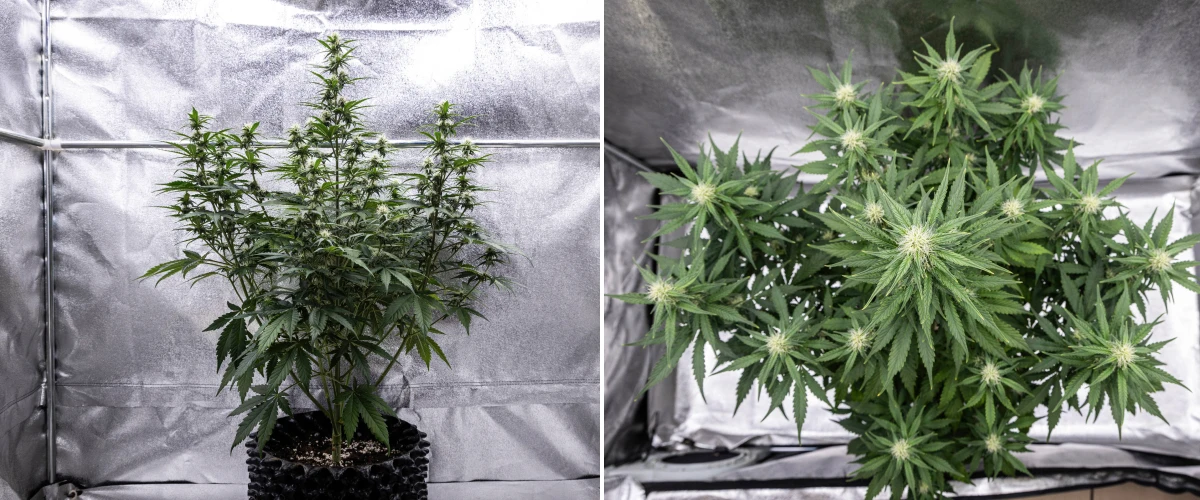
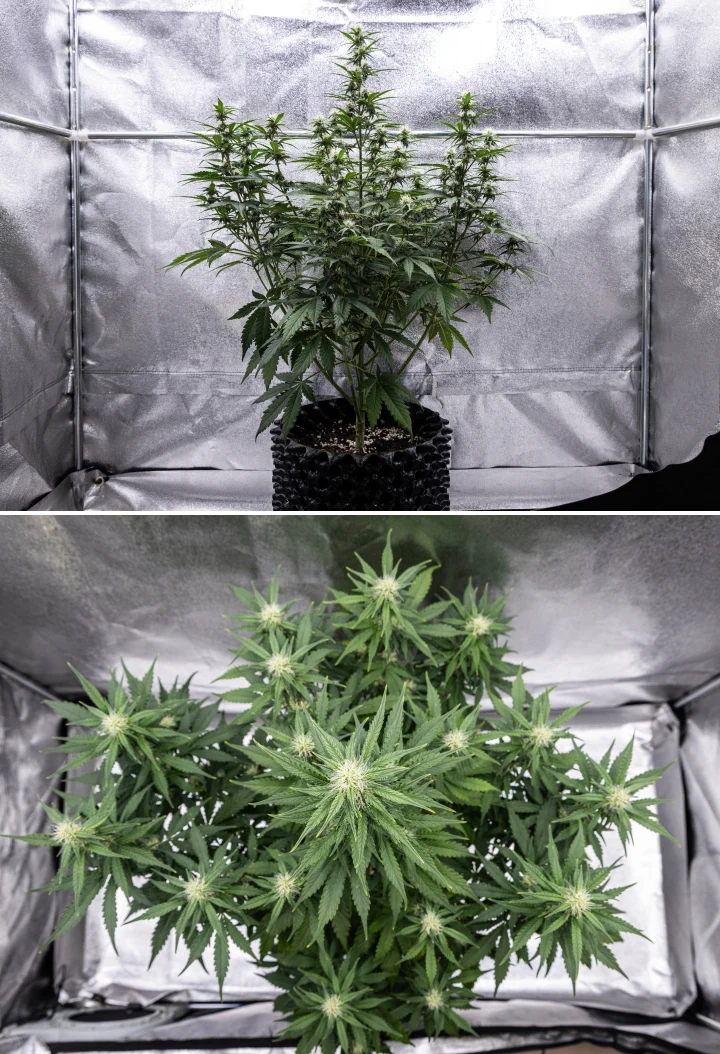
Vertical growth slowed as the plant committed fully to flower production, topping out at around 75 cm. Density increased, resin began to accumulate, and the first proper stickiness appeared on the calyxes. Watering was moved to every three days consistently as water demand climbed with the growing flower mass.
Cosmos F1 showed more leaf yellowing than her Orion F1 companions this week. The lower leaves in particular started to pale, the early signs of a potassium deficiency, so I moved to make it up to her. I removed the affected leaves as they developed.
Thicker Flowers, one of the three parts of the Bio Flowering Booster range, doubles as a PK booster, so I leaned on it to lift her potassium: 7 L with 7 ml CalMg, 6 ml Bigger Flowers, and 10 ml Thicker Flowers at pH 6.0. I repeated the same a few days later. Towards the end of the week, I removed yellow leaves before photographing. The flowers looked excellent: dense, sticky, with an aroma that was impossible to ignore even with the filter running. The peppery caryophyllene note had arrived clearly alongside the pine, with something sweet and creamy building underneath.
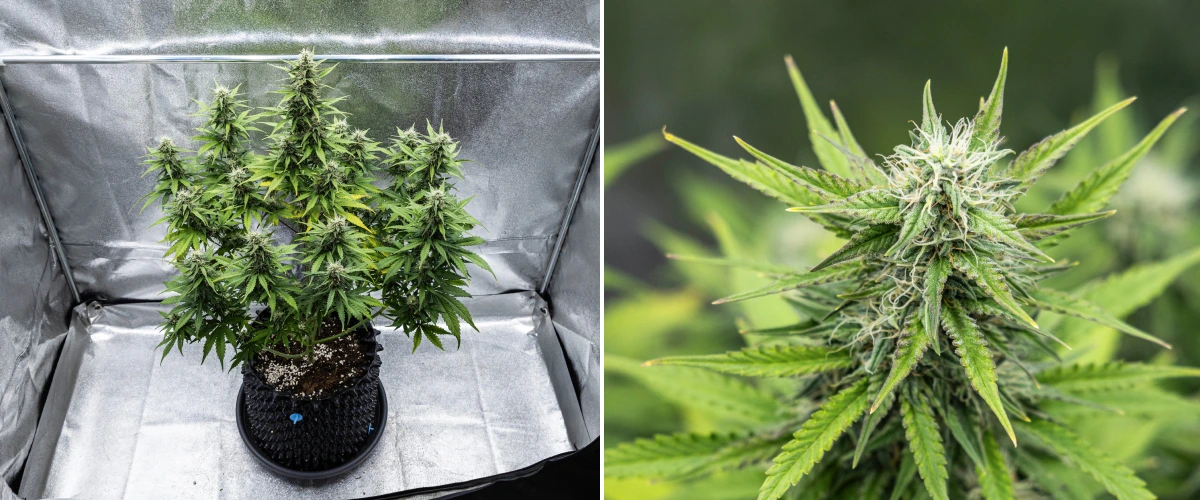
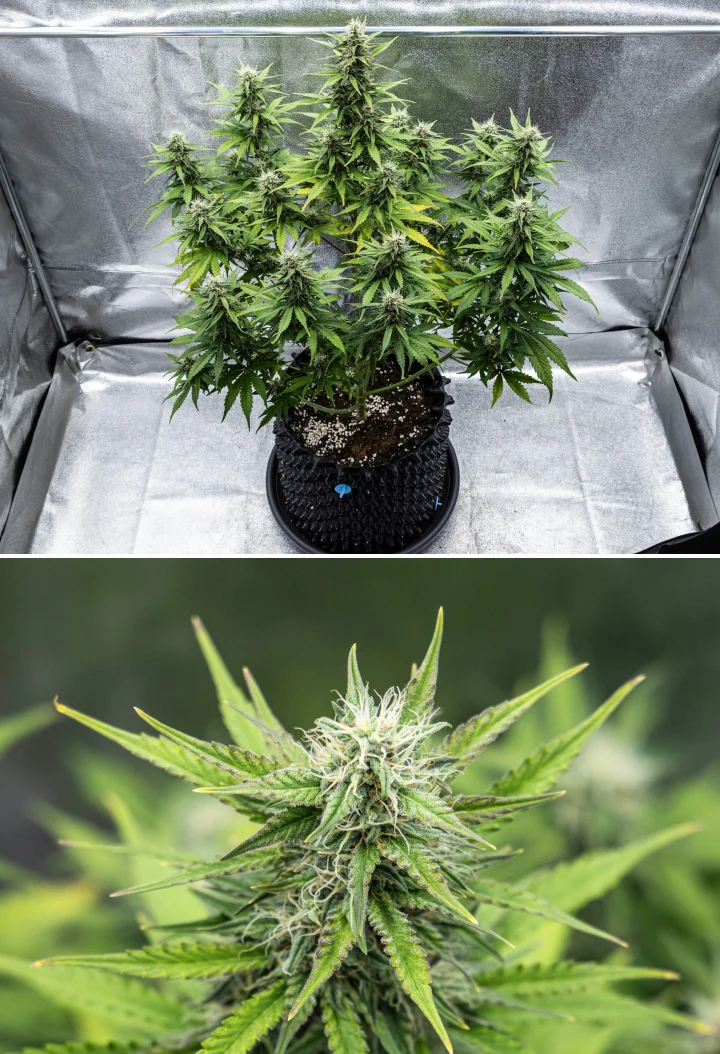
The last nutrient watering of the cycle came early this week: 7 L with CalMg and Bio Flowering Booster, pH 6.0. A few days later, plain water only, 7 L at pH 6.0. At the end of the week, I took photographs.
Cosmos F1 had turned noticeably yellow, the leaves reclaiming everything before the plant shut down. I removed all affected leaves. But the flowers told the better story: beautiful, trichome-heavy, hard and compact at the top of the main cola and at the ends of all lateral branches, with slightly puffier but still well-coated lower sections.
Trichome checks under the microscope began at this point. Trichomes were mostly milky, with a small number beginning to turn amber. Harvest was close.
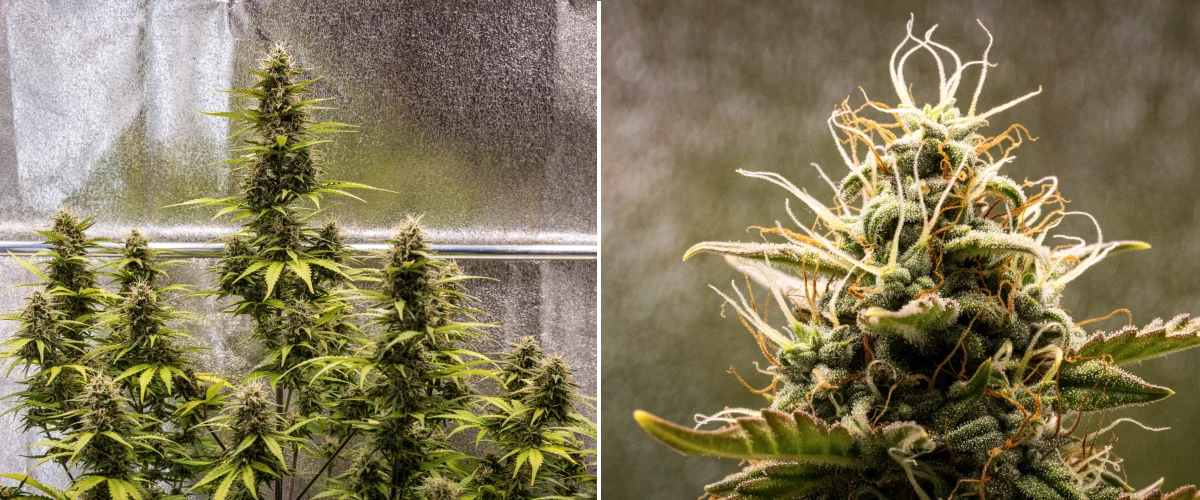
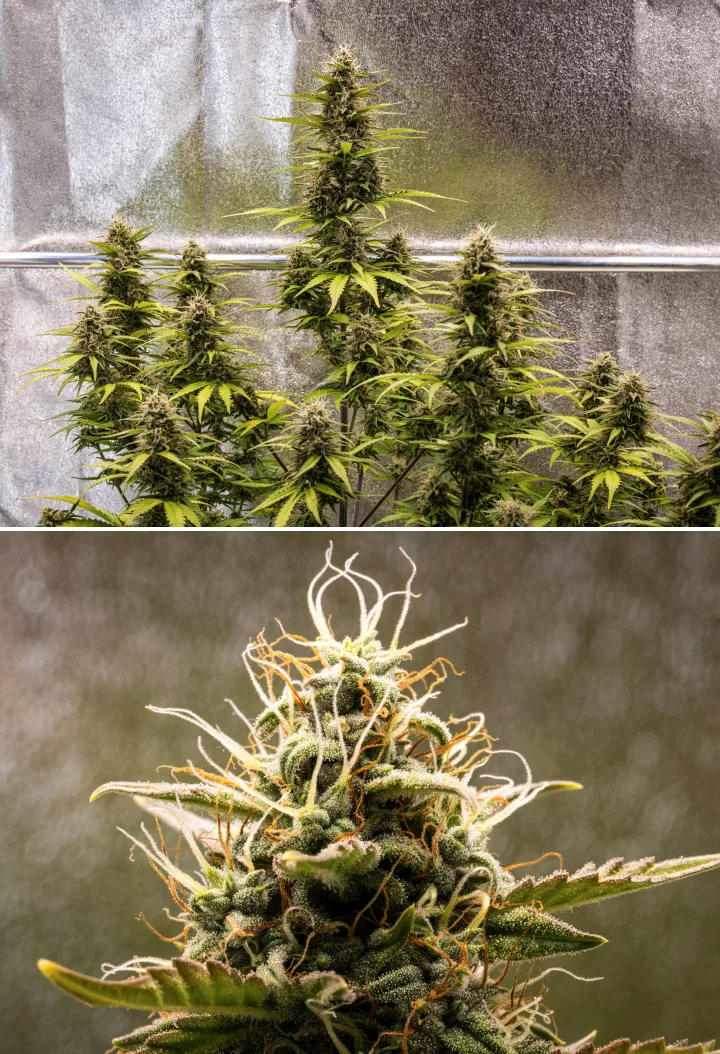
Plain water every three days, no nutrients. The plant was finishing on her own reserves: calyxes swelling slightly, resin thickening, the smell in the tent impossible to ignore.
Daily trichome checks confirmed the window was open by sprout day 68: majority milky, a proportion of amber. I gave the final plain-water watering two days before cutting to allow the plant to use up some internal moisture and reduce mould risk early in drying.
On sprout day 68, I harvested Cosmos F1. Hard and sticky across most of the canopy, covered in trichomes right down to the lower bud sites. For a first CBD grow, she had finished exactly as described: precise, predictable, and clean.
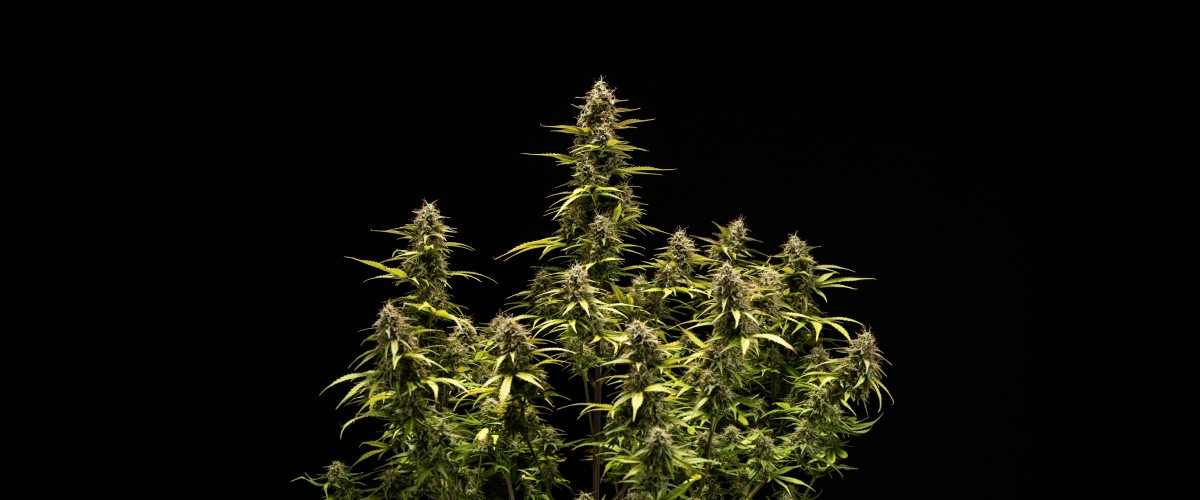
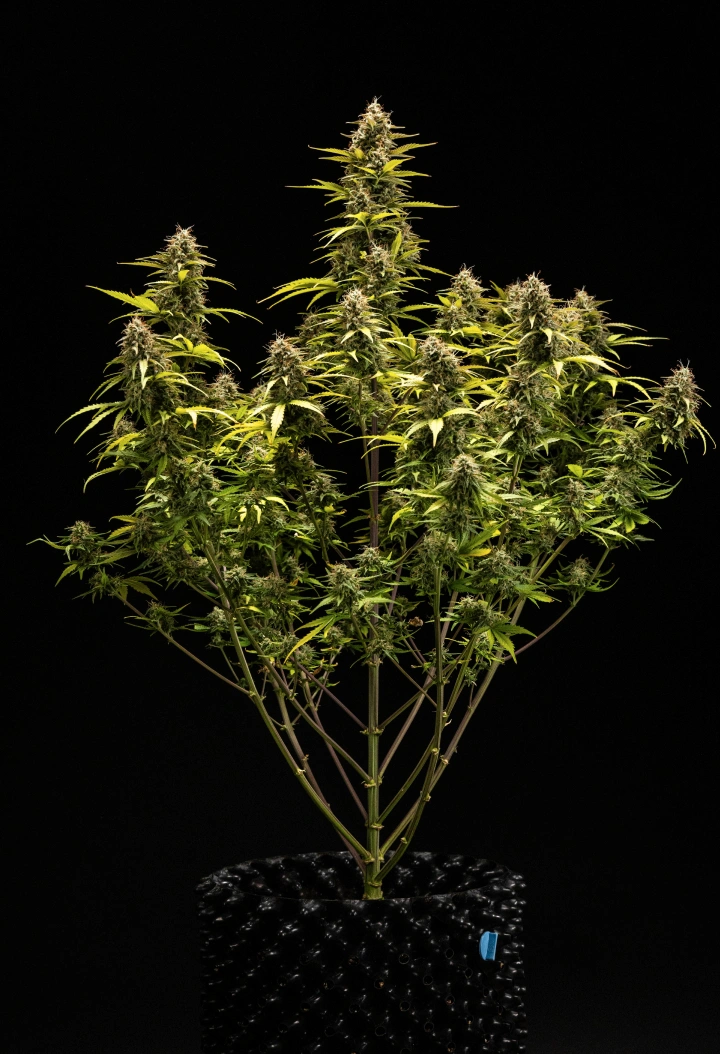
I hung Cosmos F1 whole in the grow box and dried her in darkness for approximately 10–14 days with ventilation at a reduced setting. Once the outer buds felt dry and the smaller stems snapped cleanly, I trimmed and transferred the flowers into jars. The aroma settled well in the cure: pine sharpening, cookie-cream depth becoming consistent, pepper coming through clearly on the exhale.
Total lifecycle: 68 days from sprouting. Germination took around 3–4 days before the seed broke the surface, putting the full lifecycle from seed to harvest at approximately 71–72 days. The breeder's stated window is 75–85 days from germination, and while this run came in slightly under that estimate, the trichome profile at harvest confirmed the plant was fully mature and ready. Final height: approximately 74 cm, after peaking at 75 cm in late flower. Final dry yield: 69 g from one plant.
For a single plant sharing a 120 x 60 cm tent with two others throughout, that was a very solid result. She finished within the expected height range and delivered on the XXL yield rating in real conditions.
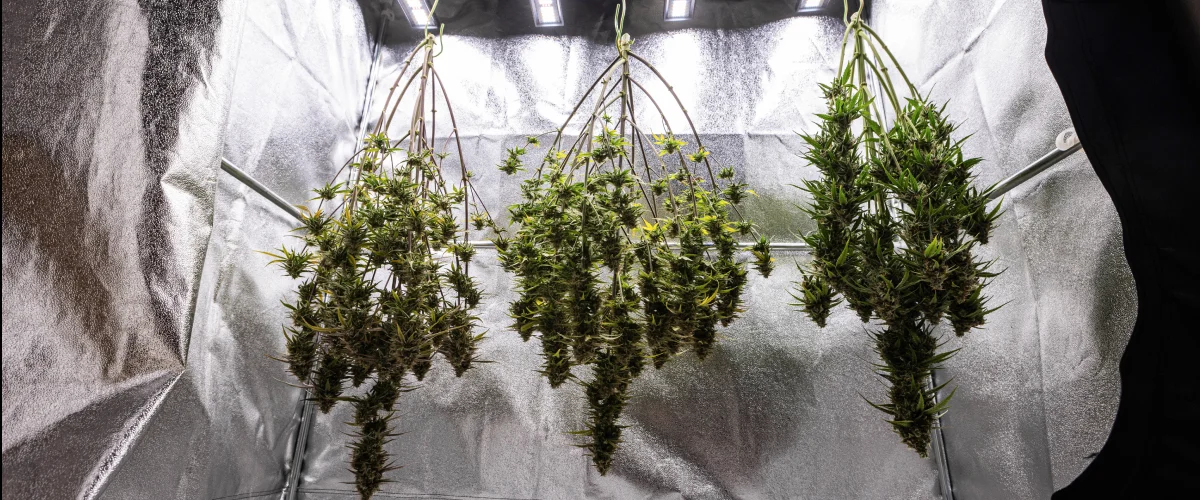
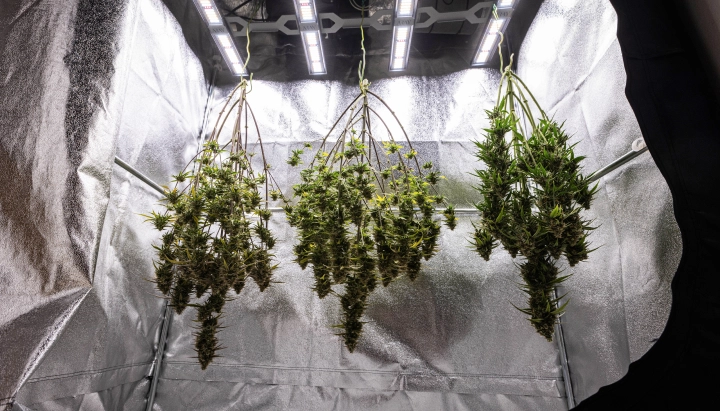
Cosmos F1 descends from a pure inbred line of CBD Oregon genetics, giving her the strong sativa structure, the long wispy flowers, and the very high CBD with negligible THC. What makes her genuinely different from conventional CBD varieties is the F1 hybrid status. Both parent lines are stabilised through generations of inbreeding before crossing, and the resulting first-generation offspring are remarkably consistent: plants in this variety grow to a very similar height, flower at the same time, and deliver a highly uniform cannabinoid and terpene expression across the crop. No major outliers, no phenotype variation to manage. For a CBD strain where consistency is the primary goal, that is exactly what you want.
Once cured, the terpene profile expressed itself clearly. The dominant note is crisp pine, clean and sharp on the nose, with a fuller, almost creamy quality underneath reminiscent of modern Cookies-adjacent varieties, and an unmistakable peppery bite at the back from caryophyllene.
The effect is clear and meditative. With only 0.5% THC and very high CBD, there is no intoxication: no fogginess, no couch-lock. Instead, genuine physical ease combined with a focused, settled mental state. Cosmos F1 is particularly popular among growers who favour high-CBD, low-THC varieties for everyday use, appreciating the clear-headed, functional quality that a near-zero THC profile provides. For daytime use, it sits comfortably in the background. Not a reset, but an alignment.
Trust the F1. Cosmos F1 grew exactly as described, hit her harvest window cleanly, and finished at a height and yield that matched the product specifications closely. No corrections were needed, no late adjustments, no phenotype-hunting. Keep CalMg consistent, water through properly, let the pot dry down between sessions, and let the plant do what F1 genetics enable it to do. The rest takes care of itself. That is the kind of honest grow reporting I want every diary on the farm to deliver.


|
CBD Oregon |

|
XXL |

|
70 - 100 cm |

|
45 - 55 days |

|
0,5% |

|
Clear, Focus , Meditative |

|
Very high |

|
75 - 85 days after sprouting |