By Luke Sumpter

Ever come across chalky white spots on cannabis leaves? More than mere dust, this substance is powdery mildew (PM), a fungal pathogen that can severely impact plant health if left unchecked. Though it thrives in humid environments, it can also strike carefully managed and relatively dry grow tents and gardens.

While the sight of powdery mildew can signal some alarm, taking swift action can help to block the spread and even cure plants entirely, reducing any impact on growth, development, and yield.

Below, we will equip you with everything you need to know to protect your plants against PM. You’ll learn exactly what it is, why it appears, how to spot it early, how to prevent it from recurring, and some quick cures, including hydrogen peroxide application. You’ll discover both organic and chemical solutions, including Oidioprot, to help you conquer the disease at varying stages of severity.

What Exactly Is Powdery Mildew?

Powdery mildew, also known as oidium, is one of the most common cannabis plant diseases[1]. Caused by several taxa of fungi that belong to the Erysiphales order, the disease impacts a wide range of plant species and typically takes hold in high-humidity environments with moderate temperature, making greenhouses and polytunnels particularly susceptible.

Mildew on cannabis begins once spores land on leaves, petioles, or buds. After germination, fungal strands begin to colonise the tissue, robbing nutrients and casting a shadow over the surface. Once well-established, infections inhibit photosynthesis, reduce terpene concentrations, and can ruin entire harvests through spore contamination.

Life Cycle in 60 Seconds

Understanding the life cycle of powdery mildew will help you get to grips with the severity of infections you come across:

  1. Conidia land on leaf surface: PM on weed begins when spore-like conidia, the asexual reproductive structures, are blown onto leaves, petioles, or buds. Underpinning the characteristic white, powdery appearance of PM, conidia are produced in chains on fungal hyphae. Unlike many other fungal spores, they do not require free water for germination, allowing them to thrive in dry environments.
  2. Germination: Each spore contains all of the DNA required for the formation of fungal hyphae, fine filaments that are capable of entering plant tissue. Germination typically occurs under warm, dry conditions and involves the formation of a germ tube, which then develops into an appressorium.
  3. Hyphal penetration: The appressorium helps the fungi to adhere to leaf, petiole, and bud surfaces. However, it also enables hyphal threads to penetrate host tissues. After breaching the cuticle (the protective, waxy layer on leaves), the hyphal threads develop another specialized structure known as a haustorium, which enables them to start absorbing nutrients from plant cells.
  4. Conidia production: Once established, the fungi then form conidiophores to reproduce. These structures release huge numbers of conidia, with single colonies releasing up to 100,000 spores. At this stage, white spots on cannabis leaves become severe, impacting photosynthesis and putting surrounding uninfected plants at risk.
  5. Cleistothecia formation: After sporulation, powdery mildew fungi survive as dormant mycelium or cleistothecia. The latter are small, spherical, pinhead-sized structures that are typically white or tan and turn black or dark brown as they mature. When temperatures rise in the spring, mature cleistothecia open up and release more spores.

How to Spot Powdery Mildew Early

Checking for the signs of early-stage powdery mildew allows growers to identify and treat the disease before it spreads out of control. These early symptoms include:

  • Chalk-dust rings: These circles form as the fungal colony grows radially from an initial infection point. The "dust" is actually a dense layer of conidia and fungal hyphae on the leaf or bud surface, working hard to constantly reproduce and expand.
  • Upper-leaf bias: Powdery mildew conidia are wind-dispersed, often landing on the upper leaves of a cannabis plant first, especially in denser setups where lower leaves are less exposed. The fungus also thrives in drier leaf surface conditions, with the upper surface of leaves drying quicker than the lower side.
  • Velvety feel: This sensation comes from the dense mat of fungal hyphae and conidiophores (spore-producing structures) that grow superficially on the plant epidermis. It’s essentially a fuzzy fungal layer that feels velvety to the touch.
  • Easy rub-off: One clear sign of PM is how easily it rubs off. Unlike other leaf spots that penetrate deeper, powdery mildew primarily grows on the leaf surface. The hyphae and conidia form a superficial layer, making it easy to wipe away.
  • Accelerated spread: Powdery mildew fungi rapidly produce countless conidia in a short window of time, around 5–7 days into the infection. Unlike dust or other diseases, you’ll notice the powder spread quickly.

PM vs Lookalikes

White spots on weed leaves aren’t exclusive to powdery mildew. However, other symptoms allow growers to distinguish PM from a host of other potential issues. Some PM "lookalikes" include:

  • Nutrient salt residue: As water evaporates from leaves, especially after foliar feeding, dissolved mineral salts are often left behind as a white film. However, this residue won’t have the distinct fungal texture of PM, and it won’t spread.
  • Botrytis: While known chiefly as a gray mold, the early stages of Botrytis cinerea infection, particularly on young tissues or under high humidity, can sometimes appear white and fuzzy. However, Botrytis will give itself away by turning brown and causing a watery brown rot.

DIY Tape-Lift Confirmation

Thankfully, home growers don’t need to invest in expensive microscopes or testing to identify powdery mildew on marijuana. The trusty DIY tape-lift method serves as an easy way to rule out other conditions and confirm the presence of PM conidia and hyphae. Follow the simple steps below to complete this test.
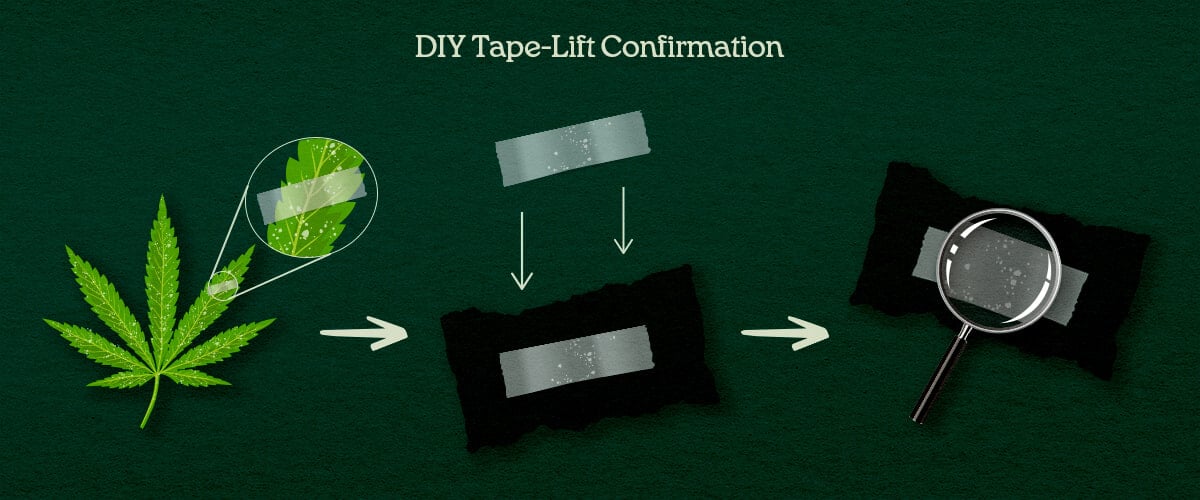
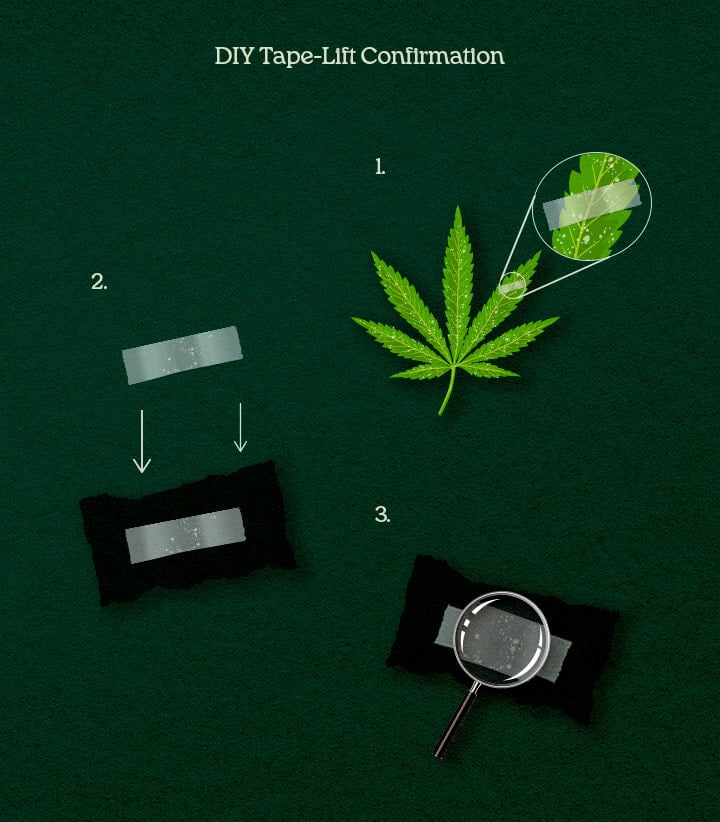
  1. Prepare: Gather a piece of clear tape, a dark piece of paper or card, and a hand lens.
  2. Collect sample: Carefully press the sticky side of the tape firmly onto the suspected patch of PM on a leaf or petiole.
  3. Mount sample: Gently peel the tape off the plant surface. Immediately stick the tape, sticky-side down, onto the dark piece of paper or card. The dark background will provide contrast, making the fungus easier to see.
  4. Observe: Hold the dark paper with the tape up to a light source. Take a close look with your lens. In cases of PM, you’ll see distinct, branched, thread-like fungal hyphae and potentially chains of oval-shaped conidia.
An illustration of a DIY tape-lift process on cannabis leaves for pest or mildew confirmation.

Why You Should Never Smoke Powdery Mildew-Infected Buds

But now to the question on many cannabis lovers' minds: can you still safely smoke cannabis nugs with powdery mildew, or are they destined for the bin? Find out why you should avoid them at all costs below.

Health Risks of Smoking Powdery Mildew

In severe cases of PM infection in weed, you just have to raise the white flag and come to terms with the loss. Smoking powdery mildew cannabis introduces fungal spores and mycelial fragments directly into the lungs. This can trigger serious respiratory issues, including asthma, bronchitis, and allergic reactions, and poses an extreme risk to health for immunocompromised individuals.

Salvage or Scrap?

While some growers attempt to “wash” or remove mildew from infected buds, complete eradication is almost impossible, making this procedure highly risky. Even if they appear clean, microscopic conidia can remain hidden and embedded in bracts. The safest approach for any powdery mildew nug is, unfortunately, to scrap it.

Prevention Blueprint: Stop Mildew on Cannabis Before It Starts

Treating powdery mildew can prove a challenge, especially in severe infections. As with all cannabis pests and diseases, prevention is better than a cure. Get familiar with key PM strategies below.

Environmental Targets

Maintaining precise environmental control is paramount to deter PM. Therefore, keep the conditions in your grow tent consistent in accordance with the stage of the growing cycle. Strive for a temperature range of 20–25°C, with relative humidity levels below 60% during veg and around 40–50% during flowering. Ensure ample airflow to prevent stagnant air where mildew thrives.

Integrated Pest Management Routine

Regularly inspect plants for the early signs of powdery mildew, making it part of your daily routine. Consider implementing companion plants, living mulch, and beneficial insects to increase biodiversity (which helps to combat disease). Regularly prepare and apply lactic acid bacteria and compost tea foliar sprays to keep your plant’s microbiome in check.

Resistant Genetics & Breeding Insight

Breeders have worked hard over the years to produce mold-resistant genetics, including varieties that display resilience against powdery mildew. Consider the following strains to bolster your crop against PM:

  • Shining Silver Haze: This progeny of Haze, Skunk, and Northern Light boasts superb mold resistance alongside 21% THC and tastes of citrus, earth, and pine.
  • Orion F1: Armed with hybrid vigour, this true F1 hybrid offers superb pest and diseases resistance and rarely falls prey to PM. You’ll also enjoy sky-high levels of THC and big yields indoors and outdoors.
  • Northern Light: An old-school classic known for its clear-headed and stoning effect, Northern Light also features impressive mold resistance that keeps it in tip-top shape, even in humid conditions.
  • Hyperion F1: Another tough true F1 hybrid, Hyperion F1’s hybrid vigour has primed her genetics to effectively fight off an array of diseases, offering excellent resistance to powdery mildew.

If you’re growing weed in humid climates, always consider growing disease-resistant genetics to save yourself lots of hassle during each growing cycle.

How to Get Rid of Powdery Mildew on Cannabis (3-Phase Cure)

Now, let's proceed with how to get rid of powdery mildew on cannabis. While effective, prevention doesn’t work 100% of the time. Plus, you might find yourself in the throes of an infection without previous knowledge of prevention techniques. In either case, you can use the approaches below to attempt to treat a PM infection.

Phase 1: Wipe & Isolate

Begin by gently wiping away any visible white powder using a damp paper towel. This physically captures and removes significant amounts of spores and hyphae. Immediately seal the paper towel in a plastic bag and place it in the bin to reduce the risk of spread.

Phase 2: Ventilate & Dry

Use additional fans or a dehumidifier to improve air circulation and reduce ambient humidity. Using a thermo-hygrometer, aim for a 10% drop in relative humidity within two hours.

Phase 3: Treat & Protect

During veg, several treatments are effective against powdery mildew. In more severe cases, consider applying neem oil as a foliar spray or a potassium bicarbonate solution to alkalise leaf surfaces.

When dealing with powdery mildew during flowering, gentler methods are essential to protect developing buds and avoid residual contamination. Hydrogen peroxide for powdery mildew during flowering, at a concentration of 3%, can be lightly misted onto affected areas. Apply this only with the lights off to prevent phytotoxicity. Treating cannabis powdery mildew with peroxide is a relatively safe and common tactic during the late flower phase.
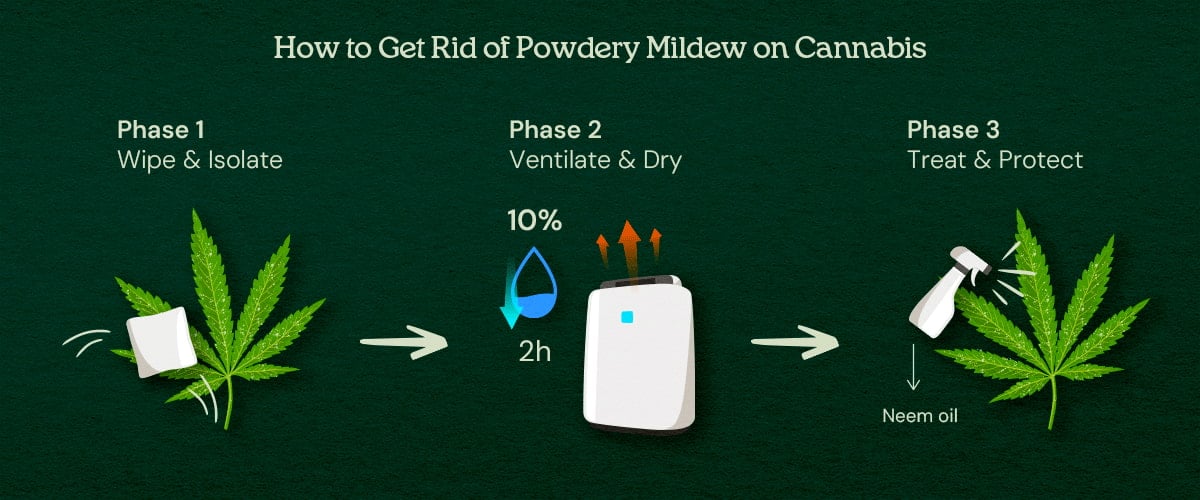
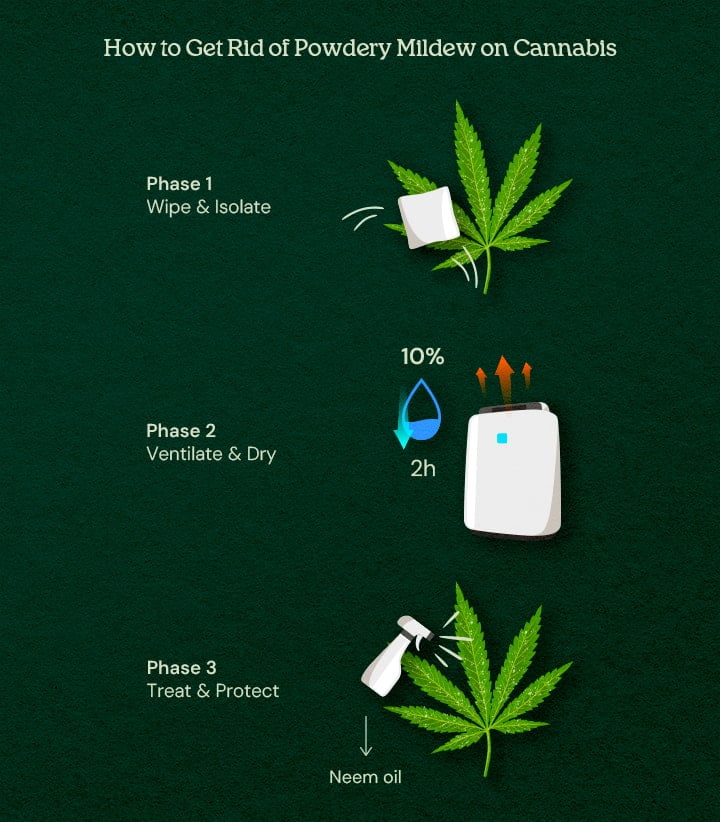
An illustration of cannabis leaves with powdery mildew, showing a 3-phase cure process including removal, treatment, and prevention, set against a neutral background.

After-Care Checklist

Observe your plants meticulously over the following week, using the checklist below to minimise reinfection:

  • Maintain a daily log of your RH readings
  • Perform a daily wipe test to check for spores
  • Remove any stressed or yellowing leaves that could become potential infection sites
  • Thoroughly clean your grow tent and stay on top of hygiene going forward

Best Sprays & Gadgets for PM Control

Various organic and chemical sprays exist to help growers swiftly take care of a powdery mildew infection. Let’s cover the organic options first:

  1. Oidioprot: This powdered mix combines proteins, vitamins, and beneficial microbes. Simply dilute 5 grams per litre of water and apply up to 10 days before harvest.
  2. Neem oil: This oil contains azadirachtin, which disrupts the fungal life cycle.
  3. Potassium bicarbonate: This acts by alkalising the leaf surface, creating an environment where powdery mildew cannot thrive.
  4. Bacillus subtilis: This beneficial bacterium works through competitive exclusion, occupying the leaf surface and outcompeting infectious fungi.

Chemical Last-Resorts (Systemics/Contact Fungicides)

Sometimes, organic controls don’t cut it. Chemical controls require extreme caution, but are useful in dire circumstances. Commonly allowed active ingredients include trifloxystrobin and myclobutanil. Always be aware of legal restrictions in your specific region and remember to adhere to strict harvest withholding periods to prevent ingesting harmful residues.

Technological Aids

UV-C handheld wands can be used for surface sterilisation, targeting and disrupting fungal DNA on grow room equipment. Ozone generators are also effective for sterilising unoccupied grow rooms by oxidising airborne spores and surface contaminants. However, both require strict safety precautions and are better reserved for regulated commercial operations.

Key Takeaways & Next Steps

To effectively manage powdery mildew, remember these three essential actions: detect early to catch infections before they spread, control your environment meticulously to inhibit fungal growth, and apply targeted powdery mildew treatments quickly at the first sign of trouble. Implement a weekly integrated pest management (IPM) log to track your observations and treatments. Now, go forth with your newfound knowledge and grow some high-quality, clean cannabis.


Frequently Asked Questions: Powdery Mildew Treatment Cannabis

Does hydrogen peroxide damage trichomes or cannabinoids?
When highly diluted and applied lightly, hydrogen peroxide poses minimal risk to trichomes or cannabinoid integrity.
Why does PM keep returning every grow cycle?
PM often recurs because of its resilient overwintering structures or dormant spores. Inadequate cleaning, insufficient air circulation, or inconsistent humidity all provide ideal conditions for the pathogen to linger.
Is milk spray effective?
Some growers find milk spray partially effective for PM due to its purported antimicrobial properties. However, it's generally less effective compared to commercially produced organic and chemical fungicides.
Can lowering the temperature alone stop PM?
Lowering the temperature alone won’t typically treat or prevent powdery mildew. Consistent low humidity and excellent air circulation are far more critical environmental factors to maintain.
Are UV lamps safe to use around people?
No, UV-C lamps are highly dangerous for direct human exposure. They emit germicidal radiation that can cause severe skin burns and eye damage. If using UV-C for sterilisation, ensure the area is completely unoccupied, and always wear appropriate personal protective equipment.
Disclaimer:
This content is for educational purposes only. The information provided is derived from research gathered from external sources.

Cookies settings

We are requesting your permission to use your data for the reasons stated below:

Functional cookies

Functional cookies help our website to function optimally and allow us to personalise certain features.

Preference cookies

Preference cookies allow us to remember information that influences the way our website looks, including your preferred language based on your region.

Analytical cookies

Analytical cookies give us insights into website traffic and customer behaviour, including how many people visit our site, how long they browse for, and which parts of our site they visit.

What are cookies?

Cookies are small pieces of data from a particular website that get stored on a user’s computer while they’re surfing the internet. Cookies have several different functions. Some of them track browser activity that enables businesses to deliver targeted advertisements. Other cookies serve to remember user login details to different websites to make jumping on social media, or other sites, a more fluid process. Because each cookie has its own unique ID, these pieces of data allow website owners to measure the unique traffic coming into their site.

Why do we use cookies?

Cookies come in handy when you visit our website. They ensure you stay logged in, that you can shop safely, and that the items you add to your cart stay there before you make a purchase. But cookies also help us. The data they provide allow us to improve our website and enable us to present you with targeted advertisements that are compatible with your interests.

What kind of cookies do we use?

Functional cookies

Functional cookies help our website to function optimally and allow us to personalise certain features.

Preference cookies

Preference cookies allow us to remember information that influences the way our website looks, including your preferred language based on your region.

Analytical cookies

Analytical cookies give us insights into website traffic and customer behaviour, including how many people visit our site, how long they browse for, and which parts of our site they visit.

How can I disable or delete cookies?

Not a fan of cookies? No worries. You can disable them (with the exception of necessary cookies) in your browser settings. However, blocking cookies may impact your browsing experience and prevent you from enjoying all of the technical features of our site.

Privacy Policy - Royal Queen Seeds

To ensure a safe online environment and guarantee adequate data protection, we strictly comply with all legal requirements. In this privacy statement, we provide information about how and for what purpose data is collected, safety measures, storage periods and contact details.


COMPANY NAME: SNORKEL SPAIN, SL (hereinafter ROYAL QUEEN SEEDS)

C/ Vilar d'Abdelà, 5 (nave 1) CP: 08170 de Montornès del Vallès

+34 937 379 846

[email protected]


The present Privacy Policy sets out the terms on which we will treat personal data at ROYAL QUEEN SEEDS; this includes any personal data collected through our website https://www.royalqueenseeds.com/ as well as any other data we process in the course of our business activities.

ROYAL QUEEN SEEDS collects the following personal data for the purposes listed below:

SECTION 1 – PERSONAL INFORMATION WE COLLECT

1.1 Account purchases

Account purchases can only be made if you are in possession of a personal account. When you create an account or purchase something from our shop, as part of the buying and selling process we collect the following personal information that you provide to us:

This information is required for delivery. In addition, when you browse our shop, we automatically receive the Internet Protocol (IP) address of your computer. Based on this information, we can optimise your online experience and at the same time protect our online environment.

Purpose of data collection

We collect and store account-related data for the following purposes:

(a) to carry out obligations arising from any contracts between you and us, and to provide you with information, products and services that you may request from us;

(b) to set up, manage and communicate with you about your account and your orders;

(c) to conduct market research and analysis;

(d) to confirm your age and identity, and to detect and prevent fraud.

1.2 Newsletters

With your explicit permission, we may send you newsletters about our shop, new products and other updates. We send newsletters based on your explicit consent. In the event that you purchase a product, and in accordance with current regulations, we may send you commercial communications in accordance with the legitimate interest of our company, always about products or services similar to those you have purchased or contracted. In any case, you may exercise your right of opposition through the channels announced in this Privacy Policy. The following information is collected in relation to the newsletter:

We do not need to know the sex of the person in order to send the newsletter (data minimisation: by law we must ask for data that is strictly necessary to provide the service, and in this case knowing the sex is not necessary to send the newsletter).

Purpose of data collection

The data collected is used to:

(a) personalise our emails, including your name and gender;

(b) provide gender-specific content.

You can withdraw your consent at any time by using the link provided in the newsletter or the contact information provided in section 2.

1.3 Customer service and contact form

In order to provide appropriate support, our customer service employees have access to information related to the account. Consequently, their support will be highly effective and friendly. The data provided in our contact form is used by our CRM provider, SuperOffice. We will only use your details to respond to your message.

SECTION 2 – LEGITIMATE INTEREST

If you have purchased any of our products, please note that we may process your personal data for promotional purposes, based on Royal Queen Seeds' legitimate interest only to offer you products or services from our company and about products or services similar to those you have purchased. You may exercise your right to opt out of future messages by the means set out in this Privacy Policy or through any notification you receive.

2.1 How do you withdraw consent?

If you change your mind, you can withdraw your consent for us to contact you for the purpose of collecting, using, or disclosing your data at any time by reaching out to us at: [email protected].

SECTION 3 – DISCLOSURE

We may disclose your personal information if we are required to do so by law or if you breach our Terms of Service.

SECTION 4 – HOW LONG DO WE KEEP YOUR DATA?

At Royal Queen Seeds, we will not retain your data for longer than is necessary for the purposes described in this Policy. Different retention periods apply for different types of data; however, the longest period we will normally hold any personal data is 10 years.

4.1 Account information

Data relating to the account remains relevant for as long as the consumer is in possession of an account. Therefore, the data remains documented for as long as the account exists. When our customers delete an account, the associated data will be deleted within a reasonable period of time. Requests regarding the inspection or correction of stored personal data or the deletion of an account can be sent to [email protected].

4.2 Newsletters

In the event that you give us your consent to inform you about our products or services, we will keep your data until you express your wish not to receive any further communications from us. However, we regularly (every month) carry out a relevance check. Registered customers (and their personal information) will be deleted whenever customers do not reply to our request. In addition, our newsletter mailing has an opt-out feature. Consumers can withdraw their consent by using this opt-out feature.

SECTION 5 – COOKIES

Cookies are small information files that notify your computer of previous interactions with our website. These cookies are stored on your hard drive, not on our website. Essentially, when you use our website, your computer displays its cookies to us, informing our site that you have visited before. This allows our website to function more quickly and remember aspects related to your previous visits (such as your username), making your experience more convenient. At Royal Queen Seeds, we use two types of cookies: functional and analytical.

5.1 Functional Cookies

Functional cookies are used to enhance your online experience. Among other things, these cookies track what is added to your shopping cart. The use of these cookies does not require prior authorization.

5.2 Analytical Cookies

Analytical cookies are used for research and market analysis. The data collected with these analytical cookies is anonymous, making it unusable for third parties. The use of these cookies does not require prior authorization.



SECTION 5 – THIRD-PARTY SERVICES

Third-party services are required to conduct transactions and provide our services. In general, the third-party providers we use will only collect, use and disclose your information to the extent necessary to enable them to perform the services they provide to us.

However, certain third-party service providers, such as payment gateways and other payment transaction processors, have their own privacy policies regarding the information we must provide to them for your transactions.

We encourage you to read the privacy policies of these providers so that you can understand how these providers will handle your personal information.

In particular, certain suppliers may be located or have facilities located in a different jurisdiction than yours or ours. Therefore, if you choose to proceed with a transaction involving the services of a third party, your information may be subject to the laws of the jurisdiction in which that service provider or its facilities are located.

Once you leave our website or are redirected to a third-party website or application, you are no longer governed by this Privacy Policy or the Terms of Service of our website.

Web analytics service (anonymous data)

On this website we have integrated an element of a web analytics service (with anonymisation functionality). Web analytics can be defined as the gathering, processing and analysis of data about the behaviour of visitors to websites. An analytics service collects, among other things, data about which website a person came from (the so-called referrer), which sub-pages they visited or how often and for how long they visited a sub-page. Web analytics is mainly used for website optimisation and for a cost–benefit analysis of internet advertising.

Courier service

To complete deliveries we use a courier service. This courier service carries out the delivery between our company and the consumer's home. To complete these logistics, the company requires access to the consumer's name and address information.

Mailing service

Royal Queen Seeds uses a third-party mail service provider to send its newsletter. This provider has access to limited account information related to opt-in consent (e.g. email address).

Marketing services

Royal Queen Seeds has the support of a company that specialises in marketing and communication activities. Their access to personal information is very limited and mostly anonymous.

Payment services

At Royal Queen Seeds we use external payment services to handle our transactions (e.g. credit card payments).

SECTION 6 – SECURITY

To protect your personal information, we take reasonable precautions and follow industry standard best practices to ensure that it is not inappropriately lost, misused, accessed, disclosed, altered or destroyed.

If you provide us with your credit card information, the information is encrypted using secure socket layer technology (SSL) and stored using AES-256 encryption. Although no method of transmission over the internet or electronic storage is 100% secure, we follow all PCI-DSS requirements and implement additional industry standards that are commonly accepted. Information related to the account is protected with a hashing method. This method transforms the information into a generated hash. As a result, confidential information is protected and invisible, even to us. In addition, our databases are exceptionally protected against unauthorised access. For example, access to the database is only possible and permitted via approved IP addresses (e.g. from Royal Queen Seeds headquarters). Other attempts and addresses are rejected at all times.

Furthermore, data is anonymised as much as possible, so it cannot be directly linked to a specific consumer. With this data, however, we may be able to carry out market research and analysis. In addition, the third parties concerned (e.g. mailing service) are examined prior to our collaboration, comply with the GDPR from the EU and receive a processing agreement. Within Royal Queen Seeds, employees are assigned different access permissions. Specific permission provides access only to information that is strictly required to perform a task. Digital security measures are subject to change and must meet high requirements to ensure the safety of online customers. That is why, at Royal Queen Seeds, we appoint a security officer. Regular verification and improvement of security measures (where necessary) are part of the role.

SECTION 7 – CHANGES TO THIS PRIVACY POLICY

We reserve the right to modify this Privacy Policy at any time, so please check back regularly. Changes and clarifications will be effective immediately upon being published on the Website. If we make substantial changes to this policy, we will notify you here that it has been updated so you will know what information we collect, how we use it and under what circumstances, if any, we use and/or disclose it.

SECTION 8 – YOU HAVE THE RIGHT TO: