By Luke Sumpter


Microbial biocontrols such as Trichoderma and Bacillus can suppress common cannabis pathogens, including powdery mildew, Botrytis, and Fusarium. They are most effective when matched to the target, applied early, and delivered consistently through soil drenches and foliar sprays. The best results are achieved when these inputs are paired with a holistic integrated pest management (IPM) plan that utilises environmental control, sanitation, and consistent reapplication.

Whether you grow indoors or outdoors, cannabis plants are susceptible to a host of health issues, from nutrient deficiencies and pest infestations to microbial infections. Amongst all these threats, fungal pathogens are some of the most serious, potentially contaminating entire harvests and wiping out plants altogether.

Given their potentially devastating effects, many growers opt to use harsh chemicals to protect their plants from pathogens like powdery mildew, Botrytis, and Fusarium. However, some cultivators are also turning to organic and eco-friendly methods to maintain the health and productivity of their crops. When used correctly, organic pest control for cannabis helps keep these dreaded fungal diseases at bay.

Below, we’ll explore microbial biocontrols and how they can help to manage fungal pathogens in cannabis. Get to know your top microbial allies below!

Key Takeaways

  • Fungal pathogens like Botrytis, Fusarium, and powdery mildew are major threats to cannabis and can destroy entire harvests.
  • Beneficial microbes, including Trichoderma, Bacillus, and endophytes, can prevent and combat these fungal infections naturally.
  • Microbial biocontrols are most effective when tailored to specific pathogens and applied strategically via soil amendments or foliar sprays.
  • Integrated pest management combines microbes, environmental controls, and sanitation to ensure sustainable, chemical-free cannabis cultivation.

What Are Microbial Biocontrol Agents?

Biological pest control for cannabis doesn’t only involve the cultivation of companion plant species and the deployment of beneficial predatory insects. This holistic strategy also includes administering different strains of fungi and bacteria that help to prevent and combat common cannabis diseases on the cellular level.

Advances in microbiology have shown that all organisms rely on healthy and diverse communities of microbes to assimilate nutrients and fight off diseases. This applies to the gut and skin of humans as it does to the foliage, roots, and internal tissue of plants, including cannabis.

Through the application of beneficial microbes, growers can both prevent fungal infections and fight them when they occur. Some key microbial allies in the cannabis garden and grow room include:

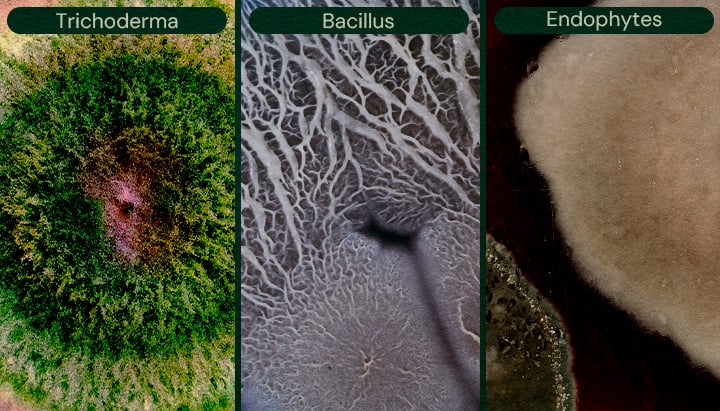
  • Trichoderma: Present in all soils, fungi of the Trichoderma genus form mutualistic relationships with many plants, entering their tissues and helping to fight off common root pathogens.
  • Bacillus species: Bacillus is a species of beneficial rhizobacteria that helps to suppress pathogens and pests while boosting nutrient availability by decomposing organic matter.
  • Endophytes: A range of different endophytes live within cannabis leaves, roots, and seeds. They’re known to produce antifungal and antibacterial compounds as well as improve a plant’s stress tolerance.
Image showcasing Trichoderma, Bacillus, and Endophytes as microbial biocontrol agents for cannabis, aiding in pest control and disease prevention.

Common Fungal Pathogens in Cannabis

When learning how to prevent mold in cannabis, it certainly helps to get familiar with the beneficial microbes mentioned above. However, it’s just as important to know your enemy; a combined knowledge of both the good guys and bad guys will help you make informed and effective pest control decisions.

Of all the fungal pathogens that infect cannabis plants, Botrytis, Fusarium, and powdery mildew are amongst both the most common and the most serious.

Botrytis (Bud Rot)

Botrytis cinerea, often called bud rot, is a necrotrophic fungus that thrives in humid, poorly-ventilated conditions. It tends to strike cannabis plants during late flowering when dense buds create microenvironments with trapped moisture.

Botrytis’ life cycle begins with airborne conidia (asexual spores) that land on plant tissue and germinate when surface humidity is high. Hyphae then penetrate the leaves and release enzymes that kill the host’s cells. Ultimately, this infection manifests as a fuzzy, gray mold that coats cannabis flowers and has the potential to spoil entire harvests.

Fusarium

Fusarium species, particularly F. oxysporum and F. solani, are soil-borne fungi that cause wilt, root rot, and stem cankers in cannabis. Their life cycle starts with chlamydospores or macroconidia that form in soil or infected dead plant matter and germinate when they detect root exudates (organic compounds released into the soil from live roots).

Fusarium hyphae enter roots through wounds or natural openings and then colonise vascular tissues. Once inside a plant’s xylem, Fusarium produces microconidia that move upward with the plant’s flow of water, spreading the infection systemically. The symptoms of Fusarium-caused disease include vascular browning, chlorosis (yellowing foliage), wilting, stunted growth, and even plant death.

Powdery Mildew

Powdery mildew in cannabis is most often caused by Golovinomyces cichoracearum or related species; obligate biotrophic fungi that penetrate cannabis leaves and buds, feeding on the nutrients they contain.

To reproduce, powdery mildew covers its hosts in fine, white spores that have a powdery appearance. In severe cases, this layer of spores can block photosynthesis and contaminate mature flowers.

How Microbes Combat Fungal Pathogens

Agriculture is facing a crisis. Ever since the Green Revolution, the over-application of chemical fertilisers and synthetic pesticides, herbicides, and fungicides has caused great damage to soils across the world and the microbial communities that are key to their fertility.

Because of this, researchers are exploring both new and old ways to grow plants, including cannabis, organically. Advances in this area have discovered the crucial role of microbes that live not only in the soil, but in and on plants, too.

The authors of a 2025 paper[1] published in BMC Plant Biology found that “the phyllosphere, which includes the surfaces of plant leaves and stems, is one of the largest and most diverse microbial habitats on Earth, yet it remains understudied in plant-microbe interactions.”

This complex and yet untapped community of life likely plays a critical role in plant diseases. Instead of simply spraying the entire community with noxious chemicals, the use of microbial biocontrols works more naturally and selectively.

These microbes not only directly fight disease themselves, but also help plants become stronger in the face of pathogens. For example, Trichoderma produces antimicrobial compounds, but also makes plants more capable of repelling diseases by reducing stress, boosting nutrient uptake, and increasing photosynthesis.

Choosing the Right Microbial Products

In order to tweak the phyllo- or rhizosphere (root zone) properly, you need to consider both the pathogen you’re fighting and the properties of the cannabis biocontrol you’re thinking of applying. The most common biocontrol products for cannabis mold defense include:

  • Trichoderma: Excels in suppressing root pathogens like Fusarium and Pythium. Supports overall plant health in terms of growth, yield, and stress reduction.
  • Bacillus subtilis: Produces lipopeptides that disrupt fungal cell membranes and compete for space and nutrients. Primarily targets powdery mildew and Botrytis.
  • Lactic acid bacteria: Produce lactic acid, lowering pH on plant surfaces to inhibit pathogen germination. Effective against powdery mildew. However, Oidioprot serves as a more well-rounded and more effective solution.
  • Chaetomium species: Produce potent antifungal metabolites such as chaetoglobosins and cellulases that degrade pathogen cell walls. They work well against Botrytis, powdery mildew, and Fusarium.

Application Methods and Best Practices

So, how exactly should you go about using Trichoderma to control Botrytis bud rot in cannabis? Or how should you deploy lactic acid bacteria against powdery mildew? Check out the following application methods for the best results.

Soil Amendment

Incorporating microbial biocontrols directly into the soil creates a protective barrier around the root system, the primary entry point for many fungal pathogens. Trichoderma and certain Bacillus species can establish themselves in the rhizosphere, competing with and directly antagonising soil-borne threats like Fusarium. In terms of prevention, the goal is to achieve early colonisation ahead of pathogens. Mix powders into your initial growing medium, apply liquid drenches early in the vegetative phase, and reapply regularly throughout the growing cycle.

Foliar Sprays

Foliar application is particularly effective against pathogens that colonise leaf surfaces, as it administers beneficial microbes exactly where they’re needed. Bacillus subtilis sprays form a living shield on plant surfaces, releasing antifungal compounds and occupying infection sites. Likewise, lactic acid bacteria are effective when applied to infected leaves, where they immediately begin producing lactic acid.

For the best results, foliar sprays should be applied during early mornings or evenings to minimise UV degradation and ensure prolonged leaf surface moisture. They’re best deployed against powdery mildew, Botrytis, and other pathogens that colonise aerial plant parts.

Hydroponic Compatibility

Hydroponic growing operations present unique challenges for microbial biocontrol due to constant or near-constant nutrient flow, sterilisation protocols, and low organic matter levels. Not all beneficial microbes thrive in these environments, but certain strains of Bacillus and Trichoderma are formulated for hydroponic use and can colonise root surfaces even when they’re suspended in nutrient solutions. Likewise, foliar sprays are also effective in hydroponic setups.

Preventative Care & Integrated Management

Effective fungal disease prevention in cannabis comes from more than simply applying microbial products; it requires a fully integrated pest management (IPM) plan where beneficial organisms work alongside cultural, environmental, and sanitation measures. This combined approach includes:

  • Environmental optimisation: Keeping relative humidity within the right range helps reduce the germination of Botrytis, powdery mildew, and Fusarium spores. Constant air circulation also prevents stagnant “hot pockets” in dense canopies.
  • Sanitation and crop hygiene: Cleanliness is a cornerstone of any IPM strategy. Disinfect tools between use in different grow rooms or areas of the garden, and regularly clean your grow tents between cycles. In hydro systems, frequently sanitise your reservoirs.
  • Nutrient and soil health management: Balanced nutrition supports stronger immune responses, making cannabis less susceptible to infections. In living soil setups, maintaining organic matter and microbial diversity ensures long-term suppression of harmful organisms through competitive exclusion.

Microbial Biocontrol in Practice

Successful cannabis cultivation demands both knowledge and adaptability, especially in the face of fungal infections. By understanding pathogens, harnessing beneficial microbes, and integrating cultural and environmental controls, growers can support the health of their plants and maximise their yields without over-reliance on chemicals.

Evidence-based strategies, refined through personal experience, create resilient, sustainable growth systems capable of thriving even under unique challenges and scenarios. Incorporating microbes into your grow won’t just help to protect your plants against infections; it promises to enhance their soil fertility, support their overall health, and even increase the size and quality of their yields.


Disclaimer:
This content is for educational purposes only. The information provided is derived from research gathered from external sources.

Cookies settings

We are requesting your permission to use your data for the reasons stated below:

Functional cookies

Functional cookies help our website to function optimally and allow us to personalise certain features.

Preference cookies

Preference cookies allow us to remember information that influences the way our website looks, including your preferred language based on your region.

Analytical cookies

Analytical cookies give us insights into website traffic and customer behaviour, including how many people visit our site, how long they browse for, and which parts of our site they visit.

What are cookies?

Cookies are small pieces of data from a particular website that get stored on a user’s computer while they’re surfing the internet. Cookies have several different functions. Some of them track browser activity that enables businesses to deliver targeted advertisements. Other cookies serve to remember user login details to different websites to make jumping on social media, or other sites, a more fluid process. Because each cookie has its own unique ID, these pieces of data allow website owners to measure the unique traffic coming into their site.

Why do we use cookies?

Cookies come in handy when you visit our website. They ensure you stay logged in, that you can shop safely, and that the items you add to your cart stay there before you make a purchase. But cookies also help us. The data they provide allow us to improve our website and enable us to present you with targeted advertisements that are compatible with your interests.

What kind of cookies do we use?

Functional cookies

Functional cookies help our website to function optimally and allow us to personalise certain features.

Preference cookies

Preference cookies allow us to remember information that influences the way our website looks, including your preferred language based on your region.

Analytical cookies

Analytical cookies give us insights into website traffic and customer behaviour, including how many people visit our site, how long they browse for, and which parts of our site they visit.

How can I disable or delete cookies?

Not a fan of cookies? No worries. You can disable them (with the exception of necessary cookies) in your browser settings. However, blocking cookies may impact your browsing experience and prevent you from enjoying all of the technical features of our site.

Privacy Policy - Royal Queen Seeds

To ensure a safe online environment and guarantee adequate data protection, we strictly comply with all legal requirements. In this privacy statement, we provide information about how and for what purpose data is collected, safety measures, storage periods and contact details.


COMPANY NAME: SNORKEL SPAIN, SL (hereinafter ROYAL QUEEN SEEDS)

C/ Vilar d'Abdelà, 5 (nave 1) CP: 08170 de Montornès del Vallès

+34 937 379 846

[email protected]


The present Privacy Policy sets out the terms on which we will treat personal data at ROYAL QUEEN SEEDS; this includes any personal data collected through our website https://www.royalqueenseeds.com/ as well as any other data we process in the course of our business activities.

ROYAL QUEEN SEEDS collects the following personal data for the purposes listed below:

SECTION 1 – PERSONAL INFORMATION WE COLLECT

1.1 Account purchases

Account purchases can only be made if you are in possession of a personal account. When you create an account or purchase something from our shop, as part of the buying and selling process we collect the following personal information that you provide to us:

This information is required for delivery. In addition, when you browse our shop, we automatically receive the Internet Protocol (IP) address of your computer. Based on this information, we can optimise your online experience and at the same time protect our online environment.

Purpose of data collection

We collect and store account-related data for the following purposes:

(a) to carry out obligations arising from any contracts between you and us, and to provide you with information, products and services that you may request from us;

(b) to set up, manage and communicate with you about your account and your orders;

(c) to conduct market research and analysis;

(d) to confirm your age and identity, and to detect and prevent fraud.

1.2 Newsletters

With your explicit permission, we may send you newsletters about our shop, new products and other updates. We send newsletters based on your explicit consent. In the event that you purchase a product, and in accordance with current regulations, we may send you commercial communications in accordance with the legitimate interest of our company, always about products or services similar to those you have purchased or contracted. In any case, you may exercise your right of opposition through the channels announced in this Privacy Policy. The following information is collected in relation to the newsletter:

We do not need to know the sex of the person in order to send the newsletter (data minimisation: by law we must ask for data that is strictly necessary to provide the service, and in this case knowing the sex is not necessary to send the newsletter).

Purpose of data collection

The data collected is used to:

(a) personalise our emails, including your name and gender;

(b) provide gender-specific content.

You can withdraw your consent at any time by using the link provided in the newsletter or the contact information provided in section 2.

1.3 Customer service and contact form

In order to provide appropriate support, our customer service employees have access to information related to the account. Consequently, their support will be highly effective and friendly. The data provided in our contact form is used by our CRM provider, SuperOffice. We will only use your details to respond to your message.

SECTION 2 – LEGITIMATE INTEREST

If you have purchased any of our products, please note that we may process your personal data for promotional purposes, based on Royal Queen Seeds' legitimate interest only to offer you products or services from our company and about products or services similar to those you have purchased. You may exercise your right to opt out of future messages by the means set out in this Privacy Policy or through any notification you receive.

2.1 How do you withdraw consent?

If you change your mind, you can withdraw your consent for us to contact you for the purpose of collecting, using, or disclosing your data at any time by reaching out to us at: [email protected].

SECTION 3 – DISCLOSURE

We may disclose your personal information if we are required to do so by law or if you breach our Terms of Service.

SECTION 4 – HOW LONG DO WE KEEP YOUR DATA?

At Royal Queen Seeds, we will not retain your data for longer than is necessary for the purposes described in this Policy. Different retention periods apply for different types of data; however, the longest period we will normally hold any personal data is 10 years.

4.1 Account information

Data relating to the account remains relevant for as long as the consumer is in possession of an account. Therefore, the data remains documented for as long as the account exists. When our customers delete an account, the associated data will be deleted within a reasonable period of time. Requests regarding the inspection or correction of stored personal data or the deletion of an account can be sent to [email protected].

4.2 Newsletters

In the event that you give us your consent to inform you about our products or services, we will keep your data until you express your wish not to receive any further communications from us. However, we regularly (every month) carry out a relevance check. Registered customers (and their personal information) will be deleted whenever customers do not reply to our request. In addition, our newsletter mailing has an opt-out feature. Consumers can withdraw their consent by using this opt-out feature.

SECTION 5 – COOKIES

Cookies are small information files that notify your computer of previous interactions with our website. These cookies are stored on your hard drive, not on our website. Essentially, when you use our website, your computer displays its cookies to us, informing our site that you have visited before. This allows our website to function more quickly and remember aspects related to your previous visits (such as your username), making your experience more convenient. At Royal Queen Seeds, we use two types of cookies: functional and analytical.

5.1 Functional Cookies

Functional cookies are used to enhance your online experience. Among other things, these cookies track what is added to your shopping cart. The use of these cookies does not require prior authorization.

5.2 Analytical Cookies

Analytical cookies are used for research and market analysis. The data collected with these analytical cookies is anonymous, making it unusable for third parties. The use of these cookies does not require prior authorization.

SECTION 5 – THIRD-PARTY SERVICES

Third-party services are required to conduct transactions and provide our services. In general, the third-party providers we use will only collect, use and disclose your information to the extent necessary to enable them to perform the services they provide to us.

However, certain third-party service providers, such as payment gateways and other payment transaction processors, have their own privacy policies regarding the information we must provide to them for your transactions.

We encourage you to read the privacy policies of these providers so that you can understand how these providers will handle your personal information.

In particular, certain suppliers may be located or have facilities located in a different jurisdiction than yours or ours. Therefore, if you choose to proceed with a transaction involving the services of a third party, your information may be subject to the laws of the jurisdiction in which that service provider or its facilities are located.

Once you leave our website or are redirected to a third-party website or application, you are no longer governed by this Privacy Policy or the Terms of Service of our website.

Web analytics service (anonymous data)

On this website we have integrated an element of a web analytics service (with anonymisation functionality). Web analytics can be defined as the gathering, processing and analysis of data about the behaviour of visitors to websites. An analytics service collects, among other things, data about which website a person came from (the so-called referrer), which sub-pages they visited or how often and for how long they visited a sub-page. Web analytics is mainly used for website optimisation and for a cost–benefit analysis of internet advertising.

Courier service

To complete deliveries we use a courier service. This courier service carries out the delivery between our company and the consumer's home. To complete these logistics, the company requires access to the consumer's name and address information.

Mailing service

Royal Queen Seeds uses a third-party mail service provider to send its newsletter. This provider has access to limited account information related to opt-in consent (e.g. email address).

Marketing services

Royal Queen Seeds has the support of a company that specialises in marketing and communication activities. Their access to personal information is very limited and mostly anonymous.

Payment services

At Royal Queen Seeds we use external payment services to handle our transactions (e.g. credit card payments).

SECTION 6 – SECURITY

To protect your personal information, we take reasonable precautions and follow industry standard best practices to ensure that it is not inappropriately lost, misused, accessed, disclosed, altered or destroyed.

If you provide us with your credit card information, the information is encrypted using secure socket layer technology (SSL) and stored using AES-256 encryption. Although no method of transmission over the internet or electronic storage is 100% secure, we follow all PCI-DSS requirements and implement additional industry standards that are commonly accepted. Information related to the account is protected with a hashing method. This method transforms the information into a generated hash. As a result, confidential information is protected and invisible, even to us. In addition, our databases are exceptionally protected against unauthorised access. For example, access to the database is only possible and permitted via approved IP addresses (e.g. from Royal Queen Seeds headquarters). Other attempts and addresses are rejected at all times.

Furthermore, data is anonymised as much as possible, so it cannot be directly linked to a specific consumer. With this data, however, we may be able to carry out market research and analysis. In addition, the third parties concerned (e.g. mailing service) are examined prior to our collaboration, comply with the GDPR from the EU and receive a processing agreement. Within Royal Queen Seeds, employees are assigned different access permissions. Specific permission provides access only to information that is strictly required to perform a task. Digital security measures are subject to change and must meet high requirements to ensure the safety of online customers. That is why, at Royal Queen Seeds, we appoint a security officer. Regular verification and improvement of security measures (where necessary) are part of the role.

SECTION 7 – CHANGES TO THIS PRIVACY POLICY

We reserve the right to modify this Privacy Policy at any time, so please check back regularly. Changes and clarifications will be effective immediately upon being published on the Website. If we make substantial changes to this policy, we will notify you here that it has been updated so you will know what information we collect, how we use it and under what circumstances, if any, we use and/or disclose it.

SECTION 8 – YOU HAVE THE RIGHT TO: