By Max Sargent


In 2023, researchers in Israel confirmed[1] that Cannabis sativa can be infected by cucurbit chlorotic yellow virus (CCYV) under controlled conditions. Using whiteflies as a vector, the virus was successfully transmitted to cannabis plants, which then developed chlorotic yellowing and other characteristic symptoms typically seen in infected cucurbits. While this was not a commercial outbreak, the study proved that cannabis is a viable host for CCYV, raising concerns for growers in regions where whitefly pressure is high.

CCYV is not a household name among cannabis producers, but perhaps it should be. Initially a threat to cucurbit vegetables like cucumbers and melons, it has crossed into new host species and now poses a growing danger to commercial cannabis growers. The virus is especially problematic in high-density growing environments, where even a small outbreak can result in large economic losses. Understanding how CCYV infects plants, recognising its symptoms, and adopting proactive strategies, however, can make all the difference.


What is Cucurbit Chlorotic Yellow Virus (CCYV)?

Cannabis plant with test tube and question mark on green background, exploring CCYV virus.

Cucurbit chlorotic yellow virus (CCYV) is a member of the genus Crinivirus in the Closteroviridae family. These are single-stranded, positive-sense RNA viruses known for causing chlorotic disorders in host plants.

CCYV was first described in Japan in the early 2000s after it affected melon crops. It has since been detected across Asia, the Middle East, southern Europe, and the Americas. Although initially limited to cucurbit crops, recent studies have shown that CCYV can infect a broader range of plant species under the right environmental conditions. In cannabis, the presence of CCYV is not widespread, but the potential for rapid expansion exists.

CCYV is particularly insidious because it often evades early detection. Infected plants may appear healthy for several days to weeks before symptoms emerge, during which time the virus can spread via its primary vector—the silverleaf whitefly (Bemisia tabaci).

What makes CCYV particularly dangerous is its adaptation to greenhouse ecosystems, where pest populations can thrive year-round. The virus itself is not mechanically transmitted—instead it relies entirely on whitefly vectors for movement. Once acquired by the insect, the virus remains within the whitefly’s foregut, from where it can be passed onto new plants during feeding. While not circulative or replicative in these insects, whiteflies can retain the virus long enough for it to efficiently spread across a crop.

Unlike airborne pathogens, CCYV cannot move from plant to plant on its own—it needs a carrier. This dependency gives growers a potential weak point to exploit for control, namely proper whitefly management.

How CCYV affects weed and cannabis crops

Cannabis is not a traditional host for CCYV, but experimental infection studies now confirm that the plant is susceptible to it under certain conditions. This includes genetic factors, plant stress, and vector exposure. Because cannabis cultivation often involves intensive practices such as cloning and monoculture planting, it creates the ideal conditions for viral proliferation if proper checks are not in place.

CCYV can reduce the vitality of cannabis plants[2] in multiple ways. First and foremost, it interferes with chlorophyll production and distribution, which limits the plant's ability to photosynthesise. This results in slower growth, poor nutrient uptake, and vulnerability to other opportunistic pathogens. In flowering plants, CCYV may also reduce trichome production, affecting both potency and visual appeal.

Symptoms of Cucurbit Chlorotic Yellow Virus

The challenge with CCYV is that its symptoms can mimic several common issues in cannabis, including nitrogen deficiency, overwatering, and heat stress. That means it often goes undiagnosed until whitefly infestations or systemic patterns raise suspicion.

Key symptoms of CCYV in cannabis include:

  • Interveinal yellowing (chlorosis): This is the hallmark of CCYV infection. It usually starts on older leaves but can spread rapidly through the canopy.
  • Leaf curling and brittleness: Leaves may curl upwards or downwards and become more fragile over time.
  • Weakened stems: CCYV can interfere with cell wall development, resulting in stems that are more prone to bending or snapping.
  • Flower and bud abnormalities: Affected cannabis plants often produce misshapen, undersized, or underdeveloped flowers with poor resin production.
  • Patchy leaf death: Necrotic spots may form on mature leaves in later stages of infection.
  • General decline in vigour: Growth slows, branches become sparse, and the plant’s overall development becomes stunted.

CCYV symptoms may develop slowly at first, particularly in cool or low-light conditions. However, once the infection takes hold, there is nothing that can be done to counter it.


Three potted cannabis plants showing CCYV symptoms with yellowing and curling leaves on green background.

How CCYV spreads among cannabis crops

The spread of CCYV is directly tied to the behaviour of the whitefly—a common cannabis pest that poses many threats to a healthy cannabis crop, including:

  • Virus acquisition and retention: A whitefly needs only 30–60 minutes of feeding on an infected plant to acquire the CCYV virus. Once acquired, the virus remains in the insect’s foregut for up to 48 hours—plenty of time to infect multiple plants.
  • Rapid population growth: Under optimal conditions (25–30 °C with moderate humidity), whitefly populations can double every 5-7 days.
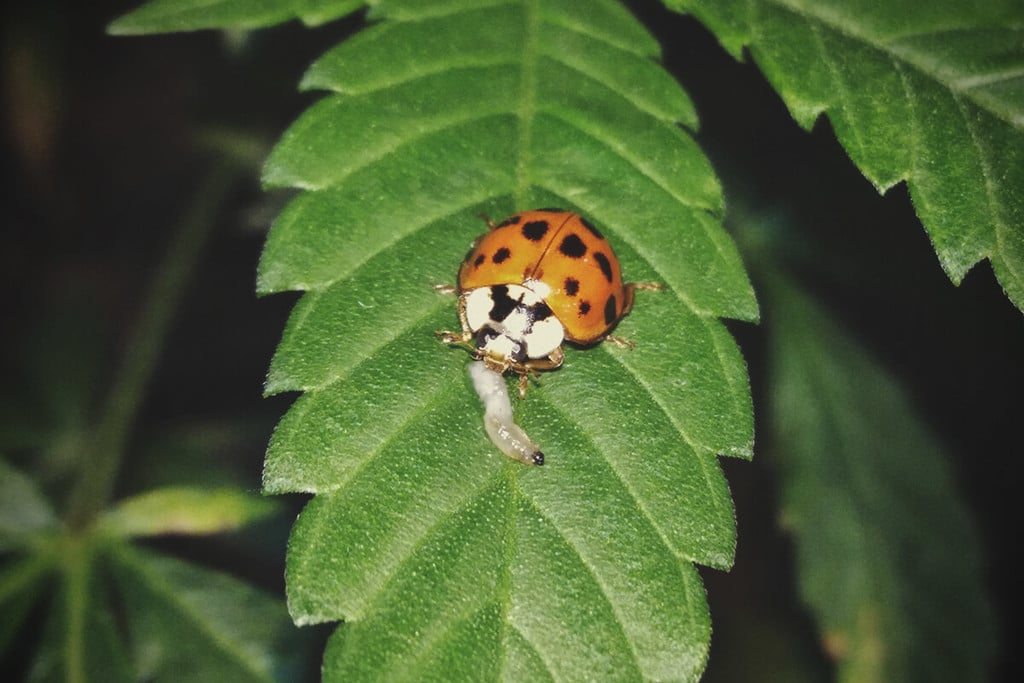
  • Limited natural control indoors: Without natural predators such as ladybirds or parasitic wasps, indoor environments can easily become breeding grounds for unchecked whitefly colonies.
  • High mobility: Whiteflies can travel several metres per day, especially if disturbed. This allows them to move quickly through grow spaces and spread diseases to multiple plants.

Note that CCYV is not seed-borne and cannot spread through pollen or leaf contact. However, human activity can indirectly aid its transmission. Contaminated gloves or tools that came into contact with an infected plant’s sap, for example, can transmit the virus to.

Moreover, infected clones can transmit the virus, especially when moved around or between facilities. Interacting with infected cucurbits nearby can also increase the risk of spreading the virus to your cannabis crop.

Environmental conditions also play a major role in the spread of CCYV. High humidity and poor ventilation both favor the reproduction of whiteflies and the stability of the virus. Once a few whiteflies enter a grow room, they can potentially spread CCYV to every plant within reach very quickly.


The economic and agricultural impact on weed growers

Cannabis grower with test tube, coins, and downward red graph on green background, showing economic impact.

For commercial cannabis cultivators, CCYV could become a serious problem. Growers often operate on tight margins and under strict regulatory oversight. A viral outbreak can compromise product quality, delay harvest timelines, and lead to the destruction of an entire harvest.

The key economic impacts of CCYV on cannabis include:

  • Loss of yield: Studies show that CCYV can reduce total plant biomass by up to 50% in affected cucurbits. Early reports in cannabis suggest a similar figure, particularly in larger operations where virus or pest containment is delayed.
  • Reduced THC and terpene levels: Flowering cannabis plants infected with CCYV may produce less resin, resulting in a final product with fewer cannabinoids and terpenes and, consequently, of considerably lower value.
  • Diagnostic and containment costs: Identifying CCYV often requires lab testing, which can be costly, especially if used to screen multiple plants.
  • Pesticide and biological control costs: Frequently spraying plants or releasing beneficial whitefly predators into a grow space can raise operational costs and reduce profitability while damaging the local environment.
  • Reputational damage: Poor-quality buds that reach consumers can undermine brand trust and lead to a drop in future orders or dispensary contracts.

How to prevent and manage CCYV in weed crops

Cannabis plant with protective shield and test tubes on green background, illustrating CCYV prevention in weed crops.

CCYV can’t be cured—so a cannabis grower’s best offense against it are preventative strategies, as well as the efficient treatment of infected plants to help minimise any further spread of the virus.

The goal when preventing CCYV in cannabis is to remove infected plant material, control vectors, and strengthen prevention moving forward. Prevention, in particular, needs to be a layered process that combines mechanical, chemical, and biological methods.

CCYV prevention strategies

Effective CCYV prevention begins before planting and continues throughout the crop cycle:

  • Start with clean stock: Always source clones or seeds from trusted, certified suppliers. Avoid acquiring plants from operations that grow both cannabis and vegetables unless they maintain strict separation protocols.
  • Isolate and observe new plants: Quarantine all new arrivals for 10–14 days in a separate space. Monitor for whiteflies or unusual leaf discoloration.
  • Disinfect tools and surfaces: Use bleach or hydrogen peroxide solutions to sterilise trimming scissors, and irrigation equipment between uses. Replace disposable gloves regularly.
  • Seal your environment: Ensure that vents are screened with 150-micron mesh or finer. Use positive air pressure to prevent outdoor insects from being drawn into your grow space.
  • Install airlocks and sticky barriers: Antechambers or airlocks between rooms reduce the chance of pest movement. Sticky mats and adhesive panels can help trap whiteflies before they reach plants.
  • Avoid planting cannabis near cucurbits: When growing outdoors or in polyculture settings, avoid placing cannabis near squash, cucumber, or melon plants that can harbour CCYV or attract whiteflies.
  • Introduce natural predators: Use beneficial insects such as ladybirds (ladybugs) to help control early whitefly populations. These predators can reduce the need for chemical treatments and support long-term biological control.

Routine hygiene practices can also minimise the introduction of whiteflies into your cannabis growing space. Remember to:

  • Use separate uniforms for each growing room or disinfection processes before entry.
  • Implement pest scouting logs with routine leaf inspections.
  • Schedule weekly whitefly monitoring into your operation.
  • Rotate biological controls (predators, parasitoids) to prevent resistance.

Treatment options for CCYV-infected cannabis plants

Once CCYV is detected, act quickly. Your treatment plan should focus on removing infected material and eliminating vector populations safely and quickly.

  • Remove symptomatic plants: Pull up and seal infected plants in heavy-duty bags. Burn them if local laws allow it, otherwise dispose of them in sealed bins. Alternatively, move infected plants to an isolated grow space and push them to harvest to cut your losses. Never compost plants that you expect have been infected with CCYV or any other pest/pathogen.
  • Apply targeted insecticides: Insect growth regulators (IGRs) and horticultural oils can suppress whiteflies.
  • Deploy biological controls: Encarsia formosa and Eretmocerus eremicus, for example, are predatory wasp species that are extremely effective at managing whiteflies.
  • Use reflective mulches: In greenhouses and outdoor beds, silver or UV-reflective mulches can deter whiteflies.
  • Apply UV-blocking films: Covering greenhouse windows with UV-absorbing plastics reduces whitefly navigation and viral spread.

In heavily-infested rooms, it may be worth halting operations and performing a complete cleanout:

  • Remove all plant material and organic waste.
  • Fog the space with insecticidal agents.
  • Clean all surfaces, ducts, and tools.
  • Allow downtime between your next growing cycle for any remaining vector populations to collapse.

The role of whiteflies in CCYV transmission

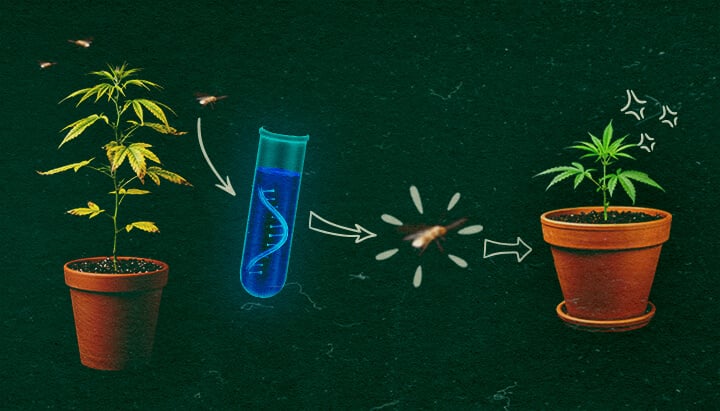
Cannabis plants with test tube and whiteflies on green background, depicting CCYV transmission process.

Whiteflies are essential to the transmission of CCYV. Their biology makes them uniquely effective at spreading the virus:

  • Feeding behaviour: Whiteflies feed by piercing leaf tissue and sucking out sap. During this process, they can introduce CCYV from their foregut into plant phloem.
  • Fast reproductive rate and growth: A single female whitefly can lay over 300 eggs in her lifetime, usually on the underside of leaves. Whitefly eggs can develop into adult flies in just 18 days.
  • Host range: Whiteflies feed on hundreds of plant species, including many weeds, making them extremely hard to control —especially outdoors.

To effectively disrupt CCYV transmission, whitefly control must be constant and proactive. Be sure to:

  • Monitor egg and nymph stages, not just adults.
  • Use entomopathogenic fungi such as Isaria fumosorosea and Beauveria bassiana to prevent larvae growth.
  • Avoid using broad-spectrum insecticides that kill beneficial insects.
  • Use sticky traps to gauge population trends—not as a standalone control.
  • Implement netting and double-door systems in greenhouses.

The sooner whiteflies are identified and controlled, the less chance CCYV has to establish itself in your cannabis garden.

Future outlook: Will CCYV continue to threaten weed cultivation?

Given the global spread of CCYV and increasing cannabis legalisation, it is highly likely that this virus will become a more prominent threat to cannabis grows. Climate trends also favor longer whitefly activity windows, particularly in temperate regions. Finally, increases in protected cropping systems mean that more environments can become conducive to year-round insect pressure.

Luckily, emerging solutions offer some hope against CCYV transmission in cannabis grows. First and foremost, cannabis breeders are consistently producing cultivars with increased resistance to viral pathogens. Moreover, AI and automation promise to revolutionise pest management. As cannabis becomes a global commodity, stricter controls are also being put in place to restrict plant movement and cultivation standards, which may minimise CCYV infestations. Finally, advanced agricultural testing may also allow for faster detection of viral RNA in crops, including cannabis.

For now, CCYV is a known threat with no magic bullet. Fortunately, while the virus has been shown to be able to infect cannabis, it hasn’t yet done so naturally, meaning it’s not a pressing problem. However, it could soon become one, so vigilance and knowledge are crucial for protecting your crop.


Disclaimer:
This content is for educational purposes only. The information provided is derived from research gathered from external sources.
Cookies settings

We are requesting your permission to use your data for the reasons stated below:

Functional cookies

Functional cookies help our website to function optimally and allow us to personalise certain features.

Preference cookies

Preference cookies allow us to remember information that influences the way our website looks, including your preferred language based on your region.

Analytical cookies

Analytical cookies give us insights into website traffic and customer behaviour, including how many people visit our site, how long they browse for, and which parts of our site they visit.

What are cookies?

Cookies are small pieces of data from a particular website that get stored on a user’s computer while they’re surfing the internet. Cookies have several different functions. Some of them track browser activity that enables businesses to deliver targeted advertisements. Other cookies serve to remember user login details to different websites to make jumping on social media, or other sites, a more fluid process. Because each cookie has its own unique ID, these pieces of data allow website owners to measure the unique traffic coming into their site.

Why do we use cookies?

Cookies come in handy when you visit our website. They ensure you stay logged in, that you can shop safely, and that the items you add to your cart stay there before you make a purchase. But cookies also help us. The data they provide allow us to improve our website and enable us to present you with targeted advertisements that are compatible with your interests.

What kind of cookies do we use?

Functional cookies

Functional cookies help our website to function optimally and allow us to personalise certain features.

Preference cookies

Preference cookies allow us to remember information that influences the way our website looks, including your preferred language based on your region.

Analytical cookies

Analytical cookies give us insights into website traffic and customer behaviour, including how many people visit our site, how long they browse for, and which parts of our site they visit.

How can I disable or delete cookies?

Not a fan of cookies? No worries. You can disable them (with the exception of necessary cookies) in your browser settings. However, blocking cookies may impact your browsing experience and prevent you from enjoying all of the technical features of our site.

Privacy Policy - Royal Queen Seeds

To ensure a safe online environment and guarantee adequate data protection, we strictly comply with all legal requirements. In this privacy statement, we provide information about how and for what purpose data is collected, safety measures, storage periods and contact details.


COMPANY NAME: SNORKEL SPAIN, SL (hereinafter ROYAL QUEEN SEEDS)

C/ Vilar d'Abdelà, 5 (nave 1) CP: 08170 de Montornès del Vallès

+34 937 379 846

[email protected]


The present Privacy Policy sets out the terms on which we will treat personal data at ROYAL QUEEN SEEDS; this includes any personal data collected through our website https://www.royalqueenseeds.com/ as well as any other data we process in the course of our business activities.

ROYAL QUEEN SEEDS collects the following personal data for the purposes listed below:

SECTION 1 – PERSONAL INFORMATION WE COLLECT

1.1 Account purchases

Account purchases can only be made if you are in possession of a personal account. When you create an account or purchase something from our shop, as part of the buying and selling process we collect the following personal information that you provide to us:

This information is required for delivery. In addition, when you browse our shop, we automatically receive the Internet Protocol (IP) address of your computer. Based on this information, we can optimise your online experience and at the same time protect our online environment.

Purpose of data collection

We collect and store account-related data for the following purposes:

(a) to carry out obligations arising from any contracts between you and us, and to provide you with information, products and services that you may request from us;

(b) to set up, manage and communicate with you about your account and your orders;

(c) to conduct market research and analysis;

(d) to confirm your age and identity, and to detect and prevent fraud.

1.2 Newsletters

With your explicit permission, we may send you newsletters about our shop, new products and other updates. We send newsletters based on your explicit consent. In the event that you purchase a product, and in accordance with current regulations, we may send you commercial communications in accordance with the legitimate interest of our company, always about products or services similar to those you have purchased or contracted. In any case, you may exercise your right of opposition through the channels announced in this Privacy Policy. The following information is collected in relation to the newsletter:

We do not need to know the sex of the person in order to send the newsletter (data minimisation: by law we must ask for data that is strictly necessary to provide the service, and in this case knowing the sex is not necessary to send the newsletter).

Purpose of data collection

The data collected is used to:

(a) personalise our emails, including your name and gender;

(b) provide gender-specific content.

You can withdraw your consent at any time by using the link provided in the newsletter or the contact information provided in section 2.

1.3 Customer service and contact form

In order to provide appropriate support, our customer service employees have access to information related to the account. Consequently, their support will be highly effective and friendly. The data provided in our contact form is used by our CRM provider, SuperOffice. We will only use your details to respond to your message.

SECTION 2 – LEGITIMATE INTEREST

If you have purchased any of our products, please note that we may process your personal data for promotional purposes, based on Royal Queen Seeds' legitimate interest only to offer you products or services from our company and about products or services similar to those you have purchased. You may exercise your right to opt out of future messages by the means set out in this Privacy Policy or through any notification you receive.

2.1 How do you withdraw consent?

If you change your mind, you can withdraw your consent for us to contact you for the purpose of collecting, using, or disclosing your data at any time by reaching out to us at: [email protected].

SECTION 3 – DISCLOSURE

We may disclose your personal information if we are required to do so by law or if you breach our Terms of Service.

SECTION 4 – HOW LONG DO WE KEEP YOUR DATA?

At Royal Queen Seeds, we will not retain your data for longer than is necessary for the purposes described in this Policy. Different retention periods apply for different types of data; however, the longest period we will normally hold any personal data is 10 years.

4.1 Account information

Data relating to the account remains relevant for as long as the consumer is in possession of an account. Therefore, the data remains documented for as long as the account exists. When our customers delete an account, the associated data will be deleted within a reasonable period of time. Requests regarding the inspection or correction of stored personal data or the deletion of an account can be sent to [email protected].

4.2 Newsletters

In the event that you give us your consent to inform you about our products or services, we will keep your data until you express your wish not to receive any further communications from us. However, we regularly (every month) carry out a relevance check. Registered customers (and their personal information) will be deleted whenever customers do not reply to our request. In addition, our newsletter mailing has an opt-out feature. Consumers can withdraw their consent by using this opt-out feature.

SECTION 5 – COOKIES

Cookies are small information files that notify your computer of previous interactions with our website. These cookies are stored on your hard drive, not on our website. Essentially, when you use our website, your computer displays its cookies to us, informing our site that you have visited before. This allows our website to function more quickly and remember aspects related to your previous visits (such as your username), making your experience more convenient. At Royal Queen Seeds, we use two types of cookies: functional and analytical.

5.1 Functional Cookies

Functional cookies are used to enhance your online experience. Among other things, these cookies track what is added to your shopping cart. The use of these cookies does not require prior authorization.

5.2 Analytical Cookies

Analytical cookies are used for research and market analysis. The data collected with these analytical cookies is anonymous, making it unusable for third parties. The use of these cookies does not require prior authorization.

SECTION 5 – THIRD-PARTY SERVICES

Third-party services are required to conduct transactions and provide our services. In general, the third-party providers we use will only collect, use and disclose your information to the extent necessary to enable them to perform the services they provide to us.

However, certain third-party service providers, such as payment gateways and other payment transaction processors, have their own privacy policies regarding the information we must provide to them for your transactions.

We encourage you to read the privacy policies of these providers so that you can understand how these providers will handle your personal information.

In particular, certain suppliers may be located or have facilities located in a different jurisdiction than yours or ours. Therefore, if you choose to proceed with a transaction involving the services of a third party, your information may be subject to the laws of the jurisdiction in which that service provider or its facilities are located.

Once you leave our website or are redirected to a third-party website or application, you are no longer governed by this Privacy Policy or the Terms of Service of our website.

Web analytics service (anonymous data)

On this website we have integrated an element of a web analytics service (with anonymisation functionality). Web analytics can be defined as the gathering, processing and analysis of data about the behaviour of visitors to websites. An analytics service collects, among other things, data about which website a person came from (the so-called referrer), which sub-pages they visited or how often and for how long they visited a sub-page. Web analytics is mainly used for website optimisation and for a cost–benefit analysis of internet advertising.

Courier service

To complete deliveries we use a courier service. This courier service carries out the delivery between our company and the consumer's home. To complete these logistics, the company requires access to the consumer's name and address information.

Mailing service

Royal Queen Seeds uses a third-party mail service provider to send its newsletter. This provider has access to limited account information related to opt-in consent (e.g. email address).

Marketing services

Royal Queen Seeds has the support of a company that specialises in marketing and communication activities. Their access to personal information is very limited and mostly anonymous.

Payment services

At Royal Queen Seeds we use external payment services to handle our transactions (e.g. credit card payments).

SECTION 6 – SECURITY

To protect your personal information, we take reasonable precautions and follow industry standard best practices to ensure that it is not inappropriately lost, misused, accessed, disclosed, altered or destroyed.

If you provide us with your credit card information, the information is encrypted using secure socket layer technology (SSL) and stored using AES-256 encryption. Although no method of transmission over the internet or electronic storage is 100% secure, we follow all PCI-DSS requirements and implement additional industry standards that are commonly accepted. Information related to the account is protected with a hashing method. This method transforms the information into a generated hash. As a result, confidential information is protected and invisible, even to us. In addition, our databases are exceptionally protected against unauthorised access. For example, access to the database is only possible and permitted via approved IP addresses (e.g. from Royal Queen Seeds headquarters). Other attempts and addresses are rejected at all times.

Furthermore, data is anonymised as much as possible, so it cannot be directly linked to a specific consumer. With this data, however, we may be able to carry out market research and analysis. In addition, the third parties concerned (e.g. mailing service) are examined prior to our collaboration, comply with the GDPR from the EU and receive a processing agreement. Within Royal Queen Seeds, employees are assigned different access permissions. Specific permission provides access only to information that is strictly required to perform a task. Digital security measures are subject to change and must meet high requirements to ensure the safety of online customers. That is why, at Royal Queen Seeds, we appoint a security officer. Regular verification and improvement of security measures (where necessary) are part of the role.

SECTION 7 – CHANGES TO THIS PRIVACY POLICY

We reserve the right to modify this Privacy Policy at any time, so please check back regularly. Changes and clarifications will be effective immediately upon being published on the Website. If we make substantial changes to this policy, we will notify you here that it has been updated so you will know what information we collect, how we use it and under what circumstances, if any, we use and/or disclose it.

SECTION 8 – YOU HAVE THE RIGHT TO: