Amount exceeded


4.7 out of 5 based on 59601 reviews




















4.7 out of 5 based on 59601 reviews
.

In this episode of Cannabis Conversations, Max visits Cultivation for Compounds in the Netherlands to meet Maikel, the breeder behind RQS's F1 hybrid program and first photoperiod F1 varieties. Discover how inbred lines, hybrid vigor, and advanced selection methods are shaping the future of cannabis genetics.
Key Takeaways
Contents:
Innovative cultivators are constantly pushing the boundaries of what’s possible in cannabis genetics. In this episode of Cannabis Conversations, our master grower, Max, visits Cultivation for Compounds in the Netherlands, a site facilitating RQS's push towards F1 hybrid photoperiod strains.
At this unique research facility dedicated to unlocking new frontiers of potential in cannabis, Max sits down with Maikel de Bresser, the scientist behind Royal Queen Seeds’s pioneering F1 hybrid photoperiod breeding program. Join us as we dive into the science of F1 seeds, inbred lines, and the future of cannabis genetics.
Nestled in the Dutch horticultural heartland, Cultivation for Compounds is a cannabis greenhouse unlike any other. This bright, glass-covered expanse houses rows of thriving cannabis plants. Sunlight floods through the panes, while carefully calibrated climate systems keep the environment perfectly tuned for growth. Everywhere you look, plants stand in neat formation as living data sets of ambitious scientific trials.
Here, the RQS team are trialing their new photoperiod F1 hybrids. These groundbreaking genetics are poised to once again redefine what growers expect from seeds and the industry as a whole.
For Max, stepping into this space is like stepping into the future of cultivation. After a warm welcome, both Max and Maikel sat in front of a glass screen, with hundreds of plants behind them, to discuss cannabis genetics and the RQS team's vision.
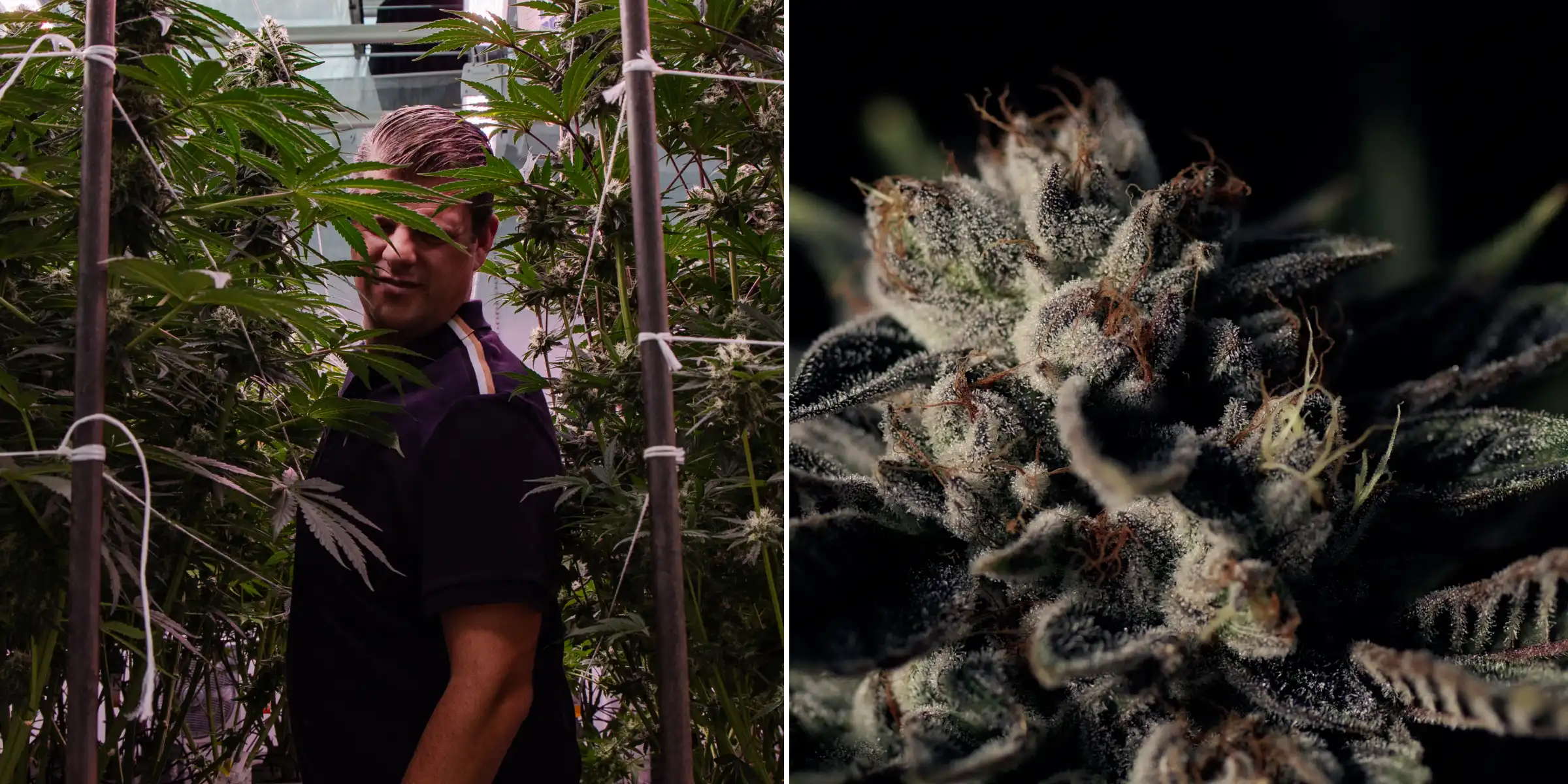
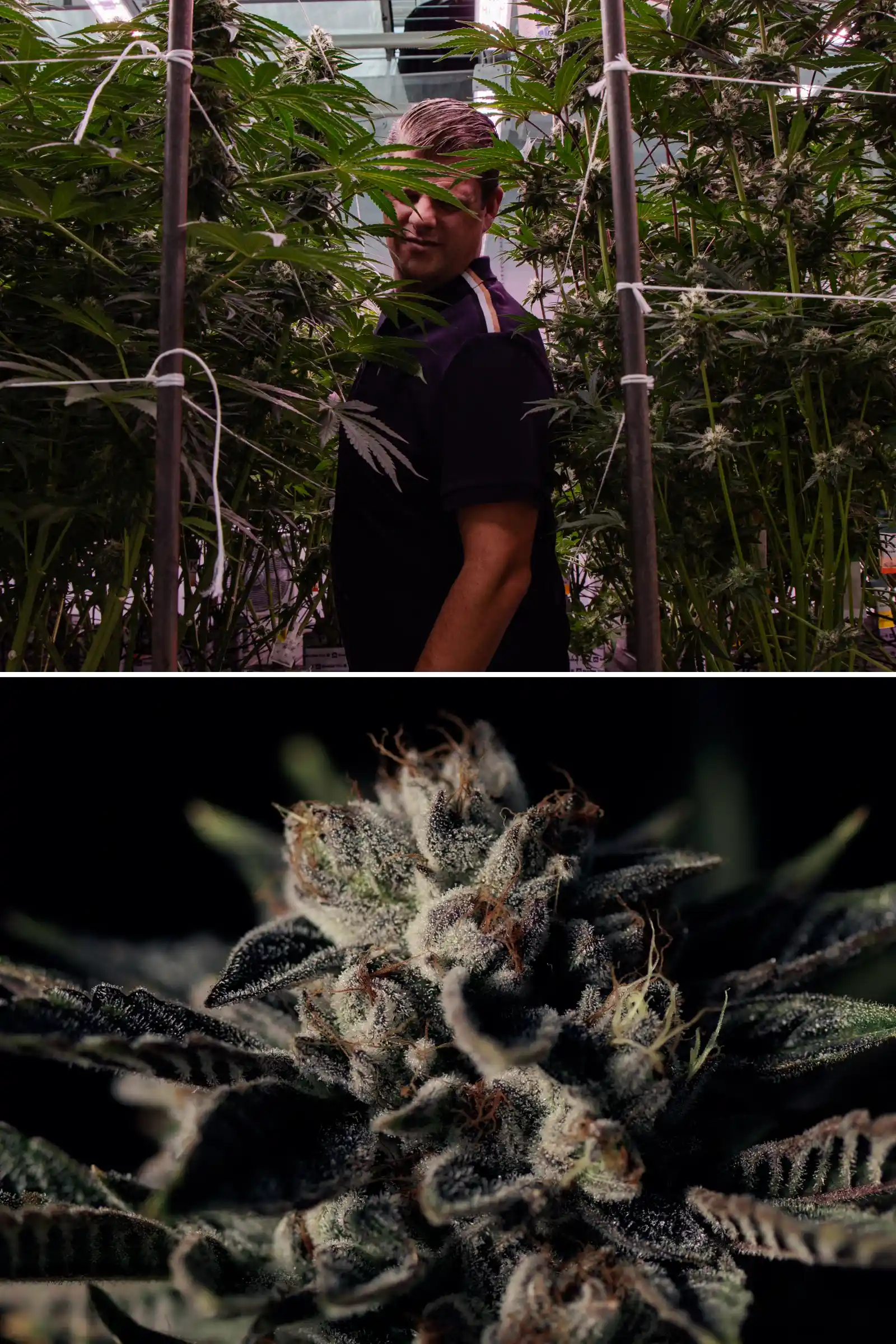
Maikel is recognized as a leading plant breeder in the field. With a background in molecular diagnostics, he served as a research specialist at Bayer and Global Head of R&D at RQS Pro before becoming the Chief Operating Officer at F1 Seed Tech. There, he helped to produce the first wave of RQS F1 hybrids , which have helped to change the game of home and commercial cultivation.
Introducing himself in his own words, Maikel said: “I have a background in molecular breeding in the vegetable industry, so tomatoes, cucumbers, where I spent my time in F1 hybrid breeding. And from 2019, I’m responsible for the F1 hybrid breeding program of Royal Queen Seeds.”
With years of experience in mainstream horticulture, Maikel brings scientific vigor to cannabis breeding. He emphasizes that the science of F1 hybrids doesn’t change, regardless of the crop, stating that it “doesn’t matter if we are talking about tomatoes, cucumbers, or cannabis. We are talking about varieties which are stabilized, and we make them uniform by creating inbred lines.”
.webp "Maikel Inspecting F1 Hybrid Cannabis Research Plants")
.webp "Maikel Inspecting F1 Hybrid Cannabis Research Plants")
Max dove straight in with a simple but clarifying question: What’s the difference between F1s and F1 hybrids? In cannabis circles, these terms are often used loosely, but Maikel set the record straight: “F1 and F1 hybrids are the same. For me, we are talking about stable, uniform F1 hybrid varieties.”
Maikel went on to explain that while F1 technically refers to the first generation after a cross, the critical part is the stability achieved through inbred parent lines:
“I know that in the industry, and especially in the cannabis industry, sometimes F1 and F1 hybrids are used a bit differently, because F1 stands for filial one, the first generation after crossing. So, if you cross two strains, you can call the name generation F1. It’s technically correct, but in my opinion, when we start talking about F1s, it should be a stabilized, uniform variety.”
In other words, true industry-recognized F1s and F1 hybrids are the product of crossing two carefully developed inbred parental lines, resulting in uniform plants where every seed produces the same reliable traits.
After clearing up the definition of F1s, Max shifted the conversation towards the next stages of the breeding process, asking Maikel, “What’s the difference between an F1 and F2, and what’s the difference between an F1 and an S1? Tell me what you think about that.”
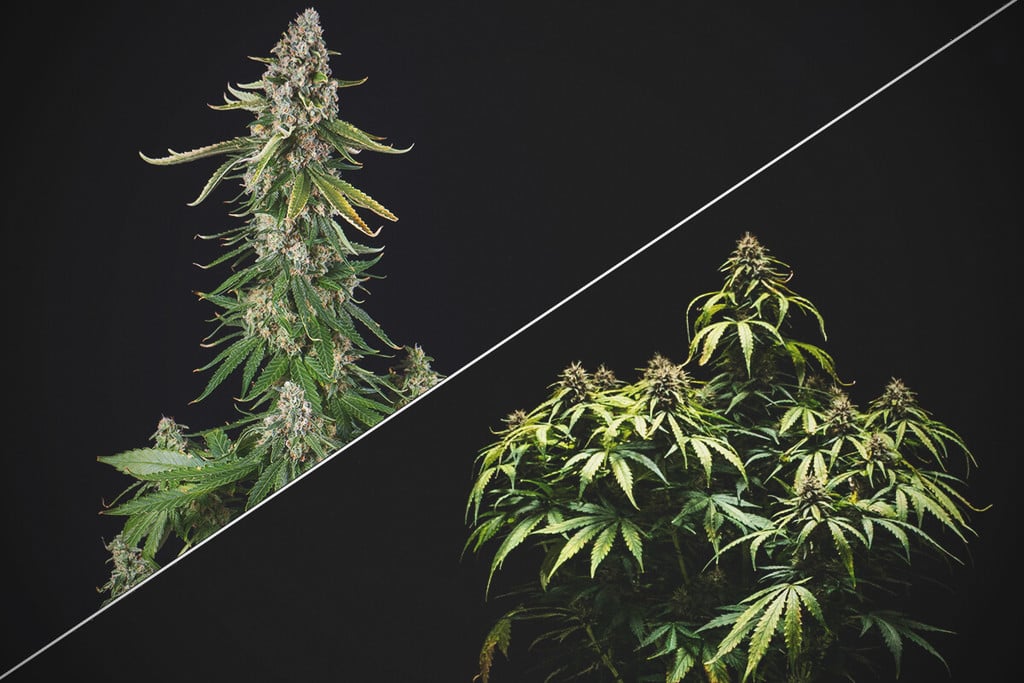
Drawing from his extensive background in breeding, Maikel put forward a concise and clear explanation: “If you take two plants from an F1 and cross them together, you get an F2 population. What happens there is you get a very strong segregating crop. You get a lot of different phenotypes, a mixture of plants showing all the genes, which were previously fixed in the parental lines, coming back again.”
This process puts all the genes on display. Through molecular breeding and QTL mapping, Maikel can then identify genes, including those that are dominant and recessive. Maikel made the important point that “F2 plants are important for breeding, but for home growers, they get all different plants.”
In response to Max’s question about S1s, Maikel explained that instead of going forward in the case of F2s, S1s are a step back to the parental lines. “An S1 stands for selfing 1,” explained Maikel, adding, “We want to make the parental lines homozygous, so the further you go from S1 to S5, you make the homozygous and fixed. The more you do this, the more fixed the DNA of the parental line.”
This careful groundwork ensures that when two inbred lines are crossed, every seed in the F1 generation carries the same uniform traits.
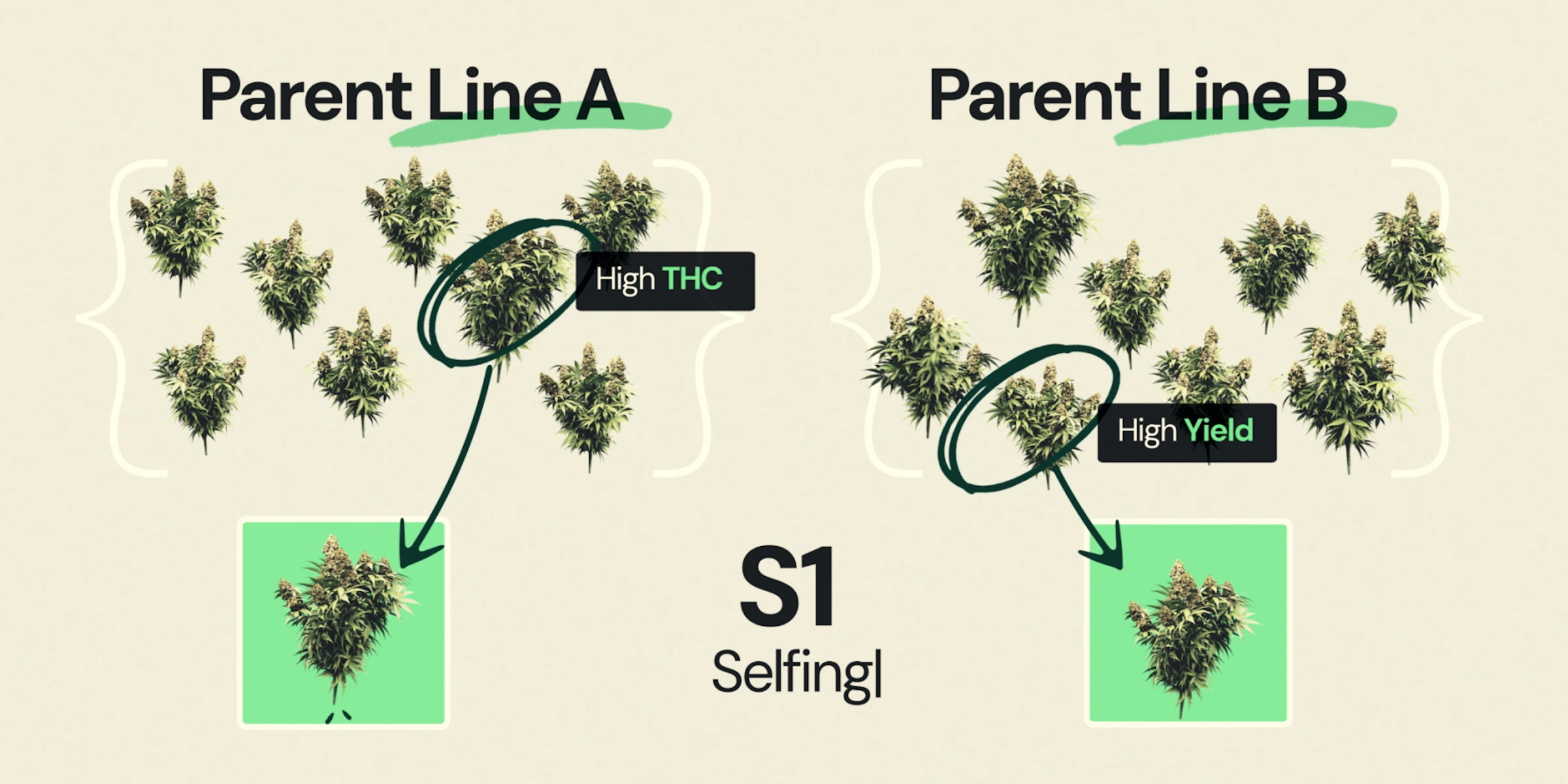
_1.webp "S1 Selfing in F1 Hybrid Cannabis Breeding")
Building inbred lines is a slow, methodical, and expensive process. “It takes about two years,” Maikel explained. “It’s very time-consuming and you need lots of plants and space.” However, all of the selfing involved comes with a catch. “If you keep selfing the same plant over and over again, you get inbreeding depression.”
This phenomenon causes plants to become weaker and their productivity and vigor decline. For this reason, inbred lines remain purely as breeding stock and aren’t sold as commercial varieties.
However, inbreeding depression also serves as an indicator of homozygous genetics, which is exactly what breeders like Maikel are chasing. After crossing two together, the offspring exhibit hybrid vigor and all of the beneficial traits of F1 hybrids. Maikel mentioned that “all the plants have the same heterozygous genetic composition, and they become vigorous again.”
Breeding F1 hybrids involves much more than just crossing plants. Aside from traits such as morphology and yield, the RQS team are hunting for genetics that produce desirable compounds in the right quantities. To help them track this, they rely on three important classification systems:
Maikel explained that all three are related to each other, saying that “pheno hunting is part of this whole breeding program. Every cycle during the inbreeding step, we do pheno hunting.” Regarding chemotyping, he explained: “We’re talking cannabinoids and terpenes, which you cannot see visually. To measure this, we need to collect flowers, bring them to the lab, and test them with HPLC.”
.webp "Max and Maikel Inspect F1 Hybrid Cannabis Plants")
.webp "Max and Maikel Inspect F1 Hybrid Cannabis Plants")
One of the most common questions growers ask is about the genetic pool behind new F1 hybrids. With traditional strains, the answer is often a recognizable family tree, often involving well-known names such as “Skunk”, “Haze”, “Gelato”, and others. However, this story changes slightly with F1 hybrids.
Maikel explained: “We have to start from somewhere. Of course, Amnesia, Gelato, you name it. But in the end, it doesn’t matter. We just want to bring a lot of variation, as much as possible, and grow all the plants. They all have interesting traits, Max, and if we find a certain profile, we will select for it.”
Ultimately, Maikel stands firm on the increasing irrelevance of strain titles, commenting:
“I don’t put any value on the genetic background. We do so many crossings that it isn’t relevant. In the end, it’s all about the traits you pull out. We focus on flower structure and compounds, not names and genetic backgrounds.”
Maikel’s words demonstrate why an F1 hybrid shouldn’t be viewed as just another strain with a new name. They represent an entirely new genetic category engineered for performance, not lineage. For growers, this shift brings more predictability, increased vigor, and less guesswork about what each seed will deliver.
So, is this all genetic engineering that flies in the face of organic growing principles? Maikel made this clear: “A lot of people think it’s GMO, but they have nothing to do with GMO. It’s just professional breeding. It’s a completely different topic. There’s no gene editing, we just look at genes without touching them, and then breed the plants normally.” By stacking selfing, inbreeding, and hybridization, the program locks in desirable traits without altering genomes in the lab.
Of course, Maikel also expressed his excitement about the photoperiod trial, which will add another segment in the history books for RQS once complete.
But what does the future hold? Where does the industry go from here? The ability to fine-tune traits like never before, including chemical constituents and disease resistance, holds great promise. RQS's trials, spearheaded by Maikel, already demonstrate synchronized flowering, consistent plants from seed to harvest, and huge yields.
.webp "Cultivation for Compounds F1 Hybrid Cannabis Greenhouse")
.webp "Cultivation for Compounds F1 Hybrid Cannabis Greenhouse")
Beyond plant performance, Maikel highlighted the importance of education going forward: “Education is the key. Letting people know the right information, showing them the evidence, and showing them data is how we convince people.”
From advanced greenhouses in the Netherlands to home grows worldwide, F1 hybrids signal a paradigm shift in cannabis genetics. For growers, it means fewer surprises, more vigor, unique chemical ratios , and maximum yields . For the industry, it means professionalism, trust, and a standard that mirrors the agricultural benchmarks of established crops.
Overall, Max’s visit to RQS's trials at Cultivation for Compounds confirms what both the science and plants are proving: the future of cannabis lies in F1 genetics. Watch the full video to enjoy the entire conversation between Max and Maikel.