Harvest time!

The end is approaching, and hopefully I have helped contribute to your gardens being filled with many wonderfully green babes. In any case, all of you now have the ability to grow top quality cannabis, even if as a beginner your first time will contain some mistakes which will inevitably impact the size and to some extent the quality of your harvest. If things have gone really tits up along the way, learn from your mistake(s) and try to eliminate them next time.

At the end of the day it is usually stupid mistakes that are made, so keep getting your hands on as much information as you can; information is power!

If everything has gone pretty smoothly for the last 8-10 weeks of blooming, which most varieties need to properly finish their blossoming, so it's now harvest time. As long as you have not managed to give an overdose of nutrients, then some cracking good buds should be visible on all your plants. Overdoing things can cause damage, and it is better to give too little than too much. The closer and closer you get to the end of the blooming period, the more you can reduce the strength of your feed water, and even stop feeding completely for the last week(s). It can't do any damage to your crop if the plants turn a nice yellow, in fact it is a good sign. The plants are sucking out every last drop of nutrient from their own leaves, which means that there will less nutrient residue left in your buds. The result is a nicer smoke.

Trimming "wet"

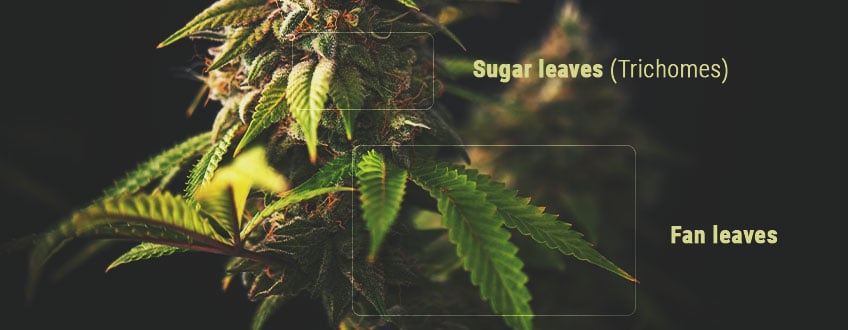
There are various methods by which you can harvest your beloved plants. Which one you use depends largely on the number of plants you have and the size of them. The most common method and the one that gets my nod is "wet" trimming the buds. We proceed by immediately trimming the plants one by one the moment they finish ripening. We take a ripened plant and cut off the branches one by one and remove the leaves around the buds. This leafage contains a lot of THC and so we keep this to one side so that later we can make water hash or 'skuff' out of it. In order to improve the eventual quality of your hash, try to avoid mixing in large leaves with little or no THC crystals visible on them with the leaf trim. The large cover leaves can actually be removed 2-3 days before you start the actual trimming, or even earlier. By doing this you will make the trimming a bit easier and also quicker, since you would only have to remove the big leaves during the trimming anyway. You can decide for yourself if you want to do this or not.

One advantage of removing the large leaves a little earlier, like a week before the harvest, is that the lower-most buds on your plant will be far smaller than the top buds thanks to having been deprived of light. With the sudden increase in available light these can shoot up in size quite a bit in this last week, and ripen more fully.

By trimming the plants wet you can trim much shorter and neater than you can with dried buds, and this will present the buds to their best. The first time does take a bit of getting used to as you figure out the best way to trim them. But after ten minutes or so you will have usually found the technique that is quickest and at the same time neatest. In itself, trimming is not hard, but the best technique will give you the loveliest end results. Women's hands are more suitable for trimming since they are slimmer and can work with more refinement.

Make sure too that you always have some reserve sheers handy when you start the job for real. There are various types of trimming sheers on the market, and I would say it's best to try out several of them since everyone has their own preferences. Once you have decided which your favourite is then in future trimming sessions you can start straight away with this model. Cheap sheers and scissors that are not sharp enough or are soon knackered are less suitable if you want to get really stuck in. These just cause more trouble than they are worth in the long run - as well as making the trimming longer.

After just a short while trimming you will get a huge quantity of THC sticking all over your sheers. If you don't have some sort of product with you that removes the sticky hairs it can be pretty difficult to get the sheers clean again. A poor set will quickly break if the hinge is impeded by too much THC. So if you're working with cheap sheers, then it is especially important to have a spare to hand so you can switch over as soon as a problem with the first pair rears its head.

Dry trimming

A second method you can use is trimming the plants dry. In this technique, you first let the plants dry out before actually getting down to trimming them. The branches are snipped off and hung or placed in the drying room. Drying the plants out first in this way does take a bit longer than when your buds have been trimmed wet. It's a method used mainly when there is a larger number of plants and a shortage of time. Dried buds are less easy to trim and end up less neat. There is a relatively larger loss of THC since this is more easilyshaken off by movement when dry. This is very relative; there is still a huge amount present on both the buds and plant material. The drier this plant material, the easier it shakes free. This method is also mainly used on outdoorgrown cannabis. The enormous outdoor plants are hung upside down in a drying space and then systematically harvested. When growing a large number of smaller plants indoors this method- hanging whole plants upside down - is also used. There is no bad way of trimming, it just depends on the growing system which method suits you more than another.

Trimming space

Try and get a room that is suitably ventilated when you're choosing where to harvest. If your growing space is big enough, you're best off doing it in here while you run the ventilator continuously. If you have to do it in a different room you will find that the plants give off quite a bit of odour, and you might find keeping the door shut and only opening it to go get the next plant for trimming helps. Try to make sure that whatever you do, don't annoy the neighbours. Even though the smell of fresh cannabis smells divine to smokers, many civilians think the strong stench revolting. Using a small vacuum pump fitted with a carbon filter will help keep the smell down during trimming, or else do it in a place where there is no danger of causing a nuisance. Mostly you'll find that you pretty soon don't notice the penetrating cannabis smell yourself because you get used to it. This underestimation of just how big an impact you're making can end in tears.

Drying room It is also important to bring the harvest to a good conclusion because after so many months of work it would be a crying shame to watch your buds turn mouldy. The ideal place in which to leave your buds to dry is in a cool and dark room kept somewhere between 15-22 degrees. It is not important to ensure that the room is very warm because the active ingredients need a bit of time to mature properly so that you get a decent effect when you smoke the cannabis. It is better to dry the buds slowly over two weeks then stick them in a warm room to get them into a smokeable condition as soon as possible. This certainly does not improve the quality. Trying to quickly dry out your buds by sticking them in the microwave or in an oven because you happen to be temporarily out of smoke makes no sense at all. Not only will it taste very sharp and bad, you only get a weak high that's not particularly enjoyable. Cannabis needs time to come to its full strength, shall we say. It is not just because it is dry that it is ready for consumption.

When you lay out your buds to dry in their room make sure that they have a good circulation of air under and over them. Laying them down on newspaper or something else that is not aerated is not advisable. There are special drying racks you can buy and I recommend them highly for drying your cannabis on. These are racks with tensioned threads across them thanks to which the buds get plenty of air from underneath. When you just stick your buds on a piece of cardboard then the side of the bud that comes into contact with the cardboard loses its moisture with more difficulty, which increases the chances of it developing mould considerably. You are better off laying harvested buds next to each other rather than piling them on top of each other. If mould does take hold it will spread less easily from bud to bud. A good 75% of the harvested bud is made up of water that has to be removed. When this moisture has trouble being removed is when we get the risk of mould. If you start with 500 grams of wet buds then you will end up about 125 grams of dry smokeables.

Too low a temperature can also mean that the buds spend too long damp, and again this increases your mould risk. There arealways mould spores floating in the air, but only when you create the poor conditions they like do they get a foothold on your buds. Insufficient ventilation thanks to putting the harvested buds in too small or to closed off a space, or by leaving them to dry on a hard surface rather than on an aerated surface is one of the most common causes of mould. The fear of mould is pretty unwarranted so long as you bear these factors in mind.

Ripening There is a big difference between ripening and drying cannabis. After just one week the small buds are usually dry, while the medium to large buds will need two weeks. If you have some really huge buggers in your garden, they could use a few more days than that even. You can always choose whether to dry any enormous buds as a whole or to break them up first, because the structure of huge buds is made up of smaller ones that have grown together. Smaller buds dry out quicker so if time is an important factor you're better off breaking them up.


The trick to telling whether your cannabis is indeed good and dry is to take a large bud and try to break its twig. When the twig snaps easily the bud is good and dry. Don't try and convince yourself they're ready by taking a small bud twig and breaking that. All your buds need to be properly dry before you can ripen them. The dried buds will be nicely smokeable after two weeks. They are not yet at their absolute peak, but they will do the business. Finally it is time to test them out, in the knowledge that they will

Once your buds are well and truly dry we can take care of the storage. In order to keep the quality of your cannabis high you will need to store it in a cool, dark space. So just put it in a light-proof plastic container or glass beaker in a dark place. Light destroys THC. If a few of your buds aren't dry enough and you store them with others, then they will all end up damp again, even the ones that were actually dry. Now you have to leave the buds where they are for another two weeks to ripen, which will put us a month on from the harvest. Thanks to the ripening process the buds will taste better, and the high will be better. As I said, cannabis needs time. After this month the taste will be fairly well developed, although some varieties do need a little more time than others in order to become a top smoke. Naturally, the buds will be good, but they can still be just a tad better... So all's well that ends well, now we're left with a large volume of leaf trim over, dripping with THC, with which we have plans to make something wonderful out of. So not only do we have a good supply of smoking material but we can yet make a good water hash or hash oil, try out cannabis recipes when we cook, and more...

Two harvests from one grow

So now you have finally - after two long months of blooming and a period of pre-growth - got some cannabis buds raised by your own fair hands. But the fun does not stop there. As well as cannabis we can also extract some skuff or water hash from the harvested plants. Both principles are dead easy and efficient. In short, the harvesting is not quite over yet...

All the buds of the plants should by now be neatly stored for drying, and the very smallest buds should even be dry enough to take for a test smoke. Two weeks further down the line and all your buds will feel or look dry on the outside, but inside they are for the most part not yet fully dry. The larger buds will need a little while longer. Let them all dry out slowly in a dark room that is large enough or is equipped with a ventilator, so that the moisture released by the buds can escape.

Once the small twigs of the buds snap cleanly - including those of the largest buds - we can gather them all up ready for leaving to ripen so that the taste and smell of the cannabis can fully develop. Don't worry if the cannabis still smells a bit green during the first couple of weeks; some varieties do need a little more time to develop the typical, trademark smell of cannabis.

Skuff In the meantime we have also let the considerable volume of leaf waste and trimmings also dry out. Depending on which variety you have just grown and the number of leaves this variety develops you should end up with about the same amount of dried leaf material as the weight of buds produced. Around 500 grams dry cannabis from your plants should result in about 500 grams of dry leaf, in other words. Of course, this will be a whole lot more with the more leafy varieties, and by the same logic if you're growing a variety that produces little leaf cover around the buds, you'll get less.

We only gather up the leaves that obviously have THC on them, generally the leaves surrounding the THC-rich buds. We also use large leaves that have THC on them. All other leaves that have no THC on them can be separated out. This usually occurs during the trimming of the buds, when we first take off the large leaves and then trim nice and neatly around the buds. In this way you should produce two piles of leaves during the trimming. In one pile you put the large leaves with no THC while the other pile is made of the THC-rich leaves. It makes little sense to just mix the two types of leaves in together, because by doing so you will only reduce the quality of your hash. There will be much more unnecessary contamination by the not THC-rich leaves in your hash.

It is very important in any case to let your leaf trim dry fully. Usually this takes longer than the buds themselves take to dry. Just 'dry' is not good enough; the leaf material must be so dry that when you take it between your thumb and finger and rub it, it just crumbles and falls apart. The drier the better and the greater the yield of hash you can expect from your leaf material. The THC crystals just come away from the leaf material much easier than when the leaves have just been lightly dried. This is when the leaf material looks pretty dried out, but it does not crumble. In this state, the leaf material gives up little to no THC crystals.

Our goal is to get as many THC crystals as possible and clump them together and make ourselves a nice lump of hash. The gold-yellow powder that is on the buds has a very different effect when you smoke it pure and some smokers prefer the sweet high and effects of hash to the more stoned effect of smoking cannabis buds. Each to his own.

When you roll a joint with welldried cannabis buds then you will frequently notice that your fingers become sticky with a sort of gold-yellow dust. These crystals are what I have been talking about. The nice thing about

making hash is that in addition to your regular harvest cannabis buds, you also get a reasonably large quantity of hash from the same harvest. So supposing you have a harvest of 500 grams of bud, and have about 600 grams of dry leaf material left over, you can count on perhaps 60 grams of hash out of this. This 10% yield is a fair rule of thumb when using well-dried leaf waste.

Naturally, it also applies here that the better the quality of your leaf material, the more crystals you will find on it, and the bigger your yield will be. So if you've grown a real white variety or another variety with a very high THC production, then logically you will get a larger yield of hash out of it.

Normally you will achieve more than a 10% yield when you are growing indoor cannabis; some growers have been known to achieve yields of up to 16% or more when using good leaves. When growing outdoors there will be much less than that possible, especially with poor autumn weather, which reduces the level of THC your leaves develop and so reduce the yield well below 10%. That is why it is important not to put yourself under pressure, since there is no point in mixing 400 grams of THC-rich leaf material with 200 grams of large leaves in the vain hope that this will produce 600 grams of good leaf material. You still have just 400 grams of good leaf material. By mixing I mean that instead of just using the neatly trimmed THCrich leaves you add in the large THC-poor leaves.

Of course it is lovely that whether you get a good or a bad harvest of buds you can still bank on scoring yourself a nice lump of hash. This is always

handy when you have had a poor harvest of buds that are hardly worth the effort, as can happen with outdoor growing. Then you can just make hash of the whole damn lot.

Polination

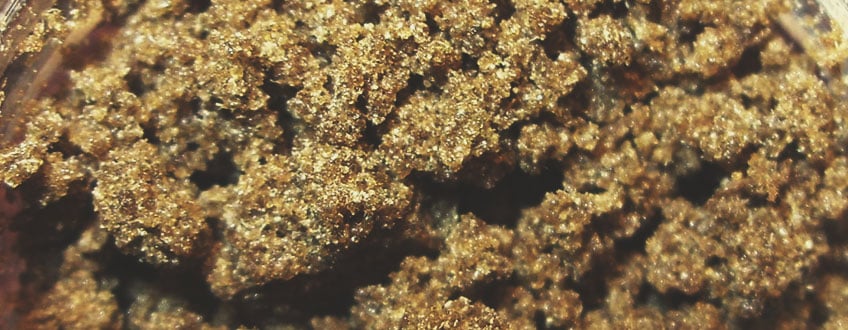
The principle of making hash is fairly easy and works thanks to the breaking loose of THC crystals. There are various ways in which this can be achieved. You can get a sieve and spread your leaf material out on it and then shake or let the sieve be vibrated. The sieve you use must be fine enough to hold back all the leaf material and let only the crystals through. There are also specialised hash making devices into which you put a small amount of leaf material and then shake it by hand. The newest grinders work according to the same principle as hash making. Many grinders now incorporate a small sieve that allows you to collect the THC crystals in a separate compartment, whilst the cannabis itself loses little of its power. You will be amazed at the amount of hash powder you collect or actually lose when you use a normal grinder or crumble your buds by hand.

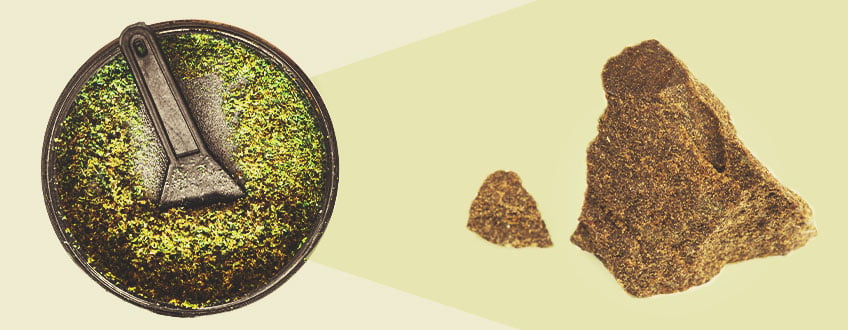
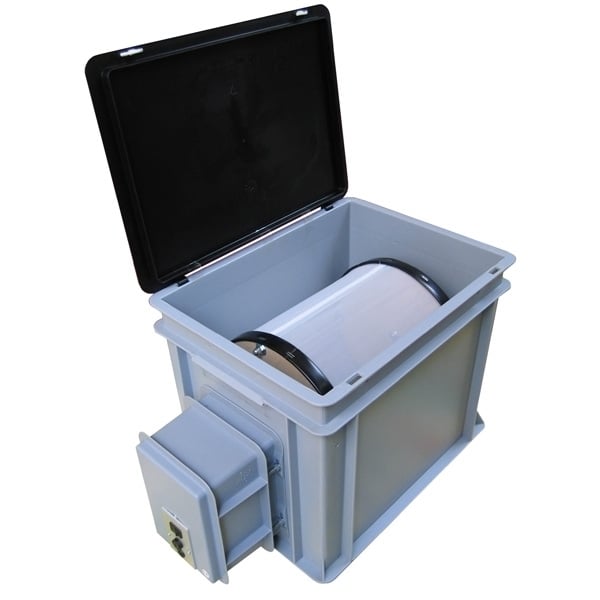
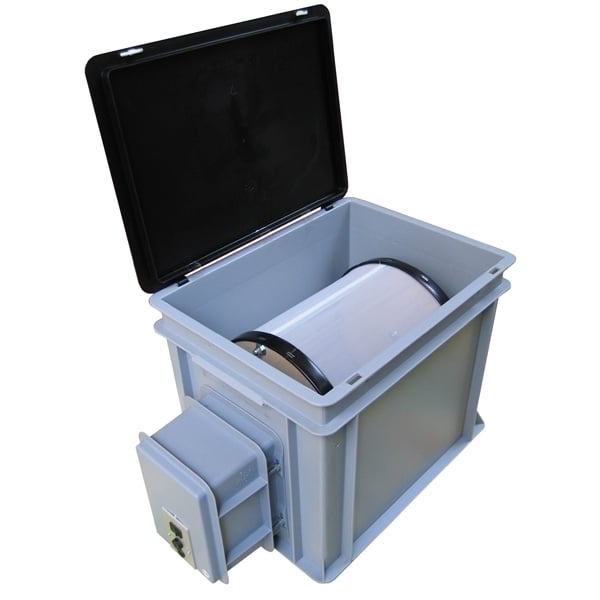
But if you want to process a reasonably large amount of leaf material then you are going to need a polinator. A polinator is a machine that uses the rotation of a drum with a sieve around it to break loose the crystals. You put the leaf material into the drum and a motor turns it around. The leaf material is shook up and down and thrown around and it is this action that shakes the THC crystals free from the leaf material. After a bit of time - 30- 40 minutes is usually enough - we can stop the polinator and scrape the hash powder into a pile, and if we are going to press this powder straight away (prior to storing it for at least a year for ripening) to get hash. This pressed powder is called skuff. The reason why we press the powder is because this improves the taste and smell. It is also easier to make a joint out of, and more easily transportable. A pressed piece of hash is easier to share with someone than a pile of sticky powder. In any case, the better the quality of the hash the less powerful the press has to be. With poor quality hash you need a press that can exert a greater deal of force because the crystals have so much contaminating vegetable matter mixed in with them they have trouble sticking to each other. As well as the material you use having to be very dry, it is also useful to give your leaf material a night in the freezer, especially if you are planning to use the polinator. The extreme cold makes the THC crystals break loose more easily. In the best scenario you would actually be able to make your hash inside a walk-in freezer or something else that allows you to keep a constant cold temperature. This would give you the very best product, but of course not many of us have such facilities to hand.

But if you know someone who can make such facilities available to you, then it is well worth going to the trouble of using them.

It is always a marvel to watch how much hash powder can be extracted from even a small amount of leaf material. It is not necessary to polinate your buds given the quality of the leaf material, but of course if you are a real hash aficionado and don't fancy smoking your buds then go ahead and polinate your whole crop. Make sure than you first break up the buds though, so that the crystals from every corner of them can be shook loose. This will dramatically increase your hash yield. Also ensure that no twigs (or as few as possible) are left in your buds because these can damage the sieve. A piece of sieve does cost quite a bit of money, so it is more than an annoyance to wreck it.

Although a polinator machine or suchlike does cost about 300- 500 euros, it is an investment that will immediately pay itself off in the first harvest and hash production. It will also work well for many years without problem. The only pre-requisite

should you be thinking of equipping yourself with such a gizmo is that you need a nice amount of leaf material every few months with which to work with. There is very little sense in getting your own polinator if you only have a very small amount of leaf waste and the polinator spends more time in the cupboard than in action.

Water hash

The newest method of hash making in recent years is to make a 'water hash'. This works according to the same principles as polination, but uses ice cold water and churning to separate the crystals and leaf material. Making water hash is somewhat more labour-intensive than simple hash making, but the quality that you get with it is something special.

To begin with, you cannot just toss it in a drum, and so you will need a bit more leaf material to work with. We need a bucket of about 20 litres capacity into which we will be plunging the special sieve bag. A water hash set consists of two or more bags into which a sieve is sewn. Each sieve has different dimensions so that one sieve lets the crystals through and the other sieve catches the crystals and so does not let them through. With many sieve bags the crystals of different sizes are caught separately. In place of one big pile of crystals in one bag, you end up with different qualities in each bag. Because the crystals in each bag differ between them, so the effects and taste of the eventual water hash differ.

So the bags are placed in the bucket; lower-most is the bag that will catch the crystals and only let water through. Above that come all the sieve bags that will hold onto some leaf material and a certain size of crystal.

We first fill the bucket with icecold water (in effect, around 3 degrees). The colder the better since then the crystals will break loose more easily. By putting a(food) mixer in the bucket the leaf material is beaten and this action loosens the crystals. Do not use the mixer at full speed because the idea is not to reduce the leaf material to a pulp. This will only succeed in creating a poorer quality end product. I'll advise you once again to let your leaf material spend a night in the freezer before you begin.

If the temperature is not low enough in the bucket you can add ice cubes. This is unless you have a water cooler attachment for your water taps, which will generally give you water that is cold enough without having to add extra ice cubes.

What you can also do is an hour before you begin to make your water hash, stick a couple of 1-2 litre bottles of water into your freezer compartment.. This water will be perfectly ice cold by the time you need it, and perfect for making a quality water hash with. Watch out that you don't leave them in the freezer too long otherwise their contents will freeze, which is no good to you. Or I suppose you can cut open the (PET) bottles and use the frozen contents instead.

The simplest way to make water hash without too much hassle is to set your mixer on a timer so that it will run for 20 minutes, then switch itself off for 5 minutes before doing another 20 minute cycle. Do this for about an hour and a half. It is important to make sure that your mixer is well and truly fixed in place so that it cannot break free and wreck the whole operation (and bags). If you're happy this is OK, then there's no need to stand and watch the mixer, switching it on and off.

Certainly do not use a beating attachment with sharp edges
- I'll repeat: the idea is not to make marihuana leaf smoothies. The simple action of gentle agitation combined with icecold water will be enough to break the THC crystals free. It is pretty easy to see whether your leaf material is delivering or not. When the water turns a goldy-browny-yellow colour then you can be assured that it contains a decent amount of crystals in it.

Since you use water extraction to make the hash there is far less contamination in your final product, which boosts the quality of the hash and its purity is increased. Water hash is also very different in its effect and power than ordinary hash. It's just something that you have to try for yourself in order to appreciate. Water hash can even be too powerful for inexperienced smokers. Not all cannabis varieties are equally suitable for making water hash from; some varieties lose some of their taste. That is why it is better to act in the same way as a wine connoisseur, so to speak, and use both methods when you are trying a new variety so that you can determine which the best method is to make hash from with this particular variety. Making water hash is an experience in itself, and that moment when you first haul the final bag out of the bucket remains a magical one, as you shake it back and forth before opening it and there are the yellow crystals lying there in a pile. It is also true when making water hash that the drier the leaf material the better the harvest of crystals you can hope for. On the other hand, the quality will be slightly lower. The advantage of making water hash is that you can get to work even with fresh, un-dried leaf material. The yield when you use fresh leaf trim is quite a bit lower, but what you get is of very good quality because you get less leaf contamination than if you use dried leaf.

Bubbleator Man is essentially a creature of leisure, and one of the drawbacks of the whole 'working with ice' routine, if I can call it that, is the difficulty of securing the mixer safely. So you can't just suddenly decide 'oh, I think I want to make some water hash', but must always first find yourself a suitable mixer that will operate safely in this context. This can discourage some growers meanwhile from even trying make this excellent variety of hash.

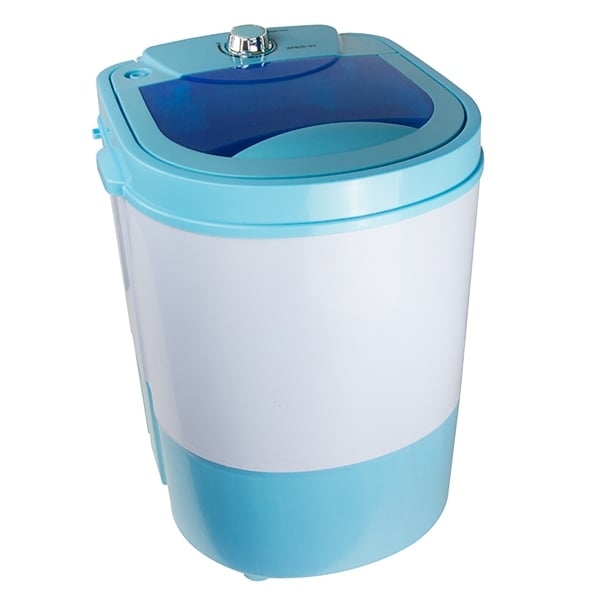
The company that makes the Polinator has recently released the Bubbleator on the market, which is designed to make water hash quickly. The Bubbleator is in effect a mixer and looks like a small washing machine. You just bung your leaf waste into one huge sieve bag that you then put inside the Bubbleator, which you then fill up with ice cold water, and by just cranking a handle you can churn the mix for 15 minutes. The advantage of the system is that you don't have to search for a suitable domestic mixer and everything is done with much less fuss and mess. You just let the Bubbleator run itself empty in your sieve bags and you're left over with the desired crystal pile. I reckon the Bubbleator will convince many new growers to give making water hash a whirl by cutting out the annoying Hunt the Mixer game. You can but the Bubbleator separately or in a deal that includes ice-o-lator bags.

The real hash-lovers leave their hash at least a year to ripen before they even think of consuming it. It is certainly worth you stashing at least a part of your harvest away. If you do this every year then you are soon going to build up a supply of fantastic quality hash.


Cart  

No cannabis seeds in your basket

Shipping € 0.00
Total € 0.00

Check out

Promocode
Soft Secrets